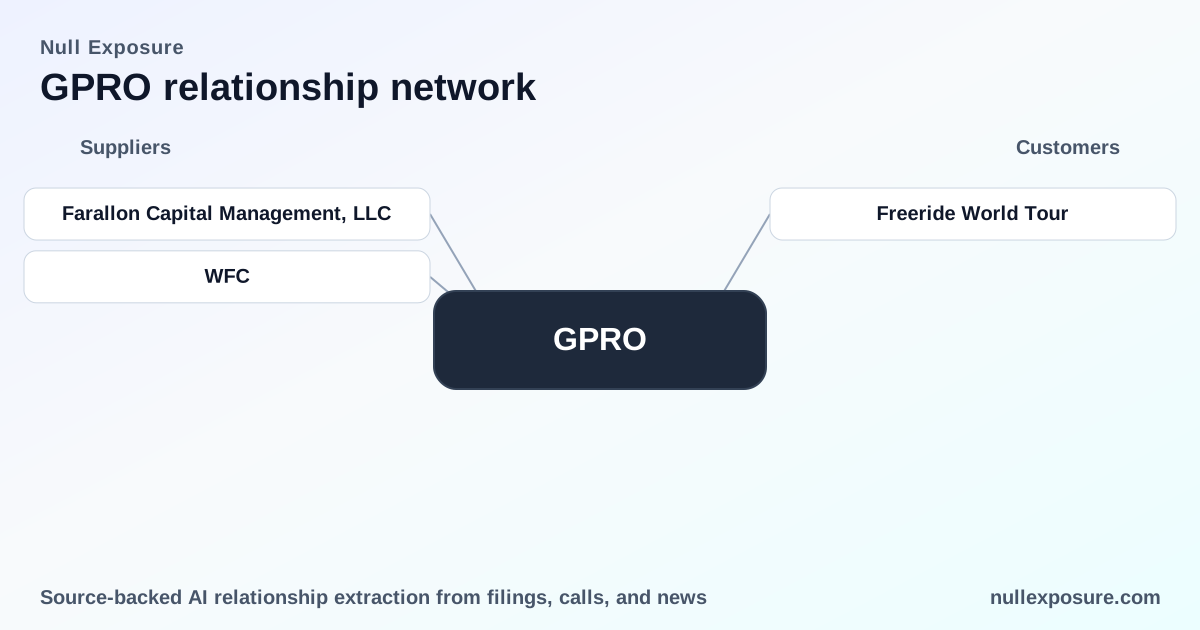
GoPro (GPRO): Customer Relationships Drive Hardware Reach and Growing Subscription Revenue
GoPro monetizes through a dual engine: direct and retail hardware sales (cameras, mounts, accessories) account for the majority of cash flow, while subscription and service offerings (Premium+, Premium, Quik) provide recurring revenue and margin stability. The business sells globally through large retailers, mid-market accounts, distributors and GoPro.com; strategic partnerships and supply agreements with sports and media properties amplify product placement and content exposure. For investors, the key lens is how these customer relationships convert product placements into unit sales and recurring payments—hardware sales remain core, subscriptions are the strategic margin lever. Learn more about relationship-level signals on the company here: https://nullexposure.com/
What the customer map tells investors about GoPro's operating model
GoPro runs a mixed contracting posture. Retail and distributor contracts create volume-oriented, sometimes seasonal revenue; subscription contracts (Premium+, Premium, Quik) create ratable, recurring cash flows recorded as deferred revenue when prepaid. The company explicitly sells to large enterprise retailers and also maintains direct sales teams for mid-market accounts, indicating a two-tier go-to-market structure that balances scale with account-level attention. Geographic coverage is global with meaningful exposure to North America and EMEA, and the company sells through both distributors/resellers and its own e-commerce channel.
- Concentration and criticality: Retail remains the dominant channel—retail accounted for roughly 75% of net revenue in 2024—so relationships with large retail chains are critical to volume and working capital. Subscription and services represented $107.0 million, or 13.3% of revenue in 2024, making services a meaningful and growing contributor to revenue diversification and margin improvement.
- Contract maturity and stage: Many customer relationships are active and operational; evidence shows ongoing supply agreements and multi-year partner roles rather than one-off placements. Subscription revenue is recognized ratably, signaling multi-period obligations and predictable recognition patterns.
- Segment mix: The P&L balance is hardware-dominant with a growing software/services layer, where services and software increase lifetime value and reduce reliance on cyclical device sales.
These company-level signals frame how individual partnerships translate to revenue and brand exposure rather than being standalone revenue drivers.
Customer relationships that matter right now
Below I cover each documented customer relationship found in recent reporting and press: Warner Bros. Discovery Sports Europe, the Freeride World Tour, and NASA. Each entry is a concise, investor-focused summary with a source reference.
Warner Bros. Discovery Sports Europe — supply agreement for wearable cameras
GoPro extended a wearable-camera supply agreement with Warner Bros. Discovery Sports Europe tied to coverage of mountain-bike competition—an agreement that locks product placement into a high-visibility, broadcast-driven sports circuit and supports sustained unit shipments to an institutional buyer. According to MarketScreener reporting in March 2026, GoPro and Warner Bros. Discovery Sports Europe extended their wearable camera supply arrangement for the WHOOP UCI Mountain Bike World Series. (MarketScreener, Mar. 18, 2026)
Takeaway: These kinds of supply extensions convert media exposure into predictable shipment volume and reinforce relationships with global sports broadcasters and rights holders.
Freeride World Tour — long-term official camera partnership and content production
GoPro has served as the Freeride World Tour’s exclusive camera partner for more than a decade and is partnering to deliver a new YouTube series, underpinning both product placement in extreme-sports content and content-driven marketing that supports direct-to-consumer sales. A press release from Sahm Capital in February 2026 notes GoPro’s role as the tour’s official camera and its production partnership for digital series content. (Sahm Capital, Feb. 10, 2026)
Takeaway: Long-tenured sponsorships like this multiply GoPro’s brand affinity among core users and act as low-cost marketing that drives e‑commerce sales and accessory attach rates.
NASA — GoPro cameras onboard the Artemis II mission
GoPro cameras are being used onboard NASA’s Artemis II mission to capture imagery during the Orion spacecraft’s lunar fly-around, which provides rare global publicity and premium brand association with high-profile scientific missions. GoPro announced the use of its cameras on Artemis II in April 2026, highlighting the product’s durability and imaging credentials in extreme environments. (GoPro announcement covered by Sahm Capital, Apr. 3, 2026)
Takeaway: NASA placement is high-saliency branding that supports premium positioning and cross-sell opportunities for higher-margin accessories and services tied to ruggedized use cases.
What these relationships imply about revenue quality and risk
- Revenue quality: Partnerships with broadcasters, event organizers and institutional customers increase visibility-driven unit demand and complement direct e-commerce and retail channels. Supply agreements with media partners likely translate to predictable hardware shipments; meanwhile, subscription revenue adds recurring component to topline—a combined model that increases revenue stability.
- Concentration risk: Retail continues to represent the bulk of revenue (about 75% in 2024), so GoPro’s financial performance depends heavily on wins with large retailers and mid-market distributors. The company has structured its go-to-market to cover both large enterprise accounts and targeted mid-market relationships, which mitigates but does not eliminate concentration risk.
- Contracting posture: The mix of subscription ratable recognition and large retailer supply agreements implies a hybrid contracting posture—shorter sales cycles for retail, multi-period recognition for subscriptions, and multiyear supply deals for institutional partners.
- Maturity and criticality of relationships: Many partnerships are mature and active—long-term sponsorships and supply extensions indicate ongoing engagement rather than transitory promotions. Institutional placements (e.g., NASA) are strategically valuable for branding but represent limited direct revenue; broadcast supply contracts and tour partnerships have clearer direct links to unit sales.
Investment implications and final thoughts
GoPro’s customer ecosystem is a balanced mix of large retail distribution, mid-market sales, e-commerce subscriptions, and high-profile partnerships that drive both short-term unit volume and longer-term brand equity. The company’s financials show a hardware-first model ($651.5M revenue TTM) with a growing services layer—subscription revenue of $107.0M in 2024 underscores the strategic pivot to recurring revenue. Investors should track the cadence of supply agreement renewals with broadcasters and tours, the growth rate of subscription revenue, and retail sell-through metrics that will determine the next inflection in profitability.
For a deeper read on how these partner relationships translate into revenue signals and risk exposure, visit the full coverage at https://nullexposure.com/
Bold takeaways: hardware drives revenue today; subscriptions reduce cyclicality; strategic partnerships amplify brand and convert to demand.