Hyperscale Data (GPUS): Customer Relationships and What They Reveal About the Business Model
Hyperscale Data, trading as GPUS, runs a hybrid industrial-services and data-infrastructure business that monetizes through three core channels: crypto mining and Bitcoin custody/hosting, colocation and AI-ready data center services, and short-duration industrial services such as heavy lifting and equipment rental. Revenue recognition is dominated by transaction and service flows rather than long-term product contracts, and the firm’s financials show rapid top-line growth alongside negative margins and elevated leverage on operating metrics. For investors, the customer relationships illuminate a business that is operationally asset-heavy, commercially flexible, and exposed to both concentration and usage volatility. Learn more about how we map counterparty risk at https://nullexposure.com/.
How the contracts behave — short, cancellable, and usage-linked
Hyperscale Data’s disclosures consistently point to a short-term contracting posture across several operating lines. The company describes loans and service arrangements with durations typically ranging from six to 12 months, while certain mining pool and operator agreements are expressly cancelable by either party and structured to renew continuously, effectively creating sub‑day durations in practice. The firm also documents hourly, daily, weekly and monthly service arrangements for heavy lifting and maintenance. These features produce high commercial flexibility for both Hyperscale and its customers, but higher revenue volatility and tighter cash conversion sensitivity.
- Short-duration contracts dominate: company filings highlight multiple short-term arrangements, including cancelable mining pool agreements and hourly/daily service contracts.
- Variable and usage-based revenue is present: some mining and pool revenues are calculated on block rewards and transaction fees, reduced by pool operator fees under FPPS payout methods.
Revenue concentration, materiality and what it means for investors
Hyperscale Data’s disclosures show mixed materiality across customer lines. The company identifies at least one customer that represented over 10% of revenue (a classic concentration signal), while certain mining-pool related transaction fees are described as not material. This combination indicates pockets of concentration embedded within otherwise diversified, transaction-driven revenues, which amplifies both upside in winning or retaining large accounts and downside if a few large relationships change terms.
According to the company’s reporting, a named “Customer A” accounted for approximately 23% of revenue in a presented period, while other mining-related revenue items are described as immaterial in isolation (Form 10‑K disclosures for FY2024).
Segments and roles — infrastructure, services, hardware
Hyperscale runs multiple reportable lines that intersect different customer roles:
- Infrastructure: the company operates data centers for mining and colocation aimed at AI and high-density compute customers, positioning it as a critical hosting provider for compute-intensive buyers.
- Services: heavy lifting, pump maintenance, crane rental and short-term site services produce recurring, transaction-level service revenue.
- Hardware and manufacturing: design and sale of power conversion systems and power supply units supplement services with product sales.
Disclosures frame Hyperscale both as a service provider (supplying hash calculation and hosting) and, in some contexts, a seller of goods. The company also functions as a buyer of third-party pool operator services when it supplies computing power into a pool operated by another entity.
Geography and counterparty mix
Hyperscale’s trade receivables and operations skew toward North America, with data centers explicitly noted in Michigan and Montana and industrial operations centered in U.S. states such as Texas and Oklahoma. Counterparty types range from large enterprise customers (enterprise, HPC and AI cloud providers) to small business borrowers and regional services clients, implying a blended credit profile across its customer book.
Customer relationships in the record — the full list from this data pull
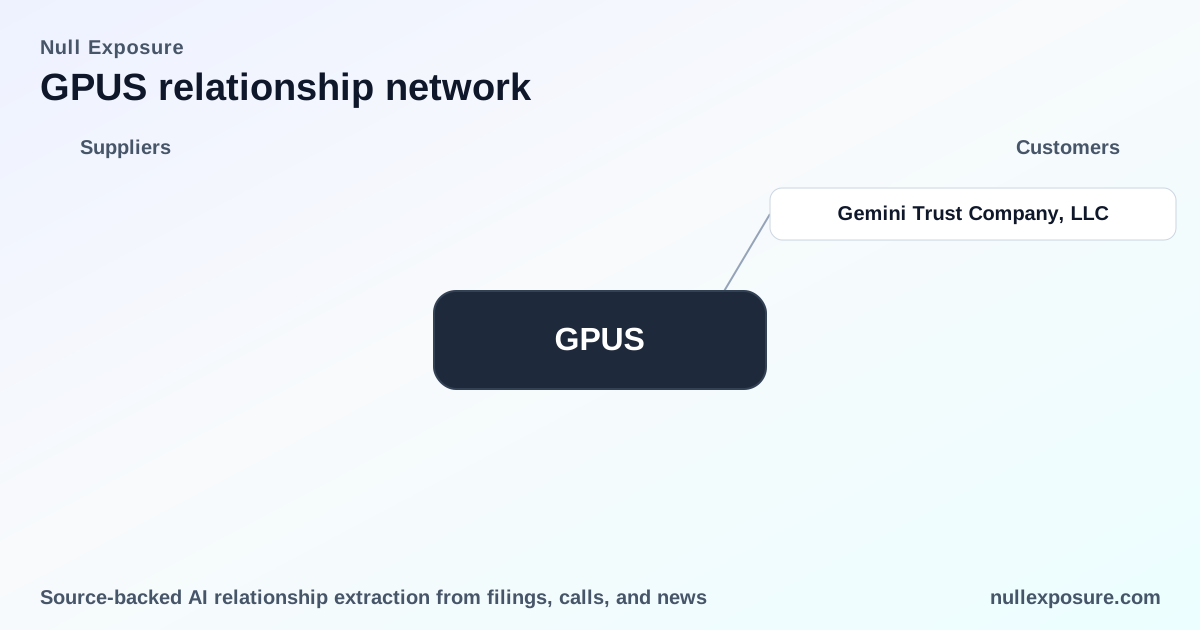
Gemini Trust Company, LLC
Hyperscale Data reports that it stores its Bitcoin custody with Gemini Trust Company, LLC, a regulated and insured crypto asset custodian, reflecting a custody relationship for the company’s mined Bitcoin (as disclosed in the FY2024 Form 10‑K). This is a custody arrangement rather than a revenue-generating customer contract, and it signals operational reliance on a regulated third‑party custodian for a material asset class in the firm’s business model (Form 10‑K, FY2024).
(That completes the universe of customer/counterparty relationships returned in this crawl.)
Discover more counterparty analytics and how these relationships map to cash flow risk at https://nullexposure.com/.
Operational constraints that shape customer risk and cash flow
Company-level disclosures surface a set of constraints that are meaningful to investors evaluating customer dynamics:
- Contracting posture — short-term and cancellable: Numerous excerpts describe cancelable mining pool agreements and short-duration service contracts; that structure increases revenue volatility but preserves operational agility.
- Revenue type mix — transaction and usage-based components: Mining economics and some pool arrangements produce variable, usage-linked consideration (block rewards, fees), creating asymmetric cash flow timing relative to fixed-cost hosting assets.
- Concentration risk exists alongside diversification: The company discloses at least one customer representing >10% of revenue while noting a broad base of smaller accounts, producing concentrated tail risk with diversified transactional revenue in aggregate.
- Segment maturity varies: Infrastructure/hosting for AI and high-density compute is positioned as a growth focus, while legacy service lines (crane rental, equipment maintenance) are stable short‑cycle revenue sources.
- Geographic concentration in North America: Trade receivables and core operations are primarily U.S.-centric, concentrating country and regulatory risk domestically.
These constraints are drawn from the company’s public filings and earnings disclosures; they function as firm-level signals that govern counterparty economics and credit exposure rather than assertions about any one named counterparty unless the filing explicitly does so.
Investment implications — concise checklist for decision-makers
- Cash-flow volatility is elevated: Short-term, usage-based contracts and mining payout mechanics create revenue variability against a fixed-cost asset base (data centers and mining rigs).
- Concentration demands attention: A small number of large customers can materially move reported revenue; monitor client‑level disclosures and receivable aging.
- Operational dependency on third‑party custodians and pool operators: Custody relationships (e.g., Gemini) and cancelable pool contracts impose counterparty operational risk that is non‑financial but material to asset security and liquidity.
- Diversified segment exposure can be a hedge: Services, hardware sales, and colocation present different margin and cyclicality profiles; the mix supports resilience if management executes across segments.
Key questions for further diligence: what percentage of revenue is subscription vs. transactional in the latest quarter, how receivables age by customer, and what contractual protections exist in the largest customer agreements.
Bottom line
Hyperscale Data’s customer map shows a business operating at the intersection of asset-intensive infrastructure and short‑cycle service revenue, with custody and mining-pool relationships central to its Bitcoin business and colocation operations supporting AI workloads. Investors should weigh the company’s operational flexibility and growth thrust against concentrated counterparties and short-term commercial terms, and track custodian and pool operator arrangements as part of any credit or equity thesis.
For deeper counterparty intelligence and an exposure-focused view of counterparties across filings, visit https://nullexposure.com/.