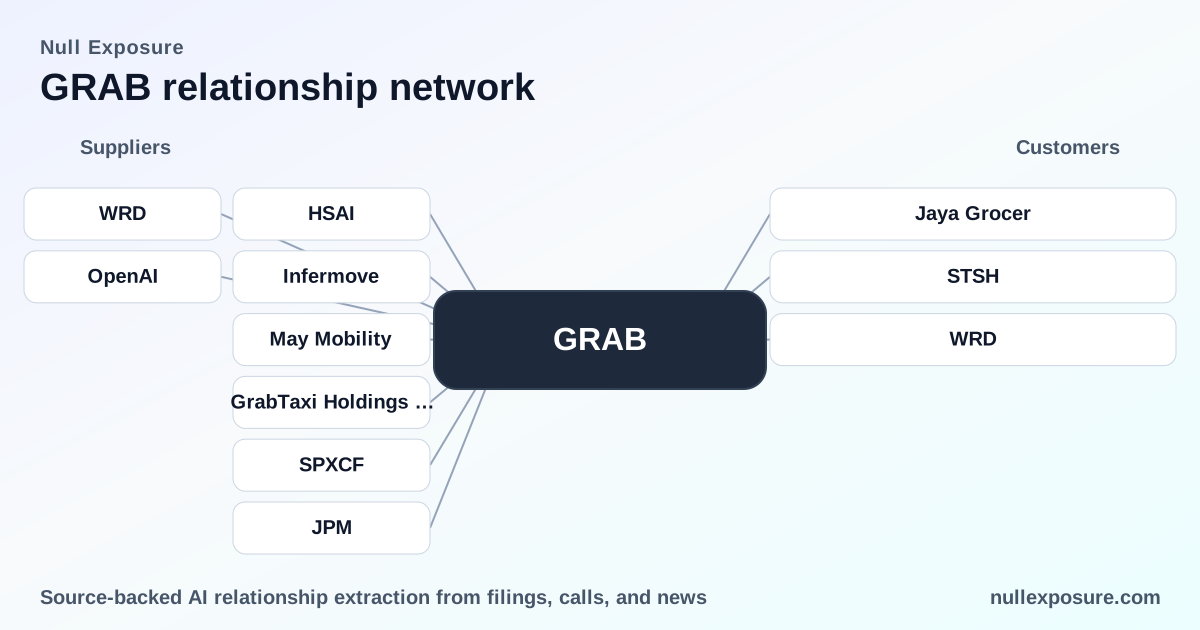
Grab’s customer ecosystem: partnership signals, strategic bets, and what investors should price in
Grab operates a multi-sided mobility and super-app platform that monetizes through marketplace commissions (rides and deliveries), merchant integrations and loyalty, payments and financial-services fees, and increasingly through financial product distribution and M&A-driven capability expansion. The customer relationships in the public record reveal a mix of traditional merchant integrations, strategic mobility pilots, and a financial-services acquisition that collectively signal a platform pursuing revenue diversification and product ownership. For deeper scenario analysis and sourcing, visit https://nullexposure.com/.
Why these specific customer ties matter to an investor
Grab’s growth thesis rests on two dynamics: expanding marketplace take-rates across transactions and migrating users into higher-margin financial services. The relationships covered below illustrate both dynamics:
- Contracting posture: Grab combines merchant integrations and partnership pilots with opportunistic acquisitions to accelerate capability ownership rather than pure third‑party reliance.
- Concentration and criticality: The partners range from high-frequency offline merchants (grocery) to experimental AV providers and a newly acquired U.S. digital investing platform; this mix reduces single‑counterparty revenue concentration but raises cross-border and regulatory integration complexity.
- Maturity: Merchant integrations are mature and transactional; AV partnerships are nascent pilots; the Stash acquisition shifts Grab toward ownership and integration risk in fintech.
The available record contains no explicit contract-level constraints attached to these relationships; that absence is itself a company-level signal that investor diligence must rely on public filings and management commentary for commercial terms and exposure.
The relationships seen in the record — one by one
WeRide (WRD) — AV partnership and public shuttle pilot
Grab announced a partnership with WeRide to launch its first autonomous vehicle (AV) shuttle service for the public in Singapore, signaling a tactical move into AV mobility experiments and last‑mile innovation. The partnership is referenced both in Grab’s Q4 2025 earnings call and in independent reporting noting WeRide’s operations with Grab in Southeast Asia (Grab Q4 2025 earnings call; Travolution report, May 2026).
WeRide (WRD) — broader regional association
Independent reporting on WeRide’s driverless taxi rollouts in Dubai and Singapore explicitly identifies WeRide’s work “with Grab, the region’s dominant mobility and services platform” in Southeast Asia, reinforcing that the WeRide relationship is positioned to give Grab early exposure to AV deployments and product differentiation (Travolution, May 4, 2026).
Jaya Grocer — offline grocery integration and loyalty flows
Grab’s investor materials and quarterly press releases document that offline Jaya Grocer transactions can be recorded on the Grab app when users register Jaya Grocer loyalty points, demonstrating an integrated merchant relationship that captures in-store consumer transaction data and loyalty flows into Grab’s payment and engagement ecosystem (Grab press release reporting Q3 2024 results; Grab press release reporting Q2 2025 results).
Stash (STSH) — acquisition to accelerate financial services
Grab disclosed on its Q4 2025 earnings call the acquisition of Stash, a U.S.-based digital investing platform, indicating a strategic push to own distribution and product capabilities in wealth and investment services that can be cross-sold to Grab’s user base (Grab Q4 2025 earnings call, March 7, 2026).
Operational and business-model constraints — practical investor signals
Because there are no explicit constraint excerpts attached to the recorded relationships, treat the following as company-level operating signals rather than relationship-level facts:
- Platform-to-owner posture: Grab combines partnership pilots (WeRide) with merchant integrations (Jaya Grocer) and outright acquisition (Stash). This hybrid approach accelerates capability capture but increases integration and capital deployment risk.
- Revenue diversification vs. operational complexity: Merchant integrations drive volume and capture payments data; financial‑services ownership targets higher margins and lifetime value expansion. Both increase regulatory and operational scope across jurisdictions.
- Concentration profile: The sample shows deliberate spread across mobility, offline retail, and fintech, suggesting management is actively reducing single-sector dependency while creating new cross-selling vectors.
- Maturity gradient: Expect lower near-term monetization from AV pilots (experimental, infrastructure heavy) and higher predictability from merchant loyalty integrations, while acquisitions like Stash create medium-term integration and compliance tasks before revenue commensurately scales.
What this means for valuation and risk
- Revenue upside: Merchant loyalty captures (Jaya Grocer) and financial-product distribution (post-Stash) support higher revenue per user and wallet monetization. Grab’s path to margin expansion will lean on financial services and merchant monetization becoming a larger share of total revenue.
- Execution risk: Integration of Stash into Grab’s ecosystem introduces cross-border regulatory compliance and product integration risk; AV pilots with WeRide require capital, regulatory approvals, and slow commercialization timelines before material revenue accrues.
- Capital allocation trade-offs: The combination of partnership pilots and acquisitions signals that management will allocate capital both to R&D/strategic pilots and to M&A—investors should model for elevated SG&A and potential investment-stage losses before scale benefits.
- Regulatory and operational exposures: Offline merchant data capture and financial-services expansion increase regulatory scrutiny on data privacy, payments compliance, and securities regulations in new jurisdictions.
Quick investor checklist
- Verify commercial terms and economics for merchant integrations documented in Grab’s public filings (take-rates, data sharing, loyalty revenue splits).
- Track integration milestones and cost guidance for Stash from management commentary in subsequent quarters.
- Monitor pilot KPIs and regulatory filings for WeRide/AV operations in Singapore to assess timing and probability of scaled deployment.
For an organized viewpoint on customer relationships across public filings and press coverage, see the research home at https://nullexposure.com/.
Bottom line
The relationships captured in recent public records show Grab executing a deliberate mix of merchant entrenchment, mobility innovation, and fintech capability ownership. For investors, that combination spells a clear route to diversified monetization—but it also requires disciplined scrutiny of integration execution, regulatory milestones, and the timeline for turning pilots and acquisitions into predictable earnings.