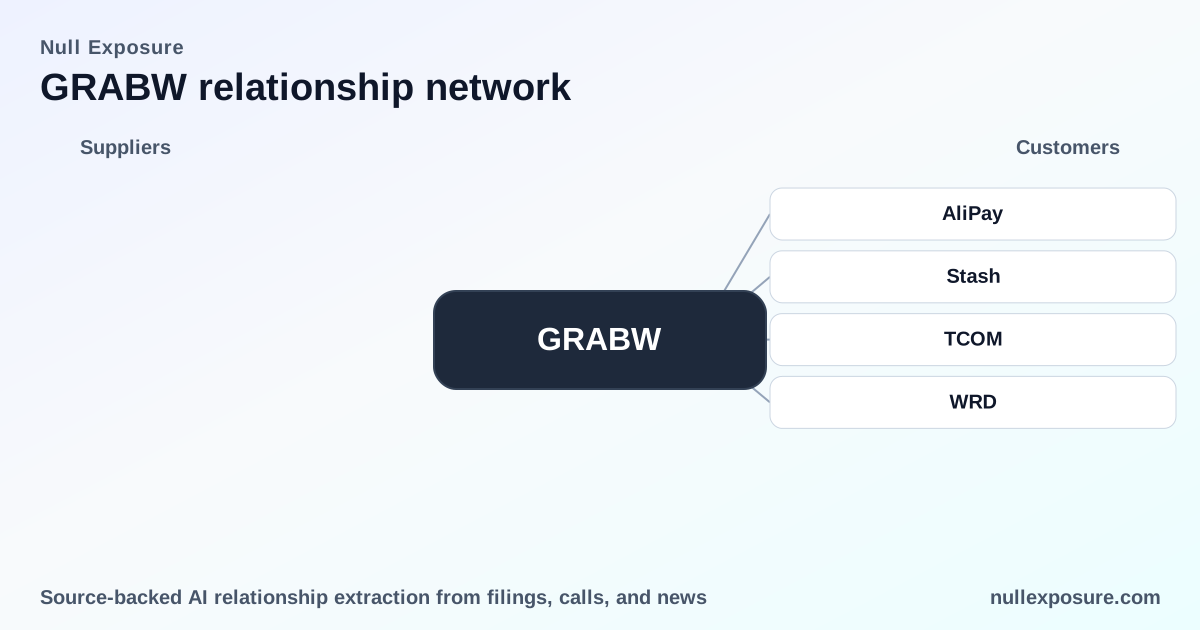
GRABW: Strategic partners, acquisition moves, and what they signal for revenue mix
Grab (GRABW) operates as a multi‑vertical platform that monetizes through transport and delivery marketplace fees, ad and merchant services, and expanding financial services — and it is increasingly using partnerships and selective M&A to accelerate brand reach and build new revenue streams. The 2025 Q4 earnings call spotlights a small set of external relationships that are tactical for customer acquisition, geographic marketing, and mobility innovation, while an announced U.S. acquisition signals a clear push into wealth and financial services. For a concise view of these customer and partner ties, see more at https://nullexposure.com/.
How these relationships fit into Grab’s commercial playbook
Grab’s operating model blends marketplace economics with platform‑level monetization: connect users to merchants and services, take platform fees, sell visibility/ads, and layer financial products. Partnerships that extend brand visibility (travel platforms and regional payment networks) directly support user acquisition and merchant demand; mobility pilots and AV tie to longer‑term unit‑economics improvement and operating cost reductions; and the Stash acquisition injects a U.S. digital investing capability that expands financial services monetization beyond core Southeast Asia markets.
- Contracting posture: Grab engages in commercially minded, partnership‑first deals rather than deep equity stakes for every initiative; this preserves capital flexibility while buying distribution and technology access.
- Concentration and diversification: The relationships disclosed span payments, travel platforms, mobility tech and investing, signaling diversification across customer acquisition channels and product verticals, reducing single‑channel dependency.
- Criticality and maturity: Several ties are highly strategic but early stage — pilots and marketing partnerships are critical for growth but not yet core revenue engines; the Stash deal represents a step toward higher maturity in financial product capability.
Relationships cited on the 2025 Q4 earnings call — what investors should know
AliPay
Grab referenced AliPay in the context of marketing and brand visibility before users arrive in Southeast Asia; this is a distribution and payment partnership aimed at inbound traveler visibility. According to Grab’s 2025 Q4 earnings call (first cited March 2026), AliPay’s role centers on enhancing brand reach for users before regional entry.
Trip.com
Trip.com is named alongside AliPay as a partner to increase Grab’s visibility to travelers prior to arrival, suggesting coordinated marketing or channel placement within travel booking flows. The 2025 Q4 earnings call (reported March 2026) highlights Trip.com as a customer/partner for pre‑arrival user acquisition.
TCOM (inferred symbol for Trip.com)
TCOM is listed as the inferred symbol for Trip.com in the call transcript; this duplicate entry confirms the same relationship was referenced under both brand and ticker formats in the 2025 Q4 earnings call (March 2026), reinforcing the travel‑platform distribution play.
WeRide
Grab disclosed a partnership with WeRide to launch an autonomous vehicle (AV) shuttle service open to the public in Singapore, marking a mobility innovation pilot intended to test AV operations, customer acceptance, and potential operating cost benefits. The 2025 Q4 earnings call (March 2026) describes WeRide as the AV technology partner for the shuttle pilot.
WRD (WeRide inferred symbol)
WRD appears as the inferred symbol for WeRide in the call, echoing the same AV shuttle collaboration noted in the 2025 Q4 earnings call (March 2026) and underlining the company’s public AV deployment activity.
Stash
Grab announced an acquisition of Stash, a U.S.-based digital investing platform, signaling an explicit move to accelerate Grab’s financial services and investable‑asset offerings beyond Southeast Asia. The acquisition was introduced during the 2025 Q4 earnings call (March 2026) as a strategic capability add to the company’s fintech roadmap.
What these ties tell investors about monetization and strategic priorities
These relationships explain three clear priorities in Grab’s go‑forward model:
- Customer acquisition and international visibility: Partnerships with AliPay and Trip.com target inbound travelers and international users, converting traveler flows into local platform usage and merchant revenue.
- Product and operational innovation in mobility: The WeRide shuttle pilot demonstrates an investment in AV technology to test cost reduction pathways and new service formats that could improve long‑term margin structure for transport services.
- Financial services expansion through M&A: The Stash acquisition is a strategic thrust into wealth and investing, diversifying revenue beyond ride and delivery fees into higher‑margin financial products.
Each initiative is structured to maximize commercial benefit without overcommitting capital to full ownership in every case; Grab mixes pilots, partnerships, and targeted acquisitions to balance growth, experimentation, and leverage.
Key risks and investment implications
- Execution risk on nascent pilots. AV shuttle services are operationally complex and early stage; success hinges on regulatory progress and scale economics.
- Integration and regulatory complexity with Stash. Cross‑border fintech M&A introduces integration and compliance demands that could compress near‑term operating leverage.
- Dependence on distribution partners. Partnerships with travel and payments platforms are powerful acquisition channels, but they create exposure to platform negotiation dynamics and co‑promotion economics.
Net investor takeaway: these relationships are pragmatic building blocks — marketing partnerships to lift user acquisition, targeted pilots to reduce future transport costs, and an acquisition to accelerate financial services revenue — forming a coherent strategy to broaden monetization while managing capital intensity.
Final read and action
For analysts modeling Grab’s revenue mix, allocate growth buffers for the travel and payments channel benefits and treat AV outcomes as optional upside rather than baseline. The Stash acquisition should be modeled as a pathway to higher‑margin financial revenue, with due attention to integration timelines.
Explore a deeper relationship map and earnings‑call extracts at https://nullexposure.com/.