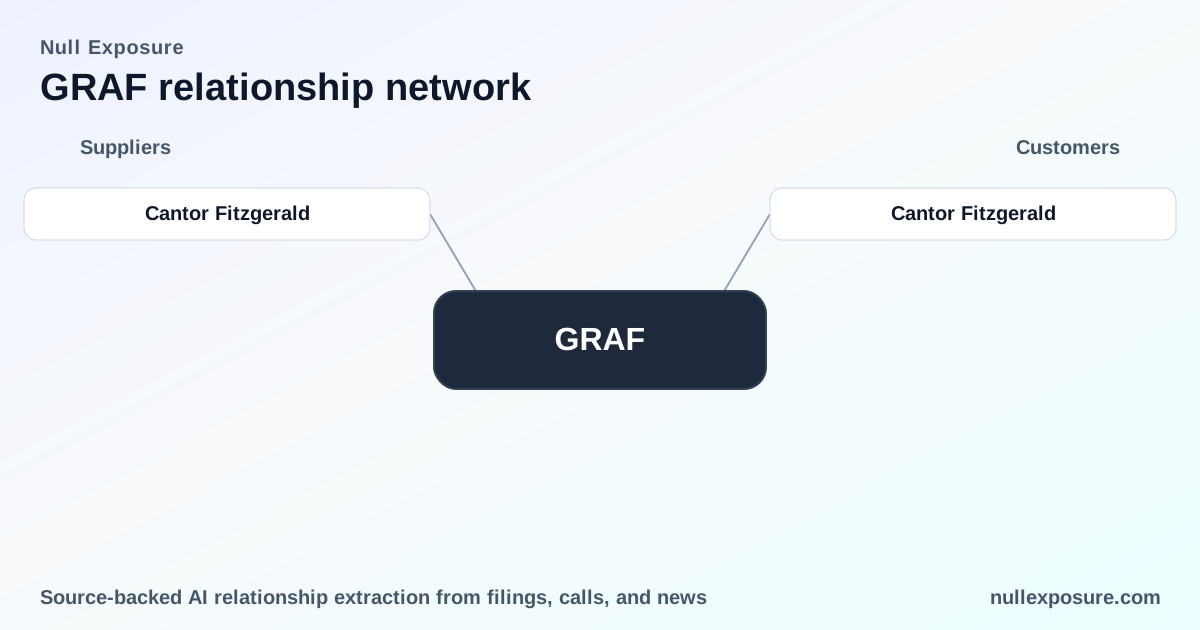
GRAF: Where capital markets and sponsor commitments shape customer risk
GRAF monetizes by combining sponsor-driven capital raises and one-off public equity transactions rather than recurring service revenues; its economic model is built on executing and selling equity units in IPO events and securing backstop commitments from underwriters and sponsors. Investors should value GRAF as a capital-markets-oriented issuer whose cash flows and counterparty exposures are concentrated around discrete financing events and sponsor/underwriter relationships.
For more structured intelligence on these partner dynamics, see https://nullexposure.com/.
The bottom line for investors: concentrated, event-driven customer exposure
GRAF’s relationship set highlights a concentrated, transactional operating model. The company’s critical customer/partner interactions are tied to underwriting and sponsor commitments during IPOs and private-placement closes, not long-duration contracts. This creates both upside—clean capital infusions at defined prices—and downside—single-event counterparty risk where a handful of counterparties determine funding outcomes.
Cantor Fitzgerald committed as a sponsor/underwriting counterparty
Cantor Fitzgerald committed to purchase 6 million private placement warrants at $1.00 each as part of GRAF’s sponsor arrangements. This commitment represents a direct capital backstop that supports unit economics for the IPO structure and reduces the likelihood of shortfalls in the close. The underlying note on this commitment was reported in a June 3, 2024 news post on SPACConference covering GRAF’s IPO filing.
Source: SPACConference news coverage (June 3, 2024) reporting on the GRAF Global IPO filing and sponsor commitments.
What the disclosed IPO tells you about business posture
GRAF executed a classical sponsor-led SPAC-style offering: the company sold 23,000,000 Units (including a 3,000,000 Unit overallotment) at $10.00 per Unit, generating $230 million of gross proceeds when the offering closed on June 27, 2024. That transaction establishes GRAF as an issuer whose primary customer/partner dynamic at IPO time is seller-of-equity to public investors and private-placement purchasers.
Source: Company filing details describing the Initial Public Offering consummated June 27, 2024 (reported in FY2024 disclosures and related notes).
How the constraints signal the operating model (company-level perspective)
The extracted constraints frame GRAF’s commercial reality:
-
Contracting posture — spot transactions. Evidence from the IPO disclosure indicates a focus on one-off public-unit sales rather than subscription or recurring revenue contracts; GRAF’s primary transactions are spot sales of equity units at fixed offering prices. This implies predictable, event-tied cash inflows but limited recurring customer revenue streams.
-
Role as seller in capital markets. The company is explicitly the issuer/seller in the IPO, which places GRAF in a counterparty relationship with underwriters, sponsors, and public investors, rather than as a provider of ongoing services. That seller role concentrates business risk in market reception and underwriting commitments.
-
Concentration and criticality. The prominence of a single IPO and sponsor/underwriter commitments indicates concentrated counterparty exposure; a small set of counterparties (for example, Cantor Fitzgerald and the sponsor group) materially affect funding and post-issuance liquidity.
-
Maturity and visibility. The June 2024 IPO consummation is a structural milestone: GRAF is positioned as an early-stage public equity issuer where future funding and growth depend on capital-market access and the willingness of counterparties to participate in follow-on offerings or warrant exercises.
These constraints are company-level signals derived from the public offering documentation and related reporting rather than specifics of any individual partner contract.
Why investors should care about the Cantor relationship
The Cantor commitment is functionally important because it is not merely an advisory relationship; it is a capital commitment that reduces execution risk at close and improves balance-sheet certainty immediately post-offering. For investors assessing downstream dilution or cash runway scenarios, the presence of sponsor/underwriter warrant purchases at defined strike prices is a measurable capital buffer. The SPACConference report captured that commitment in the context of GRAF’s IPO filing.
Source: SPACConference news post chronicling GRAF’s IPO filing and related private placement commitments (June 2024).
Implications for valuation and due diligence
- Valuation should treat future cash as event-dependent and stress-test scenarios where sponsor or underwriter participation is partial or absent. Underwriting commitments such as Cantor’s reduce that downside but do not eliminate market risk.
- Governance and contractual detail on warrant terms, exercise windows, and sponsor lock-ups are critical diligence items—these determine effective dilution and the timing of cash realization from private-placement warrant exercises.
- Counterparty concentration means investors must monitor the financial health and incentives of sponsor/underwriter partners, since their willingness to fund or exercise instruments materially affects company liquidity.
For deeper partner-level analytics and continuous monitoring of these dynamics, visit https://nullexposure.com/.
What to watch next quarter
- Public filings and proxy materials that concretely disclose warrant exercise schedules and sponsor lock-up expirations.
- Any press or filings that expand the list of committed purchasers beyond the disclosed sponsors and underwriters, which would reduce concentration risk.
- Secondary market activity in the Units and warrants that signals investor appetite and the likely future dilution path.
Final takeaway
GRAF’s commercial profile is centered on one-off capital transactions with concentrated counterparty exposure; sponsor and underwriter commitments like Cantor Fitzgerald’s are the operational levers that convert underwriting structures into realized capital. Investors should underwrite GRAF’s performance through the lens of capital-market execution risk and monitor sponsor/underwriter behavior as primary drivers of near-term liquidity and valuation.