GRAL: Commercial Partnerships Drive Reach for Galleri — a Customer Map for Investors
GRAIL operates a single-core-product commercial model built around the Galleri multi-cancer early detection (MCED) blood test and monetizes primarily by selling individual tests and institutional screening programs into health systems, employers, payors and direct-to-consumer channels. Revenue is recognized at the point the test result is delivered, and commercial scale depends on a mix of enterprise integrations, distribution partnerships, and reimbursement progress rather than recurring contract annuities. For an actionable, relationship-focused view of how Galleri reaches patients and buyers, see more at https://nullexposure.com/.
What partnerships tell you about how Galleri reaches market
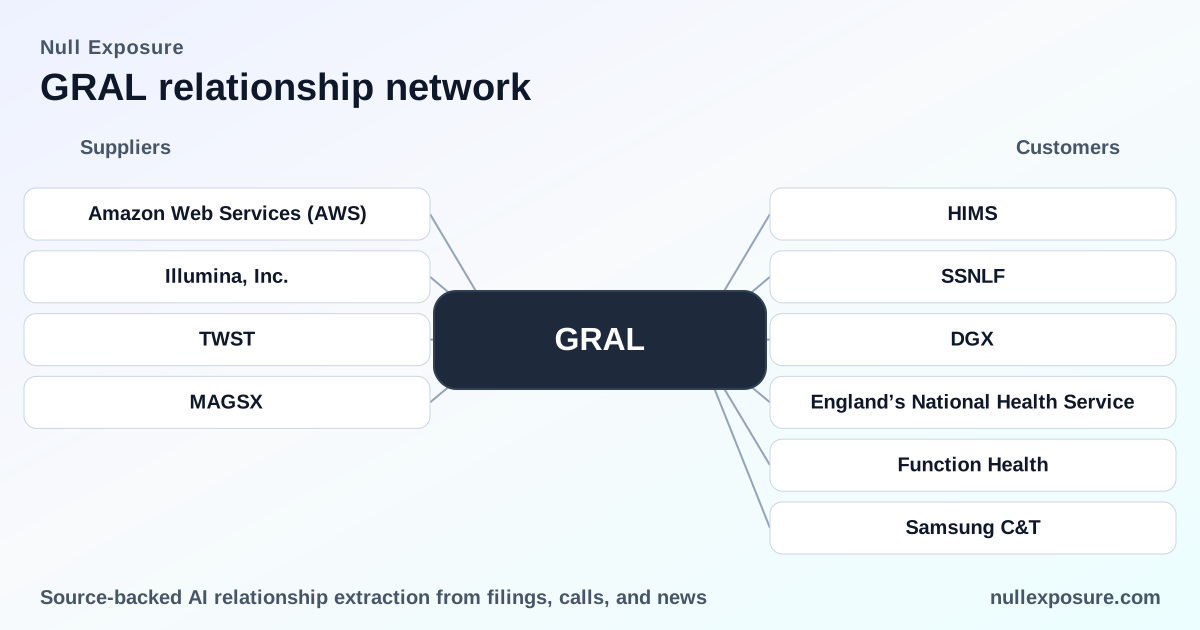
Below I walk through every customer-side relationship surfaced in recent reporting and media coverage. Each entry is a concise, plain-English take on the nature of the tie and the source that reported it.
SSNLF (Samsung group, OTC ticker)
GRAIL signed a binding Letter of Intent with Samsung C&T and Samsung Electronics to bring Galleri into key Asian markets, establishing a strategic commercial push into Asia through Samsung’s channels. According to a Samsung press release (March 9, 2026), the LOI targets regional distribution and market entry execution. (Samsung News, 2026-03-09: https://news.samsung.com/medialibrary/global/photo/60726/tag/b2b?page=2)
Samsung Electronics
Samsung Electronics is named alongside Samsung C&T in the LOI to commercialize Galleri in Asia, indicating GRAIL is pursuing large multinational distribution partners rather than incremental reseller arrangements. (Samsung News, 2026-03-09: https://news.samsung.com/medialibrary/global/photo/60726/tag/b2b?page=2)
Samsung C&T
Samsung C&T’s inclusion in the binding LOI shows GRAIL is structuring region-specific commercial partnerships that combine manufacturing, distribution, and channel footprint. The March 2026 announcement positions Galleri for coordinated entry to key Asian markets. (Samsung News, 2026-03-09: https://news.samsung.com/medialibrary/global/photo/60726/tag/b2b?page=2)
Hims & Hers Health (HIMS)
Hims & Hers added Galleri to its Labs product, expanding Galleri’s direct-to-consumer and telemedicine distribution through a national digital health platform; the market reacted positively to the announcement. TradingView reporting of March 9, 2026, noted a substantial premarket share move after HIMS said it will offer the Galleri test through its platform. (TradingView / GuruFocus, 2026-03-09: https://www.tradingview.com/news/gurufocus:4a0093369094b:0-hims-hers-launches-grail-multi-cancer-screening-test/; Sherwood News coverage, 2026-03-09: https://sherwood.news/business/hims-adds-cancer-detection-test-to-labs-product/)
Quest Diagnostics (DGX)
Quest has been a longstanding commercial partner and a channel for Galleri testing; reporting highlights Quest integration as a key execution item for scaling U.S. distribution and operational throughput. Media coverage cites Quest as an existing partner that underpins broader commercial availability. (Sherwood News, 2026-03-09: https://sherwood.news/business/hims-adds-cancer-detection-test-to-labs-product/; SimplyWallSt analysis, 2026-03-09: https://simplywall.st/stocks/us/pharmaceuticals-biotech/nasdaq-gral/grail/news/does-grails-2025-revenue-guidance-clarify-its-long-term-grow)
DGX (as reported separately)
Multiple outlets reference DGX/Quest when discussing Galleri’s channel execution, underscoring that Quest’s role is prominent enough to be cited repeatedly in coverage of commercialization and PMA progress. (SimplyWallSt, 2026-03-09: https://simplywall.st/stocks/us/pharmaceuticals-biotech/nasdaq-gral/grail/news/does-grails-2025-revenue-guidance-clarify-its-long-term-grow)
Superpower
Superpower announced a partnership to offer Galleri to its preventative health membership, expanding Galleri’s footprint in subscription-style preventative health services and giving members access to screening for 50+ cancer types. Coverage in early April 2026 framed this as another distribution channel focused on preventive care. (SimplyWallSt and Investing.com coverage, Apr–May 2026: https://simplywall.st/stocks/us/pharmaceuticals-biotech/nasdaq-gral/grail/news/is-grail-gral-turning-superpower-partnership-into-a-scalable; https://au.investing.com/news/company-news/grail-to-present-nhsgalleri-pathfinder-2-data-at-asco-meeting-93CH-4375531)
MFC (insurer)
A Canadian insurer — cited in an MFC earnings call — said it became the first insurer in Canada to offer access to the Galleri test, signaling payor-level adoption in at least one national market and the potential for life/health insurers to underwrite or subsidize testing. (MFC earnings call, 2025 Q4, reported 2026-03-07: mfc-2025q4-earnings-call)
England’s National Health Service (NHS)
The NHS trial of Galleri failed to meet its primary endpoint in a study used to evaluate routine annual screening, a development that has immediate implications for public payor adoption in the U.K. and for the regulatory/reimbursement debate in EMEA. (StockTwits/news aggregation, March 2026: https://stocktwits.com/news-articles/markets/equity/why-is-gral-stock-down-today-analysts-lower-targets-after-uk-trial-setback-selloff-overdone/cZRN5uHR4x9)
Function Health
Function Health — a lab analysis startup mentioned in press — has offered a similar product and is referenced as part of the partner ecosystem that distributes or complements Galleri, illustrating competing and adjunctive channels in the lab services market. (Sherwood News, 2026-03-09: https://sherwood.news/business/hims-adds-cancer-detection-test-to-labs-product/)
Ochsner Health
Ochsner integrated Galleri into Epic’s EHR platform to streamline ordering and clinical workflow, demonstrating a clinical pathway strategy that embeds Galleri into routine provider workflows rather than relying solely on standalone test ordering. (PR Newswire, 2026-05-03: https://www.prnewswire.com/news-releases/grail-announces-integration-of-the-galleri-test-into-epic-electronic-health-record-platform-to-expand-access-nationwide-302736109.html)
What the relationship evidence collectively signals about GRAL’s operating model
- Contracting posture: point-in-time, spot sales. Company disclosures state that each test sale is a single performance obligation and revenue is recognized when the test result is delivered, implying transactional spot economics rather than recurring contract revenue.
- Distribution is partnership-led and multi-channel. Large labs (Quest), digital health platforms (Hims), health systems (Ochsner), insurers (MFC), and multinational distributors (Samsung group) drive reach — commercial scale depends on execution of integrations and channel penetration, not an installed subscription base.
- Concentration and materiality are real. Management disclosed a customer that accounted for ~11% of 2024 revenue, indicating material counterparty concentration that investors must monitor.
- Counterparty mix spans individuals to governments. Evidence shows revenue sources include individuals, payors, employers, and government study income (Galleri‑Medicare), establishing a blended go‑to‑market.
- Geography is principally North America with active expansion into EMEA and Asia. The company derives most revenue in the U.S. but the NHS trial and Samsung LOI show EMEA regulatory debate and Asian market entry are central strategic levers.
- Relationship lifecycle is mixed: active, pilot, prospect. Management notes pilots are the customary entry for large customers, many announced relationships are active integrations, and payor coverage remains a key prospect area.
- Product centrality and criticality: Galleri is the core product. The company’s segmenting identifies Galleri as the core commercial offering; partner integrations (Epic, Quest, Samsung channels) underscore its strategic criticality.
- Supply/relationship complexity: Illumina is both customer and supplier. Company filings explicitly name Illumina as a dual-role counterparty, which is a notable operational dependency in the supply chain and customer mix (company filings covering 2024 disclosures).
For a deeper commercial mapping and real‑time relationship tracking, visit https://nullexposure.com/.
Investment implications: where upside and risk live
- Upside: enterprise integrations (Quest, Epic/Ochsner, Samsung) materially expand addressable reach and reduce friction to ordering; insurer adoption (MFC) unlocks reimbursement pathways; digital health partners (HIMS, Superpower) scale direct access.
- Downside: reimbursement and regulatory risk (NHS trial miss) can slow public payor adoption across EMEA and influence private coverage dynamics; concentration risk and transactional, spot revenue recognition create revenue volatility as partners move between pilots and full-scale deployment.
- Execution cadence matters: investors should track PMA/regulatory milestones, Quest integration metrics, and the pace of payor coverage wins — these are the primary operational levers that convert partnership announcements into sustainable revenue.
Bottom line
GRAIL’s commercial strategy is clearly partnership-centric: scale will come through large-channel integrations and payor adoption rather than subscription lift. That structure delivers rapid access to end users but concentrates execution risk around a handful of enterprise integrations and reimbursement outcomes. Monitor Quest and Epic adoption metrics, Samsung/Asia rollout progress, and payor wins to separate headline partnerships from durable revenue streams.