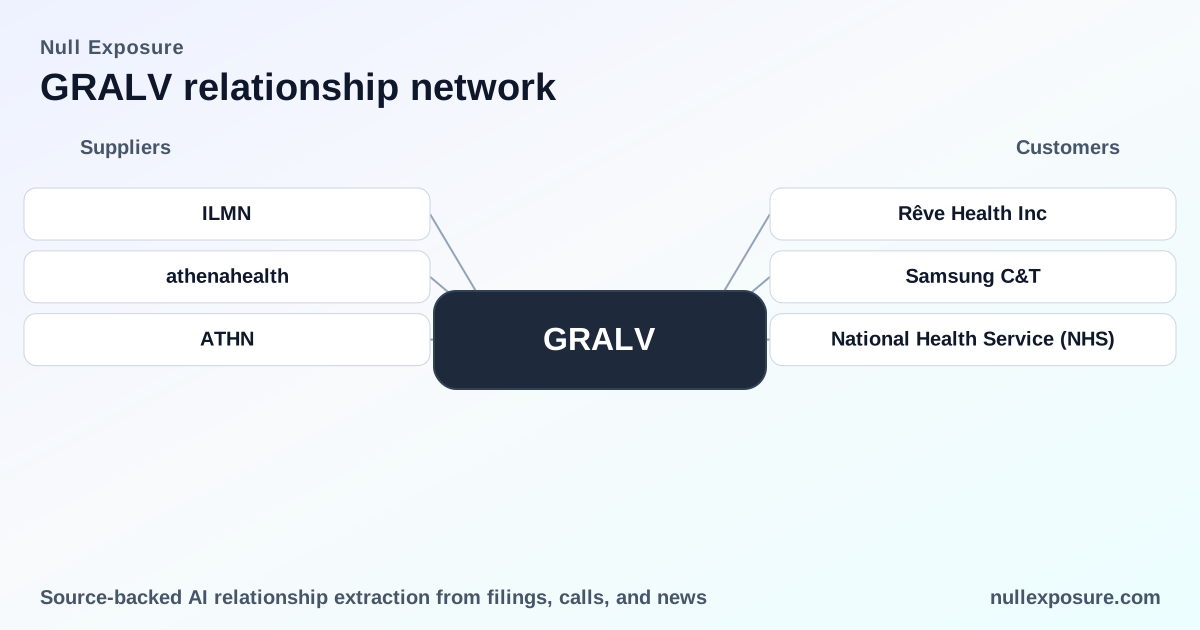
GRALV Customer Map: How GRAIL Monetizes Clinical Partnerships and Distribution
GRAIL operates a clinically focused diagnostics business that monetizes through direct-to-provider and channel distribution of its Galleri® multi-cancer early detection test, integrating the test into health systems, employer wellness plans, and exclusive regional distribution agreements. Revenue derives from test sales to partners and patients, recurring program relationships with health systems and wellness platforms, and strategic exclusive licensing in select markets that accelerate adoption and pricing control. For investors, the core thesis is simple: growth depends on scaling institutional partnerships and converting pilot programs into sustained commercial volumes.
Explore the full relationship dataset at https://nullexposure.com/ for deeper due diligence and document-level sourcing.
What the partnership footprint says about GRAIL’s operating model
GRAIL’s customer relationships reveal a hybrid go-to-market: direct integration with major health systems and branded wellness platforms, plus selective exclusive distribution overseas. This structure produces three operational characteristics investors should weigh:
- Contracting posture: Relationship-driven, with a mix of strategic partnerships and exclusive distributor agreements that require longer sales cycles but deliver durable revenue if scaled.
- Concentration risk: Exclusive arrangements in specific markets concentrate revenue dependency regionally; success in any given geography can disproportionately affect near-term growth.
- Criticality to customers: Galleri is positioned as an add-on preventive care service, increasing the test’s stickiness within subscription wellness platforms and health systems that emphasize early detection.
- Commercial maturity: Public rollouts and trials from 2021 through 2026 indicate a transition from proof-of-concept pilots to broader commercialization across multiple channels.
If you want a consolidated view of these commercial linkages, see https://nullexposure.com/ for the source-level documents and media references.
Detailed customer relationships (explicit, sourced)
Superpower — strategic wellness platform partnership (FY2026)
GRAIL announced a strategic partnership with Superpower to provide members access to the Galleri multi-cancer early detection test, embedding Galleri into a proactive, all-in-one health offering for consumers. This partnership signals GRAIL’s continued focus on integrating with subscription wellness platforms to reach employer and consumer segments. Source: PR Newswire press release (May 2026).
Samsung C&T — exclusive distributor in South Korea and regional expansion (FY2025)
GRAIL has an exclusive commercial distribution relationship with Samsung C&T to market Galleri in South Korea, with stated potential expansion into Japan and Singapore; multiple press reports identify Samsung C&T as the regional commercialization partner. This exclusive-distributor posture gives GRAIL rapid market access but concentrates execution risk in one partner per territory. Source: Investing.com insider-trading coverage (FY2025) and regional reporting on commercialization (samlover.com, FY2025).
Mayo Clinic — commercial availability at flagship locations (FY2021)
GRAIL arranged availability of Galleri at Mayo Clinic flagship locations in Rochester, Jacksonville, and Phoenix, demonstrating early adoption by leading U.S. academic health systems and serving as a high-visibility proof point for clinician uptake. Source: Fox13 Memphis reporting on Mayo Clinic availability (FY2021).
Rêve Health Inc — member-facing wellness integration (FY2025)
Rêve Health added the Galleri test as a purchasable option for members, indicating GRAIL’s distribution into personalized wellness journeys and employer or membership-based health plans. This underscores the company’s strategy to sell tests through third-party wellness vendors as an adjunct to standard preventive care. Source: Insider.fitt.co press release coverage (March 2026; FY2025 reporting).
Samsung C&T — additional regional rollout detail (duplicate FY2025 entry)
Additional coverage reiterates that Samsung C&T and GRAIL will act as exclusive partners to commercialize Galleri in South Korea, reinforcing the partner’s central role in GRAIL’s Asian expansion strategy. Multiple independent reports strengthen the signal of exclusivity and geographic focus. Source: Regional tech press coverage (samlover.com, FY2025).
Mayo Clinic Health System — wider regional deployment (FY2021)
GRAIL expanded Galleri availability into Mayo Clinic Health System sites across southern Minnesota and Wisconsin, indicating a multi-site roll within a major integrated health network rather than a single flagship pilot. This pattern reflects a commercial model that converts institutional validation into broader network deployments. Source: Fox13 Memphis report on system-wide availability (FY2021).
The NHS / National Health Service — formal trial engagement (FY2021 and FY2025 reporting)
The NHS has engaged GRAIL in trial programs for Galleri, with reporting noting the UK-wide trial activity and partnership dating back to the firm’s initial research collaborations and rollout planning. National trial participation with the NHS constitutes a major validation channel and positions Galleri for potential public health adoption in a national system. Source: Mirror.co.uk and Deutsche Welle coverage of the NHS trial partnership (reporting across FY2021–FY2025).
Key takeaways for investors and operators
- Institutional validation is the dominant growth lever. Partnerships with Mayo Clinic and NHS trials provide credibility that supports payer conversations and employer sell-through.
- Channel diversification reduces single-source exposure, but regional exclusives create pockets of concentration. Samsung C&T’s exclusivity accelerates Asia entry while increasing dependence on a single commercial partner in that territory.
- The revenue model hinges on volume conversion across three channels—health systems, wellness platforms, and regional distributors—so execution on multi-site rollouts and partner marketing is critical.
- Commercial maturity is visible: deployments and trials from 2021 through 2026 show movement from research into mainstream clinical and consumer settings.
Final assessment and next steps
GRAIL’s customer footprint demonstrates a clear commercial playbook: leverage elite institutional partnerships to establish clinical credibility, then scale through wellness platforms and selective exclusive distributors to capture market share in targeted geographies. The business is not purely transactional—contracts with health systems and exclusivity clauses produce longer sales cycles but higher lifetime value when deployed at scale.
For investors and operators conducting deeper diligence, review the underlying press releases and trial notices at https://nullexposure.com/ to validate timelines, contractual terms, and any subsequent updates to partner scope or geographic exclusivity.