Guardian Pharmacy Services: customer relationships and competitive posture investors need to know
Guardian Pharmacy Services operates a specialized pharmacy model focused on long-term care facilities (LTCFs), providing medication dispensing, technology-enabled medication management and clinical services that are billed to facilities, residents and associated payors. The company monetizes through recurring service contracts with LTCFs and per-resident pharmacy revenue, supported by technology and clinical programs that drive adherence and reduce downstream costs for payors. For investors, the combination of recurring, short-duration contracts and a geographically diversified facility base produces a predictable revenue stream with operationally manageable client turnover. For an executive view of the platform, see Guardian’s investor materials at https://nullexposure.com/.
How the business operates and what that means for revenue
- Guardian is a service-oriented seller: it contracts directly with LTCFs to act as the principal pharmacy provider, and also serves residents individually. According to the company’s FY2024 Form 10‑K, contracts with facilities “generally range from one to three years in duration and typically renew automatically,” establishing a repeatable revenue cadence while preserving flexibility for facility churn.
- Customer mix is diversified across counterparty types. The company states it serves both individual residents and large multi‑facility operators, giving Guardian a mix of many small recurring relationships plus institutional contracts with larger operators that can scale more quickly.
- Revenue concentration is low. Guardian’s 10‑K reports that no single customer accounted for more than 10% of consolidated revenues over the past five fiscal years, signaling limited client concentration risk at present.
- U.S.-centric, scaled footprint. All revenues in 2023–2024 were U.S.-generated; as of December 31, 2024, Guardian operated 51 pharmacies serving roughly 186,000 residents across about 7,000 LTCFs in 38 states. That footprint gives national scale without heavy dependence on any single geography.
- Operational criticality. The company positions itself as “generally the primary source of pharmaceuticals for the residents of the facilities we serve,” which means its services are operationally critical to facility medication workflows and resident safety.
Contracting posture, maturity and commercial constraints Guardian’s commercial model blends short-term, auto-renewing contracts with high fragmentation at the facility level and some large operator deals. This combination creates several defining characteristics for investors and operators:
- Renewal-driven stability with churn exposure: 1–3 year contracts that automatically renew support recurring revenue, but the short-duration nature exposes Guardian to periodic contract renegotiation and competitive displacement.
- Low single-customer dependency: With no customer >10% revenue, downside from losing any single contract is limited; portfolio diversification reduces tail risk.
- Service-critical positioning: Acting as the primary pharmacy provider creates stickiness tied to operational integration (medication management, MARs, clinical programs). That increases switching costs for facilities relative to a pure dispense-only vendor.
- U.S.-only revenue profile: Geographic concentration in the U.S. simplifies regulation and reimbursement exposure but concentrates macro risk domestically.
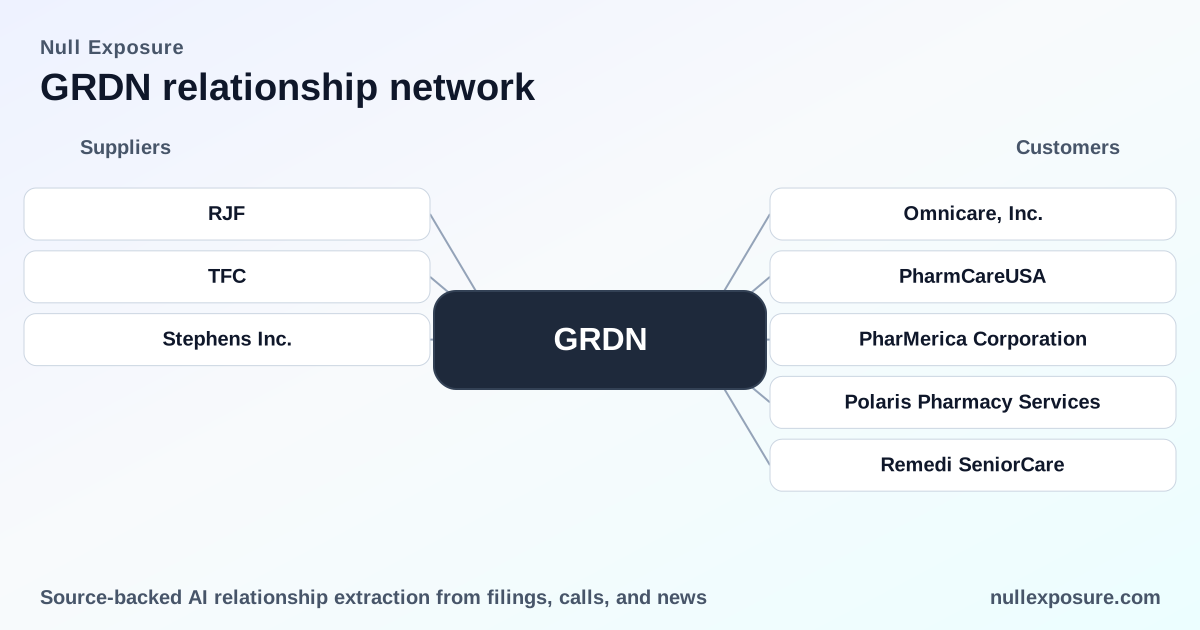
Competitive landscape: the peers and rivals Guardian names Guardian’s FY2024 Form 10‑K lists a set of direct national and regional competitors in the assisted living facility (ALF) and behavioral health facility (BHF) markets. Each mention is competitive, not cooperative, and signals where pricing and contract pressure will come from.
- Omnicare, Inc. is cited as a large national competitor in ALF and BHF markets; this positions Omnicare as a scale incumbent capable of exerting pricing pressure in national operator deals — Guardian 2024 Form 10‑K, FY2024.
- PharMerica Corporation is identified as a principal national rival for ALF and BHF accounts, indicating overlap in institutional service offerings and clinical programs that drive competitive contract renewals — Guardian 2024 Form 10‑K, FY2024.
- PharmCareUSA is named among local and regional competitors in Guardian’s markets, representing the type of regional operator that competes on service and relationships at the facility level — Guardian 2024 Form 10‑K, FY2024.
- Polaris Pharmacy Services is listed alongside other regional competitors, reflecting the fragmented nature of pharmacy services across many states where Guardian operates and the ongoing need to defend local accounts — Guardian 2024 Form 10‑K, FY2024.
- Remedi SeniorCare is called out as a peer competitor in the company’s ALF and BHF service areas, underscoring the competitive set of specialized senior-care pharmacy providers that focus on clinical and operational integration — Guardian 2024 Form 10‑K, FY2024.
What these competitor relationships imply for strategy and valuation
- Margin and pricing pressure are persistent. Large national providers (Omnicare, PharMerica) exert pricing discipline on institutional deals, while regional vendors compete aggressively on service and local relationships. Expect Guardian’s operating margin to balance scale benefits against competitive pricing dynamics.
- Renewals and retention are the main lever for growth. With short-term contracts, retention and upsell into additional facilities or clinical services are the fastest path to revenue expansion; acquisition and inorganic consolidation remain alternate levers.
- Diversification limits single-client risk but raises sales intensity. Low customer concentration reduces catastrophic revenue risk, but growth depends on winning many relationships or larger enterprise contracts with national operators.
Investor considerations and operational risk factors
- Customer concentration is immaterial, which is an investor-friendly attribute for downside protection.
- Contract tenors are short-term (1–3 years) and typically auto-renew, creating predictable near-term cash flow but requiring continual commercial investment to sustain renewals.
- Service criticality lends defensibility, since being the primary pharmacy for a facility embeds operational workflows that are costly to unwind.
- U.S.-only exposure means macro and regulatory moves in the U.S. healthcare system will have outsized impact on performance.
- Financial context: Guardian reported approximately $1.45 billion in trailing‑12‑month revenue with positive operating margins; these metrics indicate a profitable franchise with growth ceilings tied to market share gains and service expansion.
Conclusion: where to focus For investors evaluating GRDN, focus on retention trends, per-resident revenue growth, expansion into adjacent clinical services, and the company’s defense against national incumbents. Operational discipline in renewals and targeted wins with large multi‑facility operators will unlock the clearest upside. For a concise view of the platform and to explore relationship intelligence across names, visit https://nullexposure.com/.
For tactical follow-up, review Guardian’s FY2024 Form 10‑K for contract language and competitive disclosures referenced here, and monitor renewal announcements and operator win/loss commentary in quarterly filings.