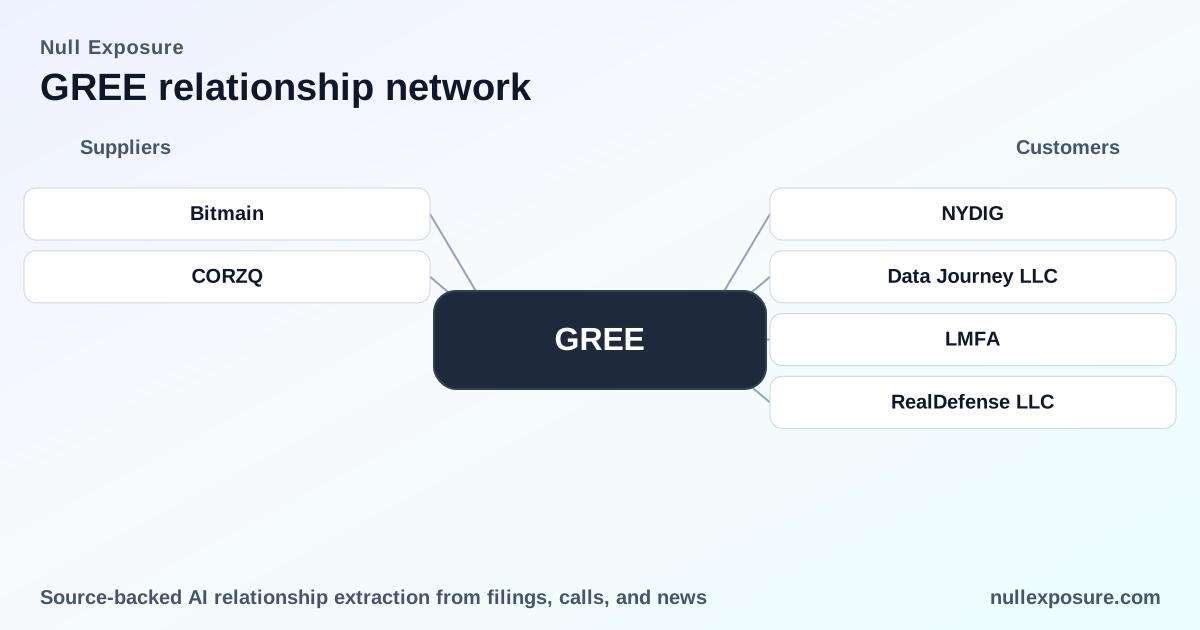
GREE: The customer relationships that define Greenidge’s repositioning
Greenidge Generation (ticker GREE) operates and monetizes as a vertically integrated bitcoin mining and power-infrastructure company: it builds and operates data centers focused on bitcoin mining, hosts third‑party miners under hosting agreements, and sells power/capacity into wholesale markets while retaining a self‑mining business. Revenue stems from three core streams — datacenter hosting, cryptocurrency mining, and power & capacity sales — with hosting contracts and asset sales shaping both near‑term cash flow and strategic exposure.
If you evaluate counterparties and revenue concentration as part of underwriting or portfolio research, start here: https://nullexposure.com/ — the platform aggregates customer and counterparty signals across filings and the news cycle.
How Greenidge’s commercial model translates into investor outcomes
Greenidge’s commercial posture is a mix of long‑tenor hosting commitments and highly liquid short‑term operational choices. That duality creates a distinct risk/reward profile: long‑term hosting arrangements underpin recurring revenue and predictable cost reimbursement, while day‑to‑day operational levers (pool operator selection, self‑mining intensity, and asset divestitures) provide rapid flexibility to respond to bitcoin price and power market volatility. Concentration is material — a single hosting customer historically accounted for roughly half of revenue — so counterparty performance and the cadence of asset sales materially influence free cash flow and margin volatility.
For proprietary signals and relationship maps that drive due diligence, visit https://nullexposure.com/.
The customer and counterparties you need on your radar
Below I summarize every named relationship surfaced in the record set. Each entry is a concise, investor‑oriented take with a direct source reference.
NYDIG — the named hosting counterparty with a multi‑year contract
Greenidge has a five‑year hosting arrangement under which it agreed to host, power, and provide technical support for affiliates’ mining equipment at its New York facility; the FY2024 10‑K also discloses dependence on a sole hosting services customer for the bulk of hosting revenue. According to Greenidge’s FY2024 10‑K, this hosting agreement includes reimbursement of power/direct costs, a hosting fee, and a gross profit‑sharing component. (Source: Greenidge FY2024 10‑K)
Data Journey LLC — a short‑lived land sale that unraveled
A March 2026 news release reported Data Journey LLC agreed to acquire Greenidge’s Spartanburg site for $12.1 million, positioning the buyer as a growing data‑center operator; later reporting indicates the land purchase deal was terminated in 2026. (Source: Yahoo Finance report, March 2026; follow‑up via Investing.com, May 2026)
US Digital Mining Mississippi LLC — buyer of the Columbus, MS facility
Greenidge completed a $3.9 million sale of its Columbus, Mississippi bitcoin‑mining facility to US Digital Mining Mississippi LLC in 2026, representing part of a disposal program that transfers legacy asset risk and generates liquidity. (Source: Investing.com coverage, May 2026)
RealDefense LLC — an acquiror in prior asset dispositions
RealDefense LLC acquired Support.com from Greenidge in an earlier transaction (reported in archived coverage), reflecting Greenidge’s history of divesting noncore businesses as it refocuses on mining and power infrastructure. (Source: SimplyWall.st article, referenced 2026)
LMFA / LM Funding America, Inc. — another buyer of Mississippi capacity
LM Funding America, Inc. (ticker LMFA) is reported to have acquired an 11 MW bitcoin‑mining site in Mississippi from Greenidge for $3.9 million; reporting lists this purchaser and the US Digital Mining entity as buyers in related coverage. (Source: SimplyWall.st article, March 2026)
Structural constraints that shape Greenidge’s counterparty risk and contracting posture
Investors must parse a set of company‑level signals and explicit contractual facts to understand the stability of Greenidge’s revenue base and the leverage of counterparties.
-
Long‑term hosting agreement (named counterparty): The record includes explicit language referencing a five‑year “NYDIG Hosting Agreement” under which Greenidge hosts and services affiliates’ mining equipment and earns reimbursement plus hosting and profit‑sharing fees. This is a material structural anchor for future hosting revenue (Source: FY2024 10‑K excerpt referencing the NYDIG Hosting Agreement).
-
Short‑term operational contracts: Greenidge historically uses pool operators under one‑day contracts, giving the company operational flexibility to switch operators frequently; this creates high short‑term fungibility in mining operations and reduces supplier lock‑in for pool services (Source: FY2024 corporate disclosures).
-
Role fluidity — buyer, seller, and service provider: Corporate statements show Greenidge functions as a buyer (it treats pool operators as customers in self‑mining), a seller (it sells power and capacity into NYISO), and a service provider (it hosts and services third‑party miners). That multi‑role posture diversifies revenue levers but also creates mixed counterparty exposures across markets (Source: FY2024 excerpts on revenue sources and hosting).
-
Concentration and criticality: Company disclosures indicate a single hosting services customer accounted for approximately 50% of revenue in 2024 (and 56% in 2023), which is a major concentration risk that amplifies counterparty performance and contract renewal dynamics as drivers of cash flow. This is a company‑level signal derived from management disclosures in FY2024 filings.
-
Maturity and activity: Operational metrics show Greenidge’s datacenter operations as active and scaled — roughly 30,700 miners and ~3.3 EH/s combined capacity at year‑end 2024 — underscoring that hosting and self‑mining operations are not exploratory but economically material and operationally mature (Source: FY2024 filing excerpts).
What investors should watch next
-
Contract renewal and counterparty concentration: Given that one hosting customer represented ~50% of revenue, any public developments around the named hosting agreement (renewal terms, performance disputes, or counterparty financial stress) will materially reshape revenue visibility. Monitor NYDIG disclosures and Greenidge filing updates closely.
-
Asset sales cadence: The pace and pricing of facility dispositions (Spartanburg, Columbus, Mississippi sites) are providing liquidity but also indicate an active reshaping of the asset base; track realized proceeds and any contingent liabilities tied to those sales. The Data Journey termination and the Columbus sale to US Digital Mining are recent examples to watch.
-
Power market dynamics and ancillary revenues: Power & capacity sales into NYISO are a structural differentiator; changes in capacity prices or regulatory treatment of crypto load will move the revenue mix materially.
Bold takeaway: Greenidge’s near‑term valuation is governed less by speculative miner economics and more by contractual counterparty performance, hosting concentration, and the successful execution of its asset disposition strategy.
For a consolidated view of counterparty exposures and to map disclosed contracts against news flow, visit https://nullexposure.com/.