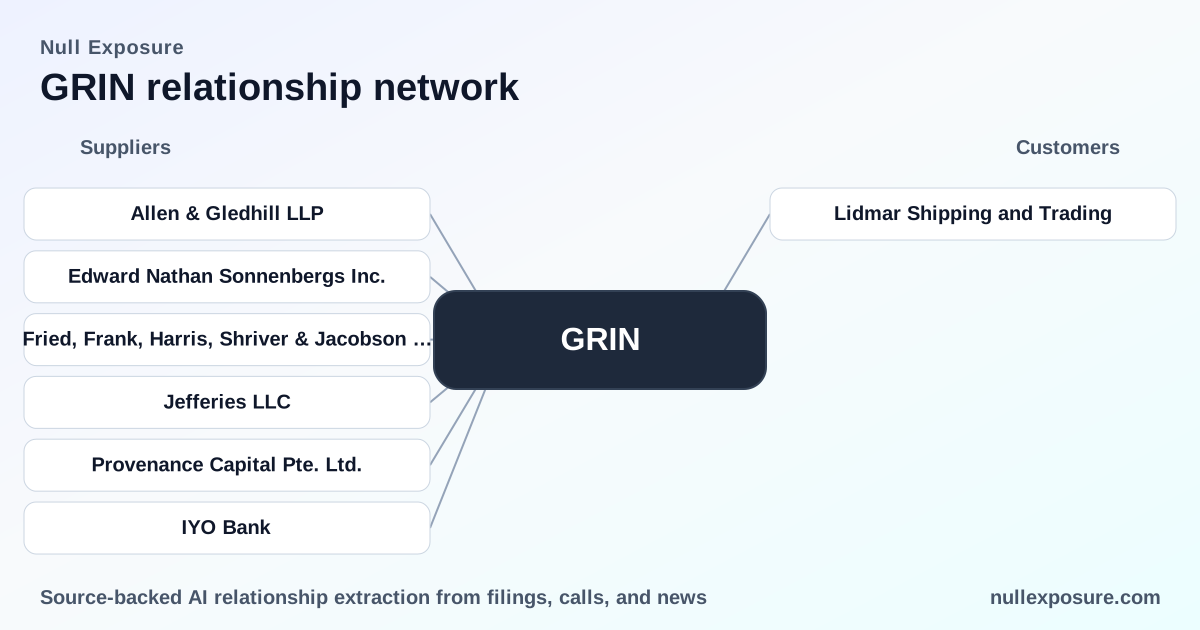
GRIN: What a Single Bulker Sale to Lidmar Reveals About Customer Dynamics and Cash Generation
Thesis: GRIN (Grindrod Shipping Holdings) operates as a shipowner and asset manager that monetizes through a mix of charter revenues, joint-venture ownership stakes and periodic asset disposals into the second-hand shipping market; transactions such as the sale of a 2009 handysize bulker to Lidmar constitute direct cash-generation events rather than recurring operating revenue. For investors, the balance between freight cashflow and opportunistic vessel sales frames valuation sensitivity to charter-rate cyclicality and asset-price liquidity. Learn more about monitoring counterparties at https://nullexposure.com/.
A one-off sale that reads like a financing tool
Grindrod’s disclosed transaction involved a joint venture in which GRIN held a majority stake selling the 2009-built handysize bulker IVS Triview to Greece’s Lidmar Shipping and Trading for $7.85m. This is a classic working-capital / balance-sheet management move: realize an older asset to extract cash rather than depend on volatile spot charters for liquidity. According to a March 9, 2026 report in Splash247, the vessel was delivered to Lidmar following the sale (Splash247, 2026).
Customer relationship: Lidmar Shipping and Trading
Lidmar purchased the 2009-built IVS Triview from a joint venture 51%-owned by Nasdaq-listed Grindrod for $7.85 million; the transaction was reported by Splash247 on March 9, 2026. This sale establishes Lidmar as a direct buyer of second-hand tonnage from GRIN-controlled interests and represents a straightforward commercial counterparty relationship in the asset-disposal channel (Splash247, 2026).
How to read this relationship in portfolio terms
- Transactional, not strategic: The Lidmar purchase is a point sale of an older vessel rather than evidence of a long-term commercial charter or a steady cargo flow relationship. That means revenue impact is one-off cash proceeds, not recurring contract revenue.
- Low customer concentration signal from a single data point: One recorded buyer does not indicate a concentrated or diversified customer base; however, the presence of third-party buyers like Lidmar shows accessible liquidity for older assets. Treat this as a signal that GRIN exercises balance-sheet flexibility through sales to established shipping firms.
- Counterparty credit is not a central dependency: The buyer is a private shipping operator; for investors, the critical factor is market liquidity for used tonnage rather than counterparty payment risk in an ongoing operating contract.
Company-level operating model characteristics informed by the evidence
Because explicit constraints data is not provided, present company-level signals based on observable behavior and the nature of the transaction:
- Contracting posture — transactional asset recycling: GRIN demonstrates a disposition to monetize vessels through sales, implying a transactional contracting style when it comes to fleet composition. This is consistent with owners who opportunistically time disposals against market conditions to preserve cash and reallocate capital.
- Concentration — indeterminate but likely dispersed: With a single recorded buyer, there is insufficient evidence to assert high customer concentration; the signal instead favors a dispersed buyer set in the second-hand market rather than dependence on a handful of charterers.
- Criticality — low ongoing criticality per buyer: Sales to third parties are not operationally critical in the same way as long-term charter contracts; therefore, counterparty criticality for liquidity generation is modest and episodic.
- Maturity and sophistication — corporate use of JV structures and secondary markets: GRIN’s use of joint ventures for vessel ownership and subsequent sale through that JV points to a mature capital-allocation toolkit that balances equity positions with asset-light or asset-rotation strategies.
Risk and opportunity: what this relationship implies for investors
- Risk — non-recurring cash flow profile: Relying on asset sales for cash introduces volatility; earnings and free cash flow will reflect spot transaction timing rather than sustainable operating margins.
- Opportunity — asset-price arbitrage and capital recycling upside: When GRIN times sales advantageously, shareholders capture value from asset-price recovery cycles without needing proportional increases in charter rates.
- Governance and JV complexity: Sales via majority-owned joint ventures require transparency around proceeds allocation and balance-sheet treatment; investors should monitor disclosures for clarity on JV accounting and cash remittance.
- Market liquidity dependency: The ability to execute similar sales depends on demand from trade buyers such as Lidmar and prevailing market sentiment for older tonnage.
Tactical monitoring checklist for analysts and operators
- Track announced disposals and the identity of buyers to assess whether GRIN is consistently able to tap a reliable buyer base.
- Watch JV disclosures: clear reporting on proceeds, ownership stakes, and distribution mechanics is essential to judge the economic benefit realized by GRIN shareholders.
- Follow used-ship price indices and regional buyer activity (e.g., Greek and Chinese operators) to anticipate windows for profitable asset recycling.
For ongoing coverage and structured counterparty intelligence, visit https://nullexposure.com/.
Bottom line: constrained exposure, but value in flexibility
The Lidmar transaction is evidence of GRIN’s active balance-sheet management—using joint-venture positions to dispose of older tonnage and convert illiquid assets into cash. For investors, this translates into a two-part thesis: operating cash flow from freight underpins baseline value, while periodic asset sales like the IVS Triview transaction provide discretionary uplift. Monitor the frequency of such disposals, JV transparency and the profile of buyers to convert this one-off relationship signal into a forward-looking assessment of GRIN’s liquidity and capital allocation discipline.
Sources: Splash247 report on Grindrod’s sale of IVS Triview to Lidmar Shipping and Trading, March 9, 2026.