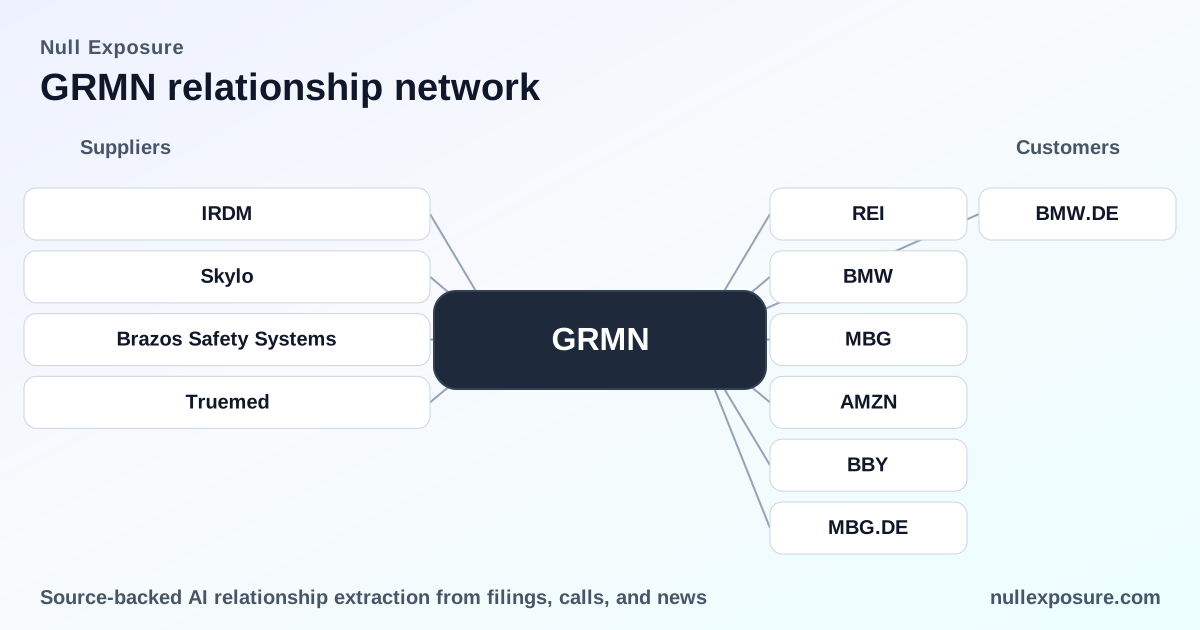
Garmin (GRMN): Customer Map and Commercial Thesis
Garmin monetizes through a hybrid hardware-plus-services model: point-of-sale device revenue across consumer, marine, aviation and automotive channels, recurring subscriptions for connected services, and high-value OEM programs where Garmin functions as a Tier‑1 supplier. The company pairs durable gross margins and strong cash conversion with geographically diversified retail and OEM distribution, generating $7.46B in trailing twelve‑month revenue and operating margin around 24.6%, making customer mix and program ramps the primary drivers of near‑term revenue volatility and medium‑term upside.
Check core relationship intelligence at https://nullexposure.com/ for deeper tracking and alerts.
How Garmin sells — the operating model investors need to understand
Garmin’s commercial model combines two distinct contracting postures: spot, point‑in‑time product sales for most retail and reseller transactions, and subscription contracts for connected services. Garmin’s public filings state that a large majority of sales are recognized at shipment when title transfers, while the company also explicitly offers subscriptions for connected services sold through garmin.com and its channel partners. That duality means revenue stability is a function of both hardware cycles and subscription adoption.
Geographically, Garmin operates globally with meaningful regional segmentation — North America, EMEA and APAC — run through distinct subsidiaries that handle sales, distribution and manufacturing responsibilities. Garmin is simultaneously a manufacturer, an OEM supplier (seller/engineer of domain controllers and infotainment modules) and a supplier to distributors/resellers, which creates layered exposure to retail channel health and a smaller number of high‑volume OEM program outcomes.
Operational characteristics that matter for investors:
- Concentration and criticality: Auto OEM programs are high-volume but lumpy; aviation and marine OEM wins are durable but specific. Success or end‑of‑life on a handful of domain‑controller programs materially affects Auto OEM segment results.
- Maturity and ramp profile: Several automotive programs have peaked (creating near‑term headwinds) while new Mercedes‑Benz ramps are expected to drive 2027 volumes — this creates a profile of alternating legacy declines and new program growth.
- Channel mix risk: Large retail partners and e‑commerce channels accelerate distribution but keep most sales point‑in‑time rather than recurring.
Customer relationships you should track (concise, source‑backed)
Below are every customer relationship identified in the reviewed coverage, with a plain‑English line on each and a source citation.
- REI — Garmin products are widely sold in specialty running shops and outdoor retailers such as REI in the U.S., reinforcing Garmin’s retail footprint in outdoors and fitness channels. (Ad‑Hoc News overview, Mar 9, 2026)
- Mercedes‑Benz — Garmin is engaged in a large automotive program with Mercedes‑Benz that will be broadly applied across passenger car models with significant volumes ramping in 2027. (Earnings‑call transcript, InsiderMonkey, Q4 2025)
- MBG — Coverage references Garmin’s Mercedes program using the MBG ticker variant, describing it as a large-scale domain‑controller engagement that underpins Auto OEM growth expectations. (Finterra/FinancialContent, Mar 6, 2026)
- BMW — BMW is a material Auto OEM customer where Garmin supplies domain controllers and infotainment products; management reports BMW volumes have peaked and certain legacy programs are near end‑of‑life. (InsiderMonkey transcript & Finterra analysis, Q4 2025 / Mar 6, 2026)
- MBG (duplicate entry) — Multiple outlets repeat the Mercedes‑Benz program commentary, underscoring cross‑source confirmation of the 2027 volume ramp. (Finterra/FinancialContent, Mar 6, 2026)
- Amazon — Garmin’s consumer products are distributed through major e‑commerce channels including Amazon, supporting broad retail availability and direct channel competition. (Ad‑Hoc News overview, Mar 9, 2026)
- BBY — Best Buy is cited as a significant U.S. retail partner carrying Garmin hardware across consumer electronics categories. (Ad‑Hoc News overview, Mar 9, 2026)
- Best Buy (duplicate) — Additional coverage reiterates Best Buy’s role as a national retailer for Garmin products in the U.S. (Ad‑Hoc News overview, Mar 9, 2026)
- Daher — Daher selected Garmin’s G3000 PRIME avionics suite for the new TBM 980 single‑engine turboprop, illustrating Garmin’s continued strength in OEM avionics. (Earnings‑call transcript, InsiderMonkey, Q1 2026)
- VEEE — Twin Vee PowerCats’ Adventure Series and other marine OEMs plan large Garmin multifunction displays as integrated entertainment and navigation screens, showing marine OEM demand. (Newswire release and Bitget coverage, Mar–May 2026)
- VEEE (duplicate variant) — Additional press items repeat Twin Vee/Adventure Series references to Garmin displays in the new model lines. (Bitget, Mar 10 & Mar 10, 2026)
- WGO — Chris‑Craft and other boatbuilders integrate Garmin ultrawide helm displays (Garmin 1543 XSV), signaling Garmin’s embedded marine electronics footprint. (GlobeNewswire and Bitget, Feb–May 2026)
- WGO (duplicate) — Multiple notices highlight the same Chris‑Craft integration and feature set, confirming marine OEM adoption. (Bitget & GlobeNewswire, Mar–May 2026)
- Textron Aviation Inc. — Textron announced updates for Cessna piston fleet featuring the Garmin G1000 NXi System Release 7 avionics upgrade, confirming continued OEM avionics business. (Textron investor release, 2026)
- NXPL — A FY2024 filing from a satellite reseller (NXPL) notes competitive dynamics for satellite communications services (Iridium, Inmarsat, Starlink), a segment where Garmin partners and competes via connected services; this is relevant to Garmin’s satellite and connectivity positioning. (NXPL 10‑K excerpt, FY2024)
- Truemed — Truemed is referenced as a partner in the Connect+ conversion and HSA/FSA purchase flows, indicating a growing DTC health‑spend channel for Garmin wearables and services. (Tikr blog, May 3, 2026)
Each entry above links back to primary press and transcription sources cited in the coverage snapshots reviewed; the most consequential customer narratives are the BMW peak and the Mercedes‑Benz ramp into 2027.
What the relationships imply for revenue and risk
- Auto OEM is a lever, not a steady base: OEM programs produce large, lumpy revenue buckets. Garmin’s management signaled BMW volumes have peaked while Mercedes‑Benz is scheduled to ramp — this explains the near‑term Auto OEM variability. (InsiderMonkey/Q1‑Q4 2025–2026 transcripts; Finterra)
- Retail ubiquity reduces demand concentration but keeps sales mostly point‑in‑time: Being sold through Amazon, Best Buy and REI broadens reach but preserves hardware timing risk because most retail sales are recognized at shipment. (Ad‑Hoc News; company filings)
- Aviation and marine OEMs deliver durable, higher‑margin aftermarket relationships: Integrations with Daher, Textron and Chris‑Craft support sustained avionics and marine revenue streams beyond consumer cycles. (InsiderMonkey, Textron release, GlobeNewswire)
- Subscription adoption is an incremental, stabilizing factor: Garmin’s connected services subscriptions are an explicit part of monetization and moderate hardware cyclicality as adoption grows. (Company filing excerpts on subscriptions)
Bottom line for investors
Garmin’s model is diversified across channels, but outcomes hinge on automotive program timing and retail hardware cycles. The Mercedes‑Benz ramp scheduled for 2027 constitutes the largest identifiable upside in the near term, while BMW legacy declines explain recent Auto OEM softness. Monitor OEM program milestones and Connect+ subscription conversion metrics to gauge whether hardware cyclicality is transitioning to more recurring revenue.
Explore ongoing customer signals, program‑level alerts, and source‑level citations at https://nullexposure.com/ to keep these dynamics under continuous surveillance.