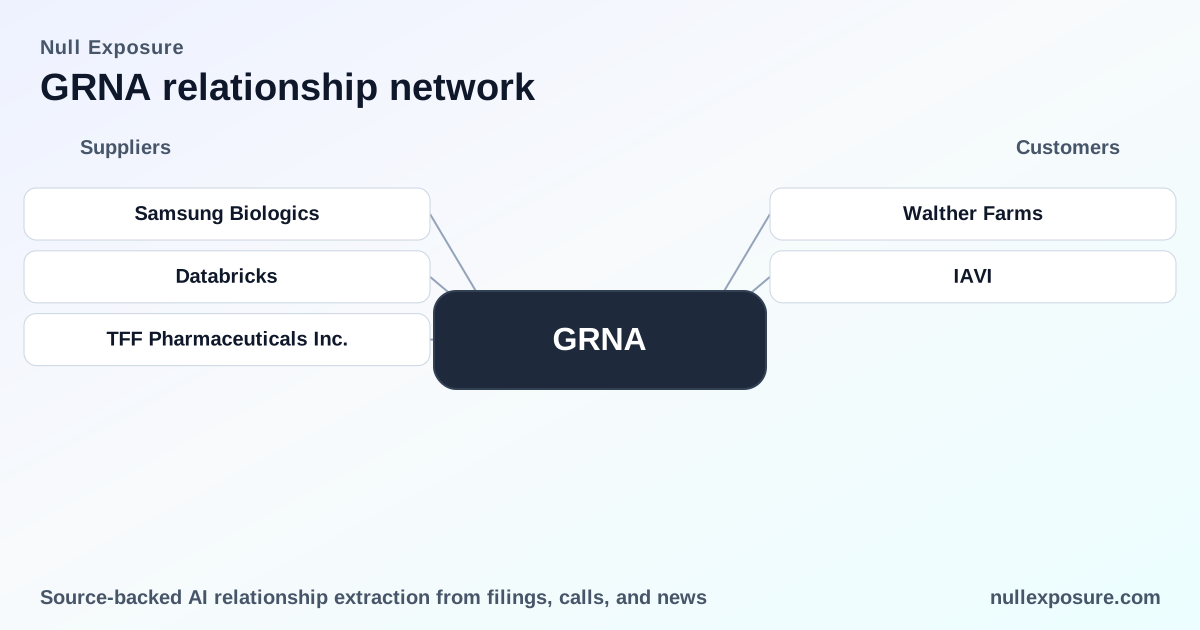
How GreenLight Biosciences (GRNA) monetizes through strategic customer partnerships
GreenLight Biosciences builds and commercializes RNA-based solutions across agriculture and human health, capturing value through direct product sales, multi-target licensing agreements, and targeted partnerships with manufacturers and non-profit research organizations. The company’s revenue model blends commercial crop protection deployments with strategic licensing to large vaccine manufacturers and clinical collaborations that de-risk downstream manufacturing commitments, creating multiple monetization levers for investors focused on commercialization velocity and partner-backed scale.
For an investor brief with ongoing updates, visit https://nullexposure.com/.
Why these customer relationships matter to an investor
GreenLight’s listed customer relationships demonstrate three commercial levers that drive valuation: commercial agricultural revenue, licensing income and royalty potential, and clinical-stage validation and manufacturing agreements that unlock public health markets. These relationships provide insight into the company’s contracting posture (partner-driven rather than single-customer captive), concentration (diversified across ag, vaccine manufacturers, and non-profits), and commercial maturity (moving from trials to field deployments).
There are no explicit contractual constraints included in the supplied materials; that absence itself is a company-level signal indicating that the dataset contains public partnership announcements and press releases rather than detailed, restrictive supply or exclusivity terms. Investors should therefore treat the relationship descriptions as commercial milestones and go-to-market signals, not as definitive indicators of revenue guarantees or exclusivity.
Customer relationships: what the filings and press releases reveal
Walther Farms — commercial agricultural deployment
GreenLight’s Calantha product is actively incorporated into crop protection rotations at Walther Farms to preserve biodiversity and control pesticide‑resistant Colorado potato beetles, signaling a field-level commercial deployment of its RNA crop protection technology. According to a TechBrew story from FY2025, Walther Farms selected Calantha specifically to manage resistance issues while supporting ecological diversity.
Takeaway: this is a direct commercial use case and an early indication of product-market fit in large-scale agriculture.
Serum Institute of India — licensing for mRNA accessibility
GreenLight entered a multi-target licensing agreement with the Serum Institute of India to accelerate access to mRNA products in emerging markets, positioning GreenLight’s platform for broad geographic scale through a high-volume contract manufacturer and distributor. The company announced the arrangement in March 2022 and highlighted it in a FY2022 investor release covered by Investing News.
Takeaway: licensing to a high-capacity vaccine manufacturer converts platform R&D into potential recurring royalty and milestone revenue while enabling low-cost regional scale.
IAVI — clinical partnership and trial supply
GreenLight partnered with the International AIDS Vaccine Initiative (IAVI) to provide a vaccine candidate for a Phase I trial in Africa and to prepare for large-scale manufacturing, demonstrating GreenLight’s engagement in clinical-stage development and public-health partnerships. IAVI documented the collaboration in a press release describing the Phase I trial activities in FY2021.
Takeaway: collaboration with a respected non-profit research organization de-risks clinical progress and signals readiness to transition from candidate development to scalable manufacturing.
How these relationships shape operating constraints and commercial posture
Because the supplied information contains partnership announcements and press releases rather than contractual attachments, there are no explicit constraints provided for GRNA’s customer relationships in this data. Treat that as a company-level signal: the commercial narrative emphasizes partnership breadth and strategic licensing rather than revealing restrictive exclusivity, supplier concentration, or onerous commercial terms.
From an operating-model standpoint:
- Contracting posture: GreenLight operates as a technology licensor and product supplier, favoring partnerships that scale distribution (licensing to Serum Institute) and validate field efficacy (Walther Farms), rather than relying on captive manufacturing alone.
- Customer concentration: available evidence shows deliberate diversification across agriculture, vaccines, and non-profit research channels, reducing single-customer concentration risk in the observed relationships.
- Criticality and maturity: relationships span commercial deployment (Walther Farms), manufacturing scale partnerships (Serum Institute), and clinical validation (IAVI), signaling a mixed portfolio of near-term revenue opportunities and longer-term clinical value drivers.
- Negotiation leverage: licensing deals with large manufacturers and collaborations with NGOs typically enhance GreenLight’s bargaining power to extract royalties and milestones, while commercial farm deployments create reference cases that support broader ag adoption.
Investor implications — revenue, risk, and upside
- Revenue diversification: the combination of direct product sales in agriculture and licensing to a major vaccine manufacturer creates dual revenue pathways, improving resilience against sector-specific headwinds. Licensing deals can produce high-margin recurring revenue; field deployments validate commercial demand.
- Commercial risk: absence of disclosed contract terms leaves investors exposed to unknowns around exclusivity, pricing, and minimum purchase commitments; treat partner announcements as proof points rather than guaranteed revenue streams.
- Regulatory and execution risk: clinical trials and scaling vaccine manufacturing introduce regulatory timelines and capital intensity; successful scale-up with a partner like Serum Institute materially increases commercialization probability and valuation multiple.
- Market expansion: field validation at large farms accelerates adoption in crop protection, while licensing to high-capacity manufacturers opens emerging-market channels and potential high-volume revenue.
For deeper coverage of partner-level impacts on valuation and contractual nuances, see the analysis hub at https://nullexposure.com/.
Closing view
GreenLight’s customer relationships reflect a coherent commercialization strategy: use early field deployments to demonstrate agronomic efficacy, convert platform technology into licensing deals with large manufacturers, and pursue clinical collaborations for human-health validation. Each relationship contributes a distinct financial vector—direct sales, licensing royalties, and clinical de-risking—that together justify an investor focus on partnership execution, manufacturing scale milestones, and published commercial terms as critical catalysts for re-rating. Investors should prioritize monitoring announced milestones, commercialization rollouts, and any future disclosures that detail contract economics and exclusivity provisions.