Greenpro Capital (GRNQ): Customer relationships that shape a small-cap services-and-digital play
Greenpro Capital operates as a cross-border business solutions and corporate advisory group that monetizes through a three-pronged model: fee-based services for small and mid‑market corporates, digital business revenue from its Green‑X digital asset exchange, and real‑estate rental/trading income. For investors, revenue visibility is driven by recurring service fees and platform activity, while strategic upside comes from nascent digital and incubation initiatives that can re‑rate growth if adoption accelerates. (See company filings for FY2024 metrics and segment descriptions.)
If you want a fast company-level snapshot before reading further, visit the firm homepage at https://nullexposure.com/.
How the customer base underpins the business model
Greenpro’s customer relationships are concentrated in the small‑ and mid‑market corporate segment across APAC, with a stated global client footprint that includes Hong Kong, China, Malaysia, Singapore and selected Western markets. The company reported Revenue (TTM) of $2,073,600 and Gross Profit of $1,666,200, indicating a high gross margin on business services and platform revenues but with negative bottom‑line profitability (Diluted EPS TTM of -$0.35). Market capitalization is roughly $43.7m, with insiders owning a meaningful share (~22.6%) and institutions holding a small fraction (~0.64%), a governance and liquidity profile investors should factor into any thesis.
Greenpro’s operating posture is service‑provider centric — it sells packaged advisory and outsourcing solutions to SMEs and mid‑market clients and runs a regulated digital exchange under Green‑X. The combination creates both stability (recurring advisory contracts) and optionality (platform network effects) in its monetization mix. According to the FY2024 Form 10‑K, the company operates three reportable segments: service business, digital business and real estate business.
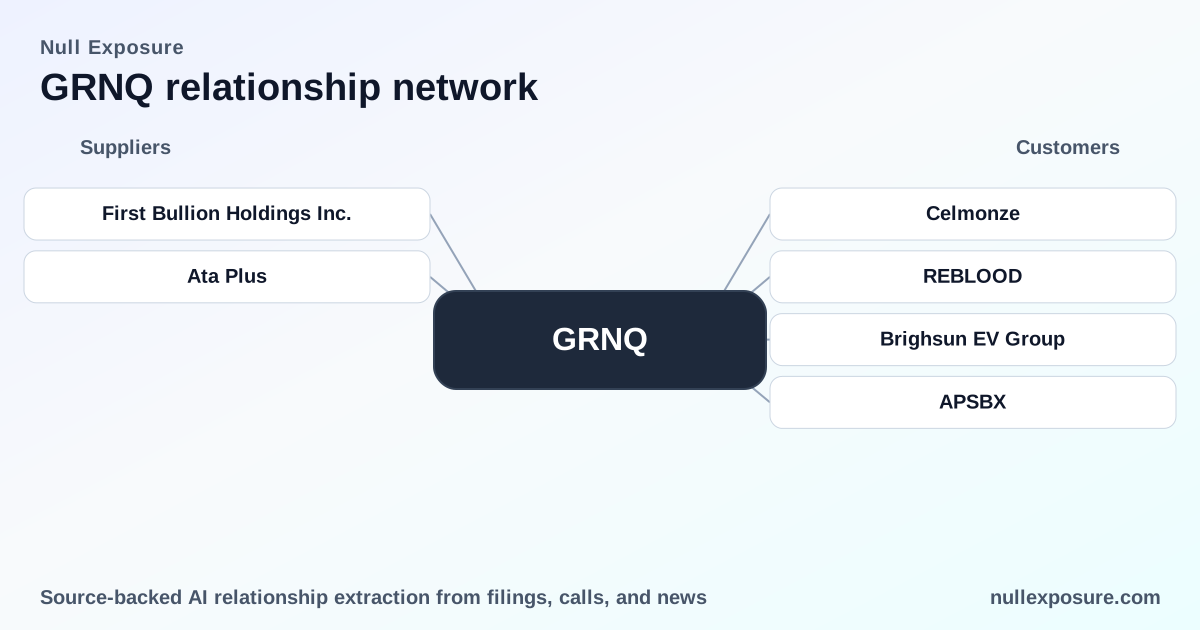
Named customer and related‑party relationships — what each one means
Below I cover every customer/related party referenced in Greenpro’s public results. Each entry is a concise, plain‑English takeaway with the underlying source.
Celmonze
Greenpro recorded deferred revenue of $81,700 from Celmonze as of December 31, 2023, indicating a contractual advance or prepayment relationship between the parties. According to Greenpro’s FY2024 Form 10‑K, this amount appears in the company’s related‑party deferred revenue disclosures.
REBLOOD
Deferred revenue includes $60,000 from REBLOOD, signaling another related‑party customer that has pre‑funded services or subscription obligations with Greenpro. This figure is disclosed in the company’s FY2024 Form 10‑K.
Brighsun EV Group
A March 2024 media account in Carz Malaysia reported that Brighsun EV Group — an Australian EV firm — is being incubated by Malaysia‑based Greenpro Capital, linking the company to automotive electrification initiatives beyond its core services business and suggesting non‑traditional incubation activity that could diversify future revenues. The Carz Malaysia story cites the connection between Brighsun EV Group and Greenpro in coverage of an EV prototype sighting.
APSB
Greenpro’s FY2024 Form 10‑K discloses deferred revenue of $15,800 from APSB, recorded among related‑party balances as of December 31, 2023, which indicates another small but contractually recognized customer advance.
APSBX
APSBX appears as an inferred symbol/alias in the same Form 10‑K disclosure and is associated with the $15,800 related‑party deferred revenue entry, essentially echoing the APSB disclosure and suggesting a single counterparty referenced under two identifiers in filings. The source is Greenpro’s FY2024 Form 10‑K.
Constraints and operating signals investors should price into a thesis
Greenpro’s filings and disclosures provide a set of company‑level operational signals that matter for credit and equity investors evaluating customer risk and business durability:
- Client mix and contracting posture: The company positions itself as a service provider to small business and mid‑market clients across APAC, delivering packaged business solutions and accounting outsourcing services; this creates many small revenue relationships rather than a small number of large, captive customers (evidence in the FY2024 disclosures).
- Geographic focus but global reach: While revenues come from a global set of clients, the operational emphasis is APAC (Hong Kong, China, Malaysia, Singapore), which concentrates regulatory and market risk regionally even as it services international clients.
- Segment diversification with asymmetric maturity: Greenpro reports three segments — services (core, mature), digital (platform, earlier stage), and real estate (other, transactional/rental). Services generate recurring fee revenue today, while digital trading and incubations are the growth levers with longer time‑to‑scale.
- Relationship role and stage: Disclosures characterize the company predominantly as a seller/service provider and indicate the relationships are active, with recorded service revenues in FY2024 and FY2023.
- Concentration and governance signals: Insider ownership of ~22.6% and institutional ownership below 1% imply insider influence and modest institutional liquidity, which affects exit liquidity and governance dynamics for investors.
- Materiality of related‑party deferred revenue: The named related‑party deferred revenue items (Celmonze $81,700; REBLOOD $60,000; APSB $15,800) total roughly $157,500. Against FY‑TTM revenue of $2,073,600, these deferred amounts represent a modest portion of top line (~7.6%), signalling limited financial dependence on any single related‑party prepayment pool as of the disclosed period.
Risks, opportunities and a concise investment takeaway
- Opportunity: Greenpro’s services cash flow provides a base while digital platform exposure and incubation bets (e.g., Brighsun EV Group) can deliver asymmetric upside if platform adoption or incubation exits occur.
- Risk: The business is SMB‑focused and regionally concentrated, with negative reported profitability and limited institutional investor oversight; these factors increase execution risk on digital and non‑core ventures. Related‑party deferred revenue is small but indicates some intra‑group commercial activity that investors should monitor for transparency and governance.
- Balance: For investors, Greenpro offers a small‑cap, high‑optionality thesis: stable service revenues today and speculative upside from digital exchange activity and incubations. Evaluate management’s capital allocation between sustaining services and higher‑risk growth bets.
If you want deeper, cross‑document relationship tracing or to monitor updates to these counterparties, see the main site: https://nullexposure.com/.
For portfolio decision making, prioritize monitoring (1) quarterly segment revenue trends, (2) Green‑X platform transaction volumes and regulatory developments, and (3) related‑party activity disclosures in future filings. These items will drive whether the company’s optionality converts into measurable value or remains a remote possibility.