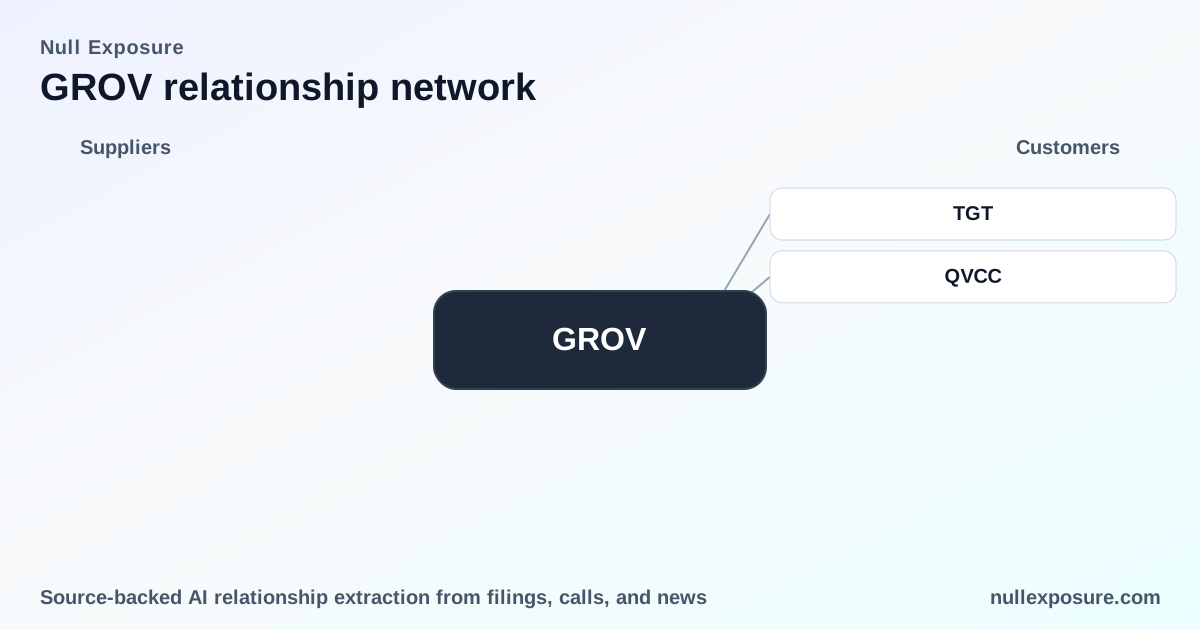
GROV: Customer relationships that shape Grove Collaborative’s distribution story
Grove Collaborative operates a direct-to-consumer retailer for sustainable household and personal-care products and monetizes primarily through product sales to individual consumers via a subscription-first DTC platform, supplemented by non-subscription purchases and third‑party retail channels. Its growth strategy blends recurring revenue from a “subscribe-and-save” customer base with channel expansion—select big‑box and partner sales—to diversify reach and offset slower online demand. For a concise investor view of customer counterparty flows and strategic partners, visit https://nullexposure.com/.
Executive takeaway: distribution-first, subscription-driven, US‑centric
Grove’s core economics are driven by recurring DTC subscribers, higher gross margins on owned brands, and episodic revenue from retail and third‑party channels that reduce reliance on pure online traffic. The company’s reported financials show contracted operating losses but stable gross profit, signaling that channel mix and customer retention are the critical levers for near‑term valuation recovery.
Relationship-by-relationship breakdown
Target — national big‑box placement expands physical reach
Grove entered brick‑and‑mortar distribution with Target in 2021 and subsequently released exclusive scents and curated assortments to Target customers, using the retailer to make its sustainable home‑care brands more accessible nationwide. This retail partnership is repeatedly noted in reporting on Grove’s move into physical stores. According to CityBiz (March 2026) and Retail Dive coverage (May 2026), Target carried Grove products and exclusive scent offerings as part of that expansion strategy (CityBiz, Mar 2026; Retail Dive, May 2026).
QVC — legacy channel retained through the 8Greens acquisition
QVC contributed $2.9 million of revenue tied to an 8Greens “Today’s Special Value” program after Grove acquired 8Greens in Q1, reflecting that Grove inherited an existing third‑party sales channel that continues to generate incremental sales. The contribution was disclosed on Grove’s Q4 2025 earnings call and summarized in MarketBeat’s March 2026 coverage of the quarter (Grove Q4 2025 earnings call; MarketBeat, Mar 2026).
JA / Janus Henderson allocation — a name collision in the coverage set
An AlternativesWatch article described a $1 billion on‑chain allocation to the Janus Henderson Anemoy AAA CLO Strategy completed via a DeFi protocol named Grove; this report concerns a separate institutional credit infrastructure protocol and not Grove Collaborative’s retail operations. The piece is relevant to signal‑matching exercises but does not reflect a commercial customer relationship for Grove Collaborative (AlternativesWatch, Jun 2025).
What the relationship set implies about Grove’s operating model
Grove’s relationship portfolio communicates a hybrid distribution posture: direct-to-consumer subscription economics at the center, augmented by selective retail and broadcast/TV reseller channels. From the company disclosures and the relationships above we draw the following operating signals:
- Subscription-first contracting posture. Grove offers a flexible monthly “subscribe‑and‑save” service and non‑subscription options, which creates recurring cashflow potential but also requires ongoing retention investment and fulfillment scalability.
- Counterparties are primarily individuals. The company operates a DTC website and mobile app serving individual consumers, which implies marketing and customer‑service cost concentration on small-ticket repeat buyers rather than a small set of large B2B customers.
- Geographic concentration in North America. Grove reports all assets and revenues within the United States, so regulatory, shipping, or demand shocks in the U.S. materially affect top‑line performance.
- Dual buyer/seller role. Grove both sells its Grove‑owned brands and partners with other natural/mission‑based CPG brands, which diversifies SKU economics but increases supply‑chain complexity and margin management responsibilities.
- Active customer metric matters. Grove counts “DTC Active Customers” as those who purchased within a trailing 364‑day window, making the active base level a central KPI for revenue predictability.
- Distribution as a primary segment. Management describes DTC and related retail channels as the operational segment driving revenue; channel mix shifts will therefore change gross margins and fulfillment costs.
Investment implications and risk mapping
- Channel diversification is a partial hedge. Target and QVC relationships reduce dependency on Grove’s website traffic, but these channels are complementary rather than core; they do not yet replace subscription economics.
- Subscription retention is the operational lever. Because the business model emphasizes recurring shipments, churn control is the single most material operational KPI for revenue stability and cashflow improvement.
- Geographic concentration increases macro sensitivity. With all revenues generated in the U.S., Grove’s top line will be sensitive to domestic consumer spending cycles and logistics cost inflation.
- Small market cap and negative margins create execution risk. Grove’s market capitalization and trailing financials show compressed valuation and operating losses; channel execution and cost discipline must improve before valuation expansion is sustainable.
- Name collisions in media coverage can confuse signal tracking. The AlternativesWatch item referencing a DeFi protocol called Grove demonstrates the importance of entity disambiguation when interpreting press signals tied to the “Grove” name.
Bottom line for investors
Grove Collaborative is a subscription‑led retail business that depends on active consumer engagement and selective third‑party channels to grow revenue. The Target partnership provides valuable mass‑market distribution, and QVC contributes episodic programmatic revenue through the 8Greens asset. However, U.S.-only revenue concentration and negative operating margins keep execution risk high until retention and unit economics improve.
For further analysis of Grove’s customer relationships and channel exposure, explore NullExposure’s customer signal coverage at https://nullexposure.com/.
Bold takeaways
- Subscription customers drive recurring revenue; retention equals valuation leverage.
- Target and QVC provide important but secondary revenue streams.
- All revenues are U.S.-based—domestic macro trends materially affect growth prospects.
Sources referenced in-line: CityBiz (Mar 2026) and Retail Dive (May 2026) on Target distribution; Grove’s Q4 2025 earnings call and MarketBeat coverage (Mar 2026) on QVC/8Greens revenue; AlternativesWatch (Jun 2025) on an unrelated DeFi protocol named Grove.