GROW (US Global Investors): Who pays the bills and why that matters
US Global Investors (ticker GROW) operates as a boutique investment manager that earns fees by providing investment advisory and administrative services to proprietary mutual funds and a small roster of exchange-traded funds. The company monetizes through management and administrative fees tied to assets under management (AUM), with revenue deeply influenced by the performance and flows of a handful of in-house ETFs and funds that it advises.
For a compact, investor-focused view of client exposures and contractual signals, see Null Exposure’s customer intelligence hub: https://nullexposure.com/
The client roster you need to know about
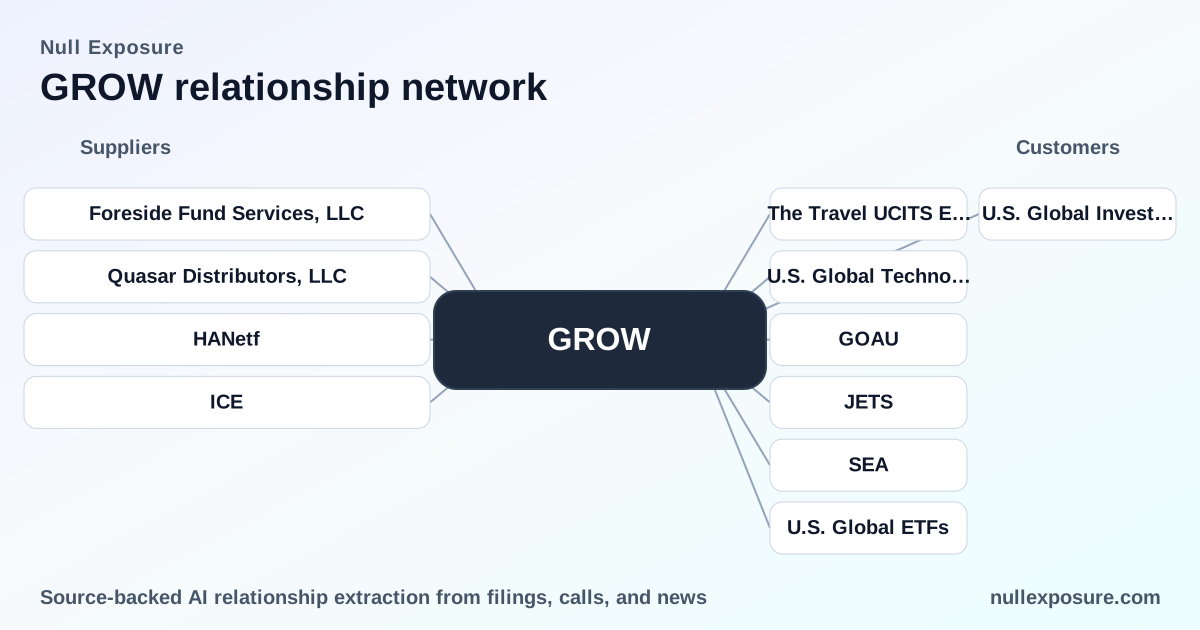
Below I list every customer relationship surfaced in public filings and press coverage, with a short plain‑English description and source note for each.
U.S. Global Jets ETF (JETS)
US Global Investors is the investment adviser to the U.S. Global Jets ETF, and JETS represents the single largest concentration of assets and revenue for the firm. According to the FY2025 Form 10‑K, JETS accounted for a substantial share of AUM and drove roughly 69% of operating revenues in FY2025. (FY2025 Form 10‑K, filed Feb 2026)
U.S. Global GO GOLD and Precious Metal Miners ETF (GOAU)
The company serves as investment adviser to GOAU, a gold- and mining-focused ETF that contributes to the firm’s income stream and dividend policy discussions. This relationship is referenced in both the FY2025 10‑K and company press materials. (FY2025 Form 10‑K; company press release, Mar 2026)
U.S. Global Sea to Sky Cargo ETF (SEA)
US Global Investors advises the Sea to Sky Cargo ETF (SEA), one of the quartet of U.S.-based ETFs named in the firm’s advisory roster and filings. The advisory role for SEA is documented in the FY2025 Form 10‑K. (FY2025 Form 10‑K, filed Feb 2026)
U.S. Global Technology and Aerospace & Defense ETF (WAR)
The FY2025 Form 10‑K lists the Technology and Aerospace & Defense ETF (WAR) among the company’s U.S.-based ETF clients; the firm provides advisory services that feed its management fee base. (FY2025 Form 10‑K, filed Feb 2026)
The Travel UCITS ETF (TRIP)
US Global Investors also acts as investment advisor to one Europe‑based ETF, The Travel UCITS ETF (ticker TRIP), confirming a modest EMEA footprint through a single UCITS vehicle. (FY2025 Form 10‑K, filed Feb 2026)
U.S. Global Investors Funds (USGIF)
The company provides investment management and administrative services to its family of mutual funds, collectively referred to as U.S. Global Investors Funds; these proprietary funds are a core source of recurring management and administrative revenues. (Company Q2 FY2026 release, Sahm Capital, Feb 2026)
U.S. Global ETFs (umbrella)
Beyond specific tickers, public statements and investor releases refer to “U.S. Global ETFs” collectively—an acknowledgement that the company’s ETF platform is a distinct client group and revenue center in its own right. (Investor releases and company resource pages, FY2025–FY2026)
For full client signal context and ongoing updates, visit Null Exposure: https://nullexposure.com/
How these relationships shape the operating model
The customer set and the firm’s disclosures reveal a compact, service-oriented business model with a few defining characteristics:
- Contracting posture: short-term, renew‑able arrangements. Advisory contracts are governed by the Investment Company Act and, after an initial term, are subject to annual renewal and 60‑day termination provisions—meaning advisory revenue is legally required to be reviewed and renewed at least annually (company 10‑K language on advisory agreements).
- Revenue concentration is material and critical. Company filings quantify concentration: the U.S. Global Jets ETF drove 69% of average net assets and roughly the same share of operating revenues in FY2025, establishing JETS as a critical single counterparty for top-line performance (FY2025 Form 10‑K).
- Service-provider posture, not client ownership. The firm’s role is explicitly advisory and administrative; revenues derive from fees for services, not transactional flow or custody spreads, per management discussion in filings.
- Maturity and stage: active relationships with near-term renewals. The 10‑K notes that advisory agreements for the U.S.-based ETFs have been renewed through July 2026 and that the advisory agreement with USGIF is subject to annual review—indicating relationships are live and under regular governance review.
- Counterparty mix and geography. The client base combines individual and institutional investor channels through funds and ETFs; geographically the book is primarily North American (four U.S.-based ETFs) with a limited EMEA presence via the Travel UCITS ETF. This produces a concentrated yet technically global product footprint.
Investment implications and risk map
With the client roster and operating constraints in view, the investment case for GROW centers on a small, fee‑driven business where a few products determine outcomes.
- Concentration risk is the primary operational hazard. With nearly 70% of revenues tied to one ETF (JETS), any adverse performance, redemptions, or structural changes to that product would have outsized earnings and cash-flow implications. This is a top-tier risk for creditors and equity holders alike. (FY2025 Form 10‑K)
- Contract renewals create discrete event risk windows. Annual renewal mechanics mean governance votes or investor actions can produce short-term revenue volatility around renewal dates; management itself frames these contracts as subject to annual renewal under the Investment Company Act. (FY2025 Form 10‑K)
- Business model defensibility is service-centric but narrow. Advisory and administrative services are stable revenue drivers when AUM is sticky, but the firm’s scale (revenue TTM roughly $8.8 million) implies lower operating leverage and sensitivity to AUM swings. (Company metrics FY2025–FY2026)
- Geographic diversification is limited. The firm’s primary exposure is North America, with one European UCITS relationship; global ambitions exist but are modest in scope based on current disclosures. (FY2025 Form 10‑K)
Bottom line for investors and operators
US Global Investors is a fee-for-service manager whose economics are highly concentrated and renewal‑driven. That structure produces attractive upside when flagship ETFs outperform and retain assets, and equally concentrated downside when flows reverse or when governance events affect renewals. Active monitoring of JETS flows, advisory agreement renewal dates, and fund-level performance is essential to any risk-adjusted valuation or operational assessment.
For an actionable feed of customer-level signals and renewal windows, Null Exposure aggregates these relationship signals in investor-ready formats: https://nullexposure.com/