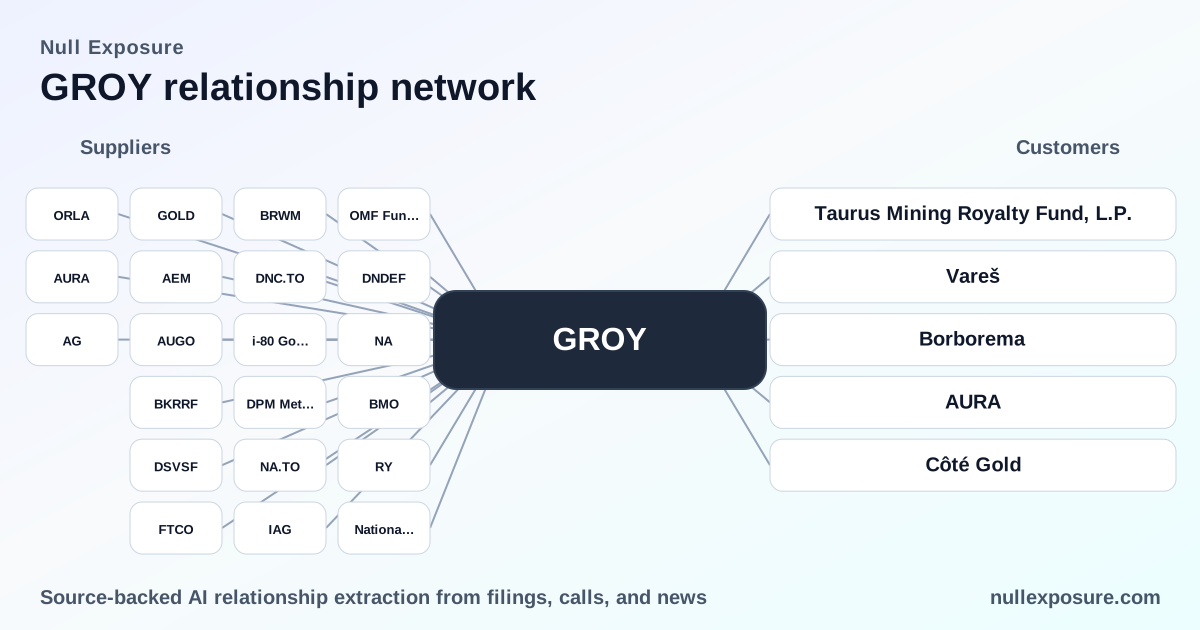
Gold Royalty (GROY): Customer Map and Commercial Implications for Investors
Gold Royalty Corp. operates as a royalty and streaming company that acquires production-linked cash flows across gold and copper assets and monetizes by collecting percentage-based royalties and commodity streams rather than running mines. The company’s revenue profile is driven by a mix of cash‑flowing royalties (Pedra Branca, Cozamin), near-term revenue contributors (Borborema, Vareš) and a pipeline of development-stage royalties that will convert optionality into recurring payments as partner operators advance projects. For a focused view of counterparty exposures and how they feed Gold Royalty’s top line, see the customer mapping at https://nullexposure.com/.
Investment thesis in one paragraph
Gold Royalty’s business model delivers asymmetric exposure to commodity cash flow: downside protection from not operating mines and upside from rising production and prices. The company monetizes by structuring NSRs, NPIs and streams that pay per unit of production, and it is scaling quickly via targeted acquisitions (including royalties on BHP’s Pedra Branca and the Borborema portfolio), which convert into near-term and medium-term revenue. The path to value is clear — grow the portfolio of cash-paying assets and let operating partners de‑risk projects; the investor question is whether project execution by operators and commodity pricing deliver the revenue trajectory priced into the stock.
For a deeper, investor-ready map of these customer relationships and how they influence balance-sheet capacity, visit https://nullexposure.com/.
Portfolio and revenue drivers: what matters
Gold Royalty’s revenues are concentrated among a handful of operators and assets that deliver either current cash or visible development optionality. Borborema and Vareš are cited as significant near‑term revenue contributors, while assets such as Côté Gold, Ren, South Railroad and Whistler provide medium‑term upside tied to operator milestones and permitting. The company’s contracting posture is classic royalty/stream: passive counterparty exposure but high dependency on operator execution, and the portfolio mixes mature, cash-flowing assets with development-stage royalties that have higher optionality and timing risk.
Full relationship inventory (FY2026 reporting / press mentions)
Below are every customer relationship mentioned in the collected results, with a concise plain‑English summary and source reference.
-
i-80 Gold Corp. (Granite Creek project, 10.0% NPI) — i‑80’s Granite Creek project is included as a 10% net proceeds interest (NPI) in Gold Royalty’s portfolio and was referenced in Gold Royalty’s FY2025/2026 reporting. Source: Investing News coverage of Gold Royalty’s FY2025 results (FY2026).
-
IAMGOLD Corporation (Côté Gold, 0.75% NSR, partial coverage) — Côté Gold is listed as a partially covered 0.75% NSR that contributes to Gold Royalty’s diversified revenue mix. Source: Investing News reporting on FY2025 operator results (FY2026).
-
Agnico Eagle Mines Limited (Canadian Malartic / Odyssey, 3.0% NSR, partial coverage) — Agnico Eagle’s Canadian Malartic/Odyssey appears as a 3.0% NSR exposure within Gold Royalty’s portfolio disclosures. Source: Investing News summary of FY2025 operator filings (FY2026).
-
U.S. GoldMining Inc. (Whistler project, 1.0% NSR with option to acquire additional 0.75% NSR) — Whistler is a development-stage project where Gold Royalty holds a 1.0% NSR and an option for additional coverage; the Whistler PEA was announced by the operator in early March 2026. Source: Investing News (Whistler PEA, March 2026).
-
Taurus Mining Royalty Fund, L.P. (participation in Borborema royalty acquisition) — Taurus elected to take a one‑half indirect economic interest in a Borborema royalty for US$22.5 million, reducing Gold Royalty’s cash outlay and sharing economic exposure. Source: Gold Royalty press reporting and Yahoo Finance (March 2026).
-
Capstone Copper Corp. (Cozamin mine, 1.0% NSR, partial coverage) — Cozamin is in the portfolio as a 1.0% NSR and is called out in operator guidance for copper production, making it a commodity‑diversifying asset for Gold Royalty. Source: Investing News operator guidance (FY2026).
-
Discovery Silver Corp. (Borden mine, 0.5% NSR, partial coverage) — Borden is included as a 0.5% NSR with operator statements targeting mill capacity restoration, representing optional upside if operator milestones are achieved. Source: Investing News (FY2026 results).
-
Barrick Mining Corporation (Ren project, 1.5% NSR and 3.5% NPI) — Ren is a multi‑interest exposure (NSR and NPI) with noted project capital spend and ongoing development, giving Gold Royalty a participation in Barrick‑operated development capital cycles. Source: Investing News MD&A summary for Barrick (FY2026).
-
BHP (Pedra Branca royalty, added exposure to a cash‑flowing mine) — Gold Royalty added a royalty on BHP’s producing Pedra Branca mine, giving the company direct exposure to a currently cash‑flowing copper asset. Source: Investing News and coverage in Simply Wall/St and Sahm Capital (FY2026).
-
Blackrock Silver Corp. (Tonopah West project, 3.0% NSR) — The Tonopah West permit progress is cited, and Gold Royalty holds a 3.0% NSR on that project, representing development‑stage upside. Source: Investing News (March 2026).
-
Orla Mining / Orla Mining Ltd. (South Railroad project, 0.44% NSR) — South Railroad is a development/feasibility project with a 0.44% NSR; Orla’s updated feasibility and pending permits are cited as catalysts. Source: Investing News (March 2, 2026).
-
Borborema (Borborema mine, 2.75% NSR) — Borborema is repeatedly called out as a near‑term revenue growth driver and operational focus following road relocation and ramp plans; Gold Royalty holds a 2.75% NSR on the asset. Source: Investing News and Intellectia financial summary (FY2026).
-
Côté Gold (listed as other significant revenue stream) — Côté Gold is specifically listed among “other significant revenue streams,” reinforcing its role in Gold Royalty’s multi‑asset revenue base. Source: Intellectia financial summary (FY2026).
-
Vareš (Vareš mine, 100% copper stream; cited as 29.2% of sales in one summary) — Vareš is a 100% copper stream with ongoing spot‑price payments and is called out as the single largest contributor to recent top‑line growth (approximately 29.2% of sales in one report). Source: Intellectia summary and DPM Metals reporting (FY2026).
-
Wallbridge Mining Company Ltd. (Fenelon gold project, 2.0% NSR) — Fenelon is in Gold Royalty’s portfolio as a 2.0% NSR; operator drilling and metallurgical programs are advancing supporting the royalty’s future cash potential. Source: Investing News (February 17, 2026).
-
Cozamin (royalty on copper at Cozamin) — Cozamin is called out again in investor call transcripts as a copper royalty that contributes to the company’s non‑gold cash flows. Source: Gold Royalty Q4 2025 earnings call transcript (Investing.com, FY2026).
-
Pedra Branca (royalty exposure) — Pedra Branca is referenced in the earnings call and multiple analyst pieces as a newly acquired royalty on a producing BHP asset and a meaningful diversification into copper cash flows. Source: Q4 2025 call transcript and Simply Wall/Sahm Capital (FY2026).
-
DPM Metals (Vareš operator updates on production ramp) — DPM Metals reported integration progress and a ramp plan to full production at Vareš by year‑end 2026; Gold Royalty’s stream benefits directly from that ramp. Source: DPM Metals FY2025 results (reported Feb 10, 2026).
-
BPM Metals (Virus mine restart cited as partner progress) — BPM Metals’ restart of the Virus mine is highlighted as an operator success that supports Gold Royalty’s partner‑operated upside. Source: The Globe and Mail coverage of Gold Royalty’s multi‑year growth path (FY2026).
-
Aura Minerals / Aura Minerals Inc. (Borborema operator activities and expansion studies) — Aura’s road relocation at Borborema and reported production increases are cited as direct supports to Gold Royalty’s near‑term revenue ramp from that asset. Source: Investing News and Simply Wall summaries (FY2026).
-
Ora Minerals (road relocation and expansion optionality) — Ora’s infrastructure progress clears the way for expansion at its partner‑operated project noted as a portfolio catalyst. Source: The Globe and Mail / Gold Royalty press release summary (FY2026).
-
BlackRock Silver / BlackRock Silver (permit and ramp targets) — BlackRock Silver’s permitting progress at its project is listed as a medium‑term catalyst for Gold Royalty’s royalty on that asset. Source: The Globe and Mail (FY2026).
-
AURA (duplicate operator references to Aura Minerals and Borborema ramp) — Multiple investor pieces reiterate Aura’s operational progress at Borborema and its relevance to Gold Royalty’s revenue outlook. Source: Simply Wall and related commentary (FY2026).
-
Taurus Mining Royalty Fund (several bulletins confirming participation in Borborema deal) — Multiple press items corroborate Taurus’ election to acquire half the economic interest in the Borborema royalty for US$22.5 million under a cooperation agreement. Source: IRW‑Press and Gold Royalty press/Yahoo Finance (March 2026).
Note: several names appear multiple times in the results set because different press pieces and analyst notes referenced the same counterparty across earnings materials and press coverage; each item above maps to those mentions.
Constraints and operating‑model signals
There are no explicit contractual constraints listed in the provided relationship results. That absence is itself a company‑level signal: Gold Royalty relies on standard royalty/stream agreements rather than complex operational guarantees, and the public record supplied focuses on operator progress and economic participation rather than restrictive covenants. From an operating‑model perspective, key characteristics are:
- Contracting posture: Passive, non‑operational counterparties that pay per unit produced (NSR/NSP/NPI/streams).
- Concentration: Revenue shows episodic concentration — Vareš and Borborema are highlighted as outsized contributors in recent commentary.
- Criticality: A small number of assets appear critical to near‑term cash flow; operator execution at those mines materially affects revenue.
- Maturity mix: Portfolio includes cash‑flowing mines (Pedra Branca, Cozamin), near‑term ramp assets (Borborema, Vareš) and development‑stage royalties (South Railroad, Whistler, Ren), creating staggered timing risk and up‑side optionality.
Risks, catalysts and what investors should watch
- Catalysts: Borborema ramp metrics, Vareš production build, feasibility/permit milestones at South Railroad and Whistler, and cash flow from Pedra Branca.
- Risks: Operator execution shortfalls, commodity price volatility (gold and copper exposure), and near‑term concentration in a few assets.
- Balance‑sheet implication: Successful operator progress converts optionality into predictable cash flows that expand Gold Royalty’s deployment capacity.
Conclusion: Gold Royalty offers investors a portfolio of production‑linked exposures where topline growth is driven as operators de‑risk projects and previously acquired royalties transition to cash payments. Monitoring the operator milestones listed above is the most direct way to forecast the company’s revenue trajectory.
For a detailed map and real‑time monitoring of these operator relationships, visit https://nullexposure.com/.