Granite REIT (GRP-U): Tenant Map and What It Means for Cash Flow Durability
Granite Real Estate Investment Trust operates a portfolio of logistics and industrial properties and monetizes primarily through long-term triple-net and industrial leases with large logistics, retail and manufacturing tenants, extracting predictable rental cash flows and distribution capacity from high-occupancy, mission-critical real estate. For investors, the story is simple: stable, income-oriented cash flow enhanced by tenant quality, offset by measurable concentration risk where a handful of tenants drive a meaningful share of revenue. Read on for a relationship-by-relationship breakdown and the investment implications. (See the full research hub at https://nullexposure.com/.)
How to read Granite’s customer map: steady cash flows, concentrated credit exposure
Granite’s operating model is a classic industrial-REIT playbook: build and acquire last-mile and large-format logistics assets, sign long leases with creditworthy tenants, and collect recurring rent. That contracting posture delivers high revenue visibility and low leasing churn, which supports distribution growth. At the same time, reliance on a small number of large tenants introduces concentration risk — the most important of these dynamics is the single-tenant exposure to Magna, which represents roughly a quarter of annualized revenue across recent reporting periods. Granite’s portfolio therefore trades like a stable income vehicle whose valuation depends on tenant credit stability and a small number of large lease relationships.
If you want the underlying relationship details in one place, Null Exposure maintains a consolidated tracking page for Granite that captures these tenant links and source documents: https://nullexposure.com/
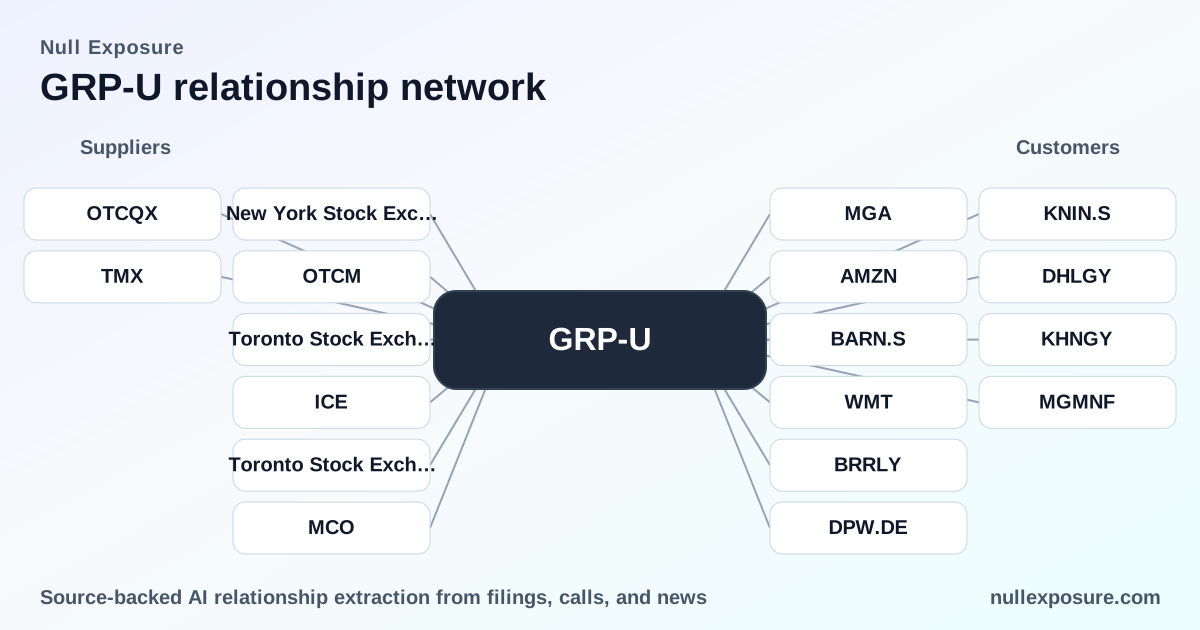
Customer relationships — the roster and what each implies
Below I list every company relationship identified in recent reporting and news items. Each entry is a 1–2 sentence plain-English summary with a concise source note.
Magna (MGA / MGMNF)
Magna is Granite’s largest single-tenant revenue contributor, accounting for about 26–27% of Granite’s annualized revenue across FY2024–FY2026 reporting snapshots, underscoring material concentration. According to Granite’s press materials and quarterly results published in late 2024 and early 2026, Magna’s share of annualized revenue was reported at roughly 26–27% (see Granite REIT press releases and related coverage in November 2024, November 2025, and March 2026).
Sources: Granite REIT quarterly/annual results summarized in FinancialContent press releases (Nov 2024; Nov 2025) and a March 9, 2026 press distribution reported via The Globe and Mail.
Amazon (AMZN)
Amazon is identified as a named tenant in Granite’s portfolio, reflecting typical large e‑commerce demand for logistics space and supporting the Trust’s strategic focus on last‑mile and regional distribution facilities. Coverage noting tenant lists that include Amazon appeared in articles detailing Granite’s corporate actions in early March 2026.
Source: RENX coverage of Granite’s corporate update (March 2026).
Walmart (WMT)
Walmart is named among Granite’s tenants and represents another high-credit, high-utility tenant type that secures occupancy of large-format distribution assets and supports lease stability. The tenant listing was cited in RENX’s March 2026 article summarizing the Trust’s tenant roster.
Source: RENX coverage (March 2026).
DHL (DHLGY / DPW.DE)
DHL appears on Granite’s tenant list, illustrating exposure to global logistics operators that require extensive warehousing and distribution footprints. RENX’s March 2026 summary of Granite’s tenant lineup includes DHL among the Trust’s marquee customers.
Source: RENX coverage (March 2026).
Kuehne + Nagel (KNIN.S / KHNGY)
Kuehne + Nagel is included among named logistics tenants, representing the freight-forwarding and contract‑logistics cohort that reinforces recurring demand for Granite’s industrial properties. The tenant was listed in RENX’s March 2026 reporting.
Source: RENX coverage (March 2026).
Barry Callebaut (BARN.S / BRRLY)
Granite has a specific asset preleased to Barry Callebaut: 4 Bowery Road in Brantford, a 409,767-square-foot property reported as preleased to the chocolate manufacturer, showing Granite’s activity in bespoke, single-occupier industrial deals. RENX reported the Brantford prelease and cited Barry Callebaut as the occupant in March 2026.
Source: RENX article describing the Brantford prelease (March 2026).
What the relationship map implies for investors
- Concentration is the dominant structural risk: Magna alone represents roughly one quarter of annualized revenue. That level of tenant concentration materially affects Granite’s cash flow sensitivity to a handful of counterparties and should be a lead input to any scenario analysis.
- Contracting posture enables predictability: Long‑dated leases to investment‑grade or large strategic tenants (Amazon, Walmart, DHL, Kuehne + Nagel) provide stable rent rolls and low capex churn relative to other RE sectors.
- Counterparty mix supports credit quality but not diversification: Tenants are globally recognized businesses, which reduces counterparty credit risk on an individual basis, yet the aggregate concentration magnifies single-tenant impact.
- Asset-level evidence of active leasing and forward deals: The Barry Callebaut Brantford prelease shows Granite is still executing preleasing strategies for new supply, which supports near-term occupancy and rental growth for that asset.
Corporate context and liquidity signals investors must price
Two operational items change the trading and liquidity profile that investors must consider. First, Granite’s public filings and news coverage around March 2026 reference a voluntary NYSE delisting plan, which changes secondary-market liquidity and shareholder access dynamics — factor that into required returns for minority holders. Second, the absence of material constraints recorded in Null Exposure’s relationship constraints indicates no public formal covenants or customer-specific restrictions were flagged in the reviewed sources; treat that as a neutral company-level signal rather than a guarantee of unconstrained operations.
Source: RENX coverage of Granite’s corporate move to delist (March 2026) and company press materials cited above.
Valuation and monitoring checklist for operators and investors
- Track Magna’s revenue share over time — any drift above the current ~26–27% should be treated as a de‑risking priority.
- Monitor renewal cadence and expiration schedule for major tenants; long-term leases reduce short-term rent volatility but increase sensitivity to rare counterparty failure.
- Watch the delisting process and its timetable, because liquidity reduction requires a higher yield premium for externally traded instruments.
- Follow new preleases and leasing spreads (example: Barry Callebaut Brantford prelease) as leading indicators of pricing power in local markets.
Bottom line
Granite is a stable, income-focused REIT with strong tenant names and predictable cash flows, but the portfolio exhibits material tenant concentration, most obviously with Magna at roughly a quarter of annualized revenue. For income investors the opportunity targets yield plus tenant credit assessment; for active operators or analysts, the priority is monitoring tenant mix shifts, lease expiries and the market impact of the Trust’s voluntary delisting. For a consolidated view of sources and ongoing relationship tracking, visit the Granite coverage hub at https://nullexposure.com/.
Key takeaways:
- Magna concentration (~26–27%) is a primary portfolio risk.
- Top-tier logistics tenants (Amazon, Walmart, DHL, Kuehne + Nagel) provide cash‑flow quality.
- Recent preleases such as Barry Callebaut’s Brantford deal demonstrate active leasing execution.
For the full relationship feed and source documents that informed this summary, see the Granite REIT customer research page: https://nullexposure.com/