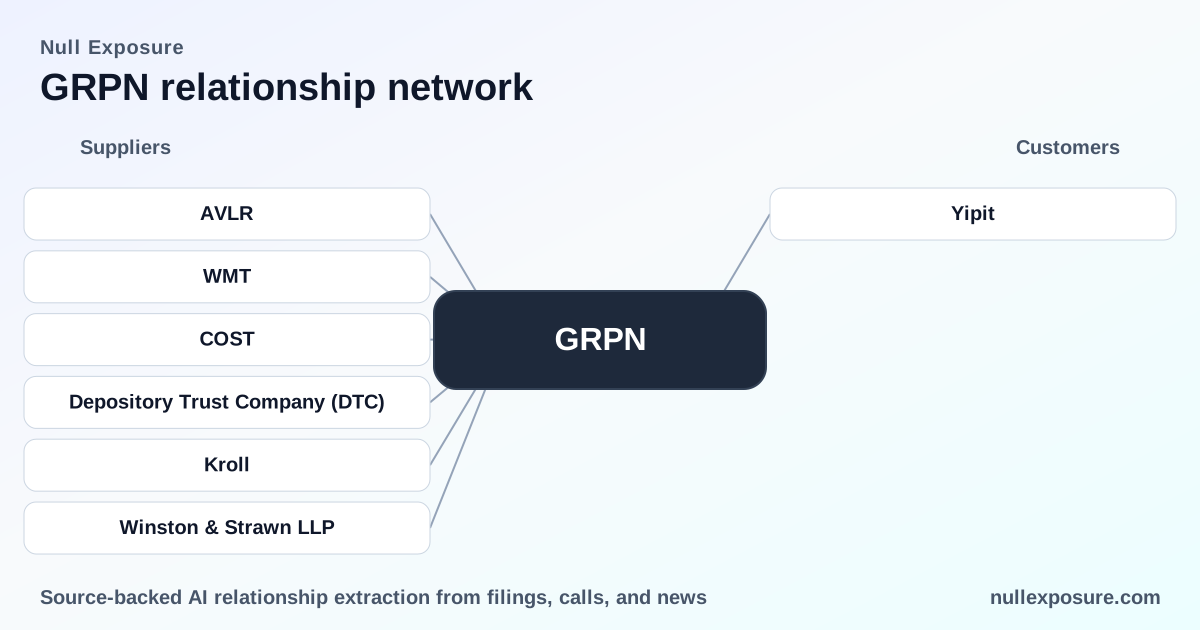
Groupon (GRPN) — customer relationship map and investor implications
Groupon operates a two-sided marketplace that connects individual consumers to local merchants, monetizing primarily by selling vouchers and experiences and retaining a commission or the net of the transaction price after merchant remittance. Revenue is transacted on a largely spot, voucher-driven basis, concentrated in North America but operated globally, producing a mature, low-beta cash flow profile with structural margin pressure from merchant payouts and consumer price sensitivity. For a concise counterparty view and relationship scoring, visit https://nullexposure.com/.
What the customer signals say about how Groupon runs its business
Groupon runs a classic consumer-facing marketplace: consumers buy discounted offers; Groupon collects the cash and remits a portion to merchants, recognizing revenue on a net basis. That operating posture drives four actionable investor signals:
- Contracting posture — spot transactions dominate. Company disclosures highlight that the majority of transactions are voucher sales where Groupon collects purchase price and remits a portion to the merchant, consistent with a spot, transactional revenue model rather than long-term contractual subscription revenue.
- Counterparty mix — individual consumers are the primary demand-side. Groupon’s channels are mobile apps and localized websites serving consumers across multiple countries, which implies high transaction frequency but low per-counterparty revenue and sensitivity to marketing spend and platform engagement.
- Geographic profile — North America is the dominant market. Public excerpts show North America contributing the bulk of revenue (for example, Total North America revenue $376,072 vs Total revenue $492,557 in the cited breakdown), indicating revenue concentration and geographic exposure.
- Relationship role — marketplace seller and net-revenue reporting. Groupon operates as a seller on behalf of third-party merchants and reports revenue on a net basis, which compresses gross topline volatility into adjusted net revenue and affects margin comparability to gross-sale marketplaces.
These are company-level signals derived from the filing excerpts and public summaries; they are not assigned to any single counterparty unless explicitly named in source text.
Mapped relationship: Yipit — aggregation includes Groupon offers
Yipit aggregates and catalogs discount offers and, according to a March 2026 write-up on BusinessModelAnalyst referencing Yipit, Yipit's catalog includes coupons from Groupon (alongside Gilt City and Google Offers), which positions Groupon as a content source for deal aggregators. The BusinessModelAnalyst article (citing Yipit) first referenced this relationship in March 2026. Source: BusinessModelAnalyst.com (citing Yipit), first seen 2026-03-09.
Why this relationship matters to investors
The Yipit relationship is tactical rather than strategic: aggregator inclusion drives additional visibility and incremental demand without locking Groupon into long-term commercial commitments. For investors, aggregator placements are demand-amplifying but non-exclusive and low-criticality, consistent with the company's spot-transaction model. Aggregation partners help acquisition and distribution at modest cost, but they do not materially change merchant or consumer contract economics.
If you want a compact counterparty map and visibility into merchant and aggregator linkages, see our platform at https://nullexposure.com/.
Operational constraints and what they mean for valuation
The available constraint excerpts are company-level signals that illuminate operating risk and unit economics:
- Contract type: spot (evidence: company disclosure that revenue is largely voucher sales where Groupon collects payment then remits merchant share). This implies revenue volatility tied to promotional cadence and customer acquisition spend.
- Counterparty type: individual consumers dominate the demand side, which means customer acquisition cost (CAC) and retention metrics primarily drive growth levers.
- Geography: North America concentration with global operations, producing a revenue mix where North America is the largest contributor and international markets provide growth optionality but lower current weight.
- Relationship role: both seller (Groupon sells on behalf of merchants) and buyer in the sense of remitting merchant shares and recognizing net revenue; this dual role constrains margin expansion because merchant payout schedules are an embedded cost of goods sold.
- Segment: services and experiences are core focus, which creates seasonality and sensitivity to discretionary consumer spending.
These constraints collectively indicate a business with mature marketplace mechanics, limited contract lock-in, and dependency on high-frequency consumer demand and aggregators for reach. For valuation, the implication is predictable but modest free cash flow conversion and sensitivity of growth multiples to improvements in customer retention and merchant economics.
Financial context that frames customer risk
Use the public financials to ground counterparty exposure: Groupon reported Revenue TTM $498.4M and Gross Profit $452.5M, with modest positive EBITDA ($15.2M) and negative EPS (-$2.06) across the trailing periods (latest quarter 2025-12-31). Low beta and a concentrated North American revenue base argue for defensive, value-oriented positioning rather than growth multiple expansion absent a visible change in unit economics or longer-term merchant partnerships.
Practical takeaways for investors and operators
- Concentration risk: North America dominance increases regional macro sensitivity; monitor regional GMV and marketing efficiency metrics.
- Volatility driver: Spot, voucher-centric contracts produce quarter-to-quarter variation tied to promotions and aggregator activity rather than long-term contractual revenue visibility.
- Distribution lever: Aggregators like Yipit increase reach but do not substitute for direct consumer engagement; investments in retention and app monetization remain the highest long-term ROI drivers.
- Margin dynamics: Net-revenue reporting limits the usefulness of gross topline growth as a margin indicator; focus on take-rate and contribution margin per transaction.
Bottom line
Groupon is a mature, consumer-facing marketplace with spot voucher economics, North American revenue concentration, and an ecosystem of low-criticality aggregator relationships such as Yipit that expand distribution without creating binding commercial dependence. Investors should value GRPN on the basis of unit economics and retention improvements rather than headline GMV growth. For additional relationship mapping and customer-exposure scoring, visit https://nullexposure.com/.