Granite Real Estate Investment Trust (GRTUF): Customer Relationships and Operational Signals
Granite Real Estate Investment Trust operates as a logistics- and industrial-focused REIT, acquiring, developing, owning and managing warehouses and distribution facilities across North America and Europe. The company monetizes through lease income on predominantly long-term industrial and logistics assets, supplemented by value creation from development and asset rotation. With a market capitalization near $4.18 billion and trailing revenue of $617.9 million, Granite’s platform is scaled for institutional tenancy and development relationships. For a consolidated view of customer links and commercial exposure, visit https://nullexposure.com/.
Why tenant line-up matters for investors
Granite’s return profile is driven by occupancy, lease tenor and the credit quality of corporate tenants. High-quality, single-tenant industrial leases and pre-let development commitments directly translate into predictable cash flows and support dividend coverage. The composition of tenants in new developments also signals leasing velocity and regional demand; those signals feed directly into valuation multiples for industrial REITs.
The recent Brantford development: tenant commitments and what they mean
A March 2026 RENX report outlines tenant commitments at Granite’s Telephone City Logistics Centre in Brantford. These commitments include both a large food manufacturing/distribution user and an international consumer-packaged goods manufacturer for the new logistics center. Pre-lease activity on large-format projects like Telephone City is a positive indicator of Granite’s development execution and regional logistics demand.
- According to the RENX coverage (March 9, 2026), the Telephone City Logistics Centre is under development in Brantford and has secured major tenants, a sign of leasing success for the project. Source: RENX, March 9, 2026 — https://renx.ca/major-lease-granite-telephone-city-brantford-industrial
Tenant snapshots — who’s on the lease roster
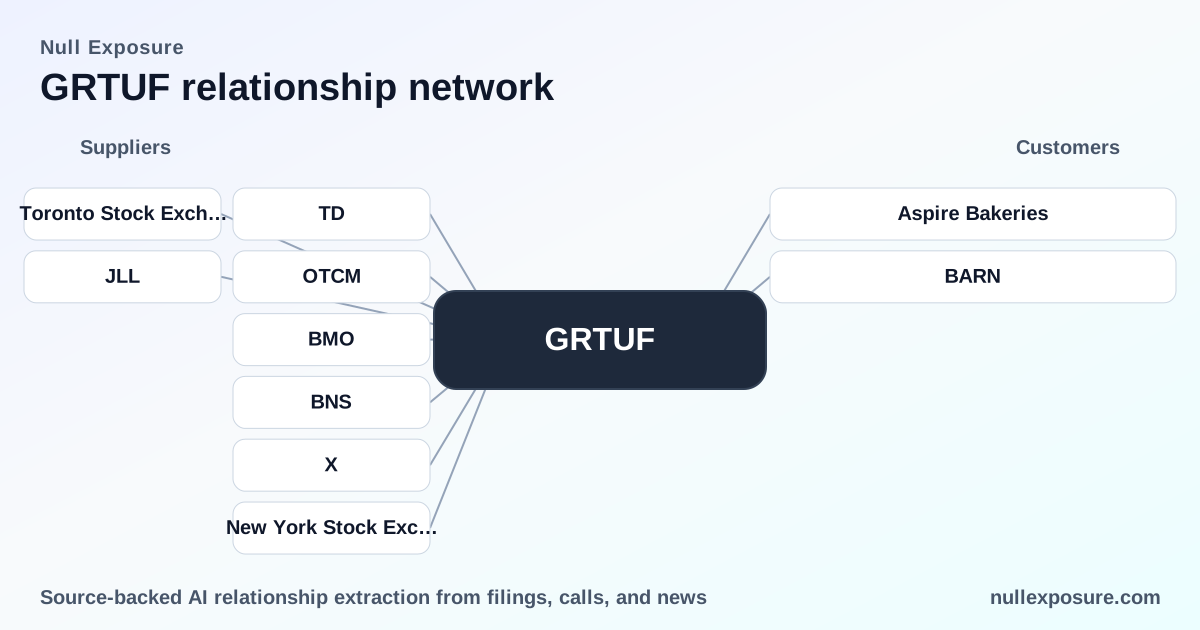
Aspire Bakeries — large-format food manufacturing and distribution
Aspire Bakeries occupies a 398,080-square-foot food manufacturing and distribution facility at 115 Sinclair Blvd. in Brantford, which is noted as fully occupying a 32-acre site associated with Granite. A single-tenant, large-format food manufacturer as an occupant points to stable, multi-year cash flows and specialized use that can increase switching costs for that asset. Source: RENX, March 9, 2026 — https://renx.ca/major-lease-granite-telephone-city-brantford-industrial
BARN — commitment to the Telephone City Logistics Centre
The RENX article references an entity listed as BARN as the first major tenant committed to the new Granite Telephone City Logistics Centre in Brantford. A named first major tenant for a development project signals successful pre-leasing and reduces development risk, supporting forward-looking income visibility. Source: RENX, March 9, 2026 — https://renx.ca/major-lease-granite-telephone-city-brantford-industrial
Barry Callebaut — global CPG firm as an anchor tenant
Global chocolate maker Barry Callebaut is cited as the first major tenant committed to the Telephone City Logistics Centre. An international CPG anchor strengthens the credit profile of the asset’s cash flows and is a positive endorsement of the site’s logistics qualities. Source: RENX, March 9, 2026 — https://renx.ca/major-lease-granite-telephone-city-brantford-industrial
What the relationship list collectively signals about Granite’s operating model
- Contracting posture: Granite’s model emphasizes lease-driven revenues with evidence of development pre-leasing. Long-term single-tenant and anchor CPG commitments indicate a contracting posture that favors term certainty and income predictability over highly flexible short-term leasing.
- Tenant concentration and diversification: The presence of large single-tenant occupiers (food manufacturing and CPG) suggests higher notional exposure at the asset level, but diversification across sectors (manufacturing, CPG, third-party logistics) and geographies (North America and Europe) supports portfolio resilience.
- Criticality and asset specialization: Large-format facilities leased to manufacturing and distribution users are relatively specialized; assets used by food manufacturers or CPG companies typically command longer lease tenors and higher switching costs, increasing asset criticality but also raising replacement complexity if vacancy occurs.
- Maturity and scale: Granite’s public financial profile—$617.9 million TTM revenue, EBITDA of $462.8 million and a market cap around $4.18 billion—positions it as a mature industry participant able to underwrite development risk and secure institutional tenants.
- Deal execution signal: Pre-lease commitments for a new logistics centre represent successful execution in development pipeline management and provide forward rent visibility that supports earnings stability.
(These are company-level signals derived from Granite’s asset focus and the tenant commitments disclosed; they are not attributed to any single relationship unless explicitly noted above.)
Key investment considerations for analysts
- Cash flow predictability is enhanced by large-format, single-tenant pre-leases. Anchor tenants like Barry Callebaut materially reduce development and leasing vacancy risk on new assets.
- Sector exposure is concentrated in industrial/logistics; this is a strength in current e-commerce and supply-chain reconfiguration cycles but introduces cyclical sensitivity to industrial real estate fundamentals.
- Development strategy matters. Granite’s ability to convert development units to pre-leased assets determines near-term capital deployment efficiency and margin capture on development gain.
For investors who require ongoing tracking of tenant commitments and project-level leasing, NullExposure’s platform centralizes these relationship signals for REIT portfolios — see https://nullexposure.com/ for more details.
Bottom line — what this set of relationships means for GRTUF investors
Granite’s disclosed tenant commitments for the Telephone City Logistics Centre in Brantford show successful pre-leasing to sizable, creditworthy occupiers, which directly supports the REIT’s income visibility and development return profile. For investors assessing cash-flow durability, the combination of large-format food and CPG tenants is a clear positive, reducing leasing execution risk on a material project. Monitor the pace of additional pre-leases, lease tenors and credit terms to calibrate valuation versus peers; Granite’s scale and development pipeline execution are the operational levers that will determine earnings growth and dividend sustainability.