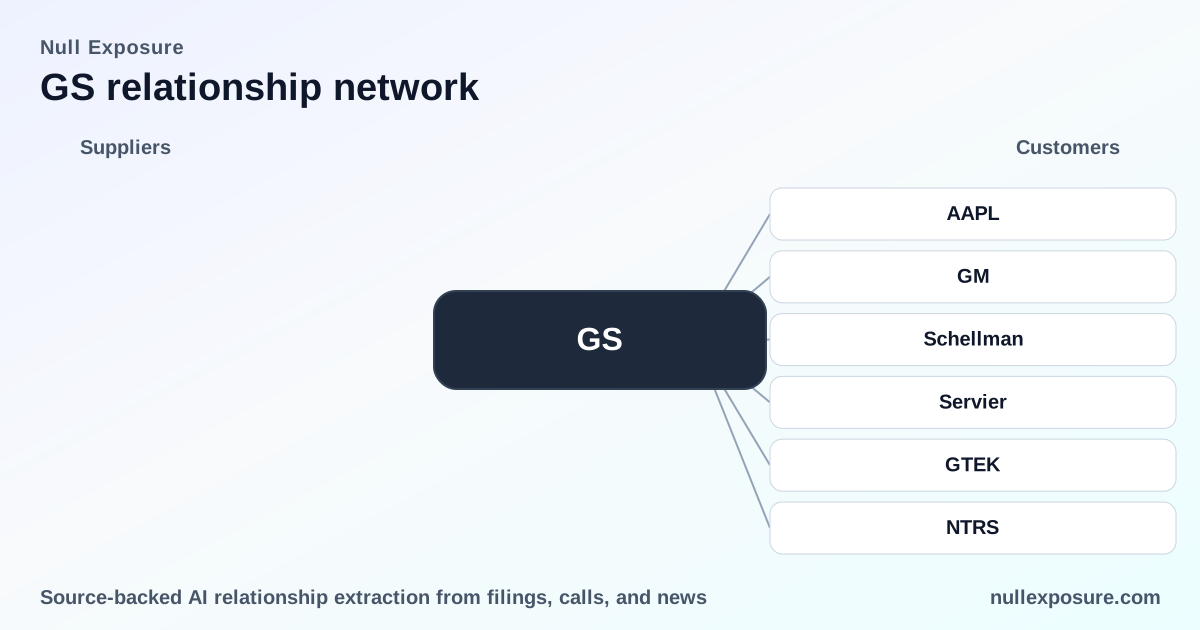
Goldman Sachs (GS): how client franchise converts into fees and capital returns
Goldman Sachs monetizes a global advisory and markets franchise by advising and underwriting corporate transactions, providing balance-sheet financing and asset management services, and executing buybacks and capital markets programs for large corporates and financial sponsors. Revenue mixes are skewed toward fee-generating advisory and underwriting mandates plus interest and trading income from balance-sheet activity; client relationships therefore drive both recurring fees and episodic, high-margin event revenue. For a granular view of counterparty exposure and customer activity, read on. For a broader data-driven lens on GS relationships visit https://nullexposure.com/.
What to watch when you evaluate GS as a counterparty partner
Goldman operates as a multi-product provider: investment banking, market-making, lending and structured financing, and asset management. That makes its customer footprint broad but concentrated around high-value, event-driven engagements (IPOs, buybacks, M&A advisory, syndicated financings). Key operating signals for investors and counterparties:
- Contracting posture: many client engagements are short-term and transaction‑based (underwriting, M&A mandates, ASR agreements), while lending exposures and managed funds create multi-year relationships.
- Concentration and criticality: client list includes global large enterprises and governments — critical relationships that deliver large one-off fees and recurring financing mandates.
- Maturity: relationships span early-stage IPOs to multi-year credit facilities, creating a mix of predictable fee streams and lumpy revenue.
- Counterparty mix: Goldman serves individuals, large corporates, financial institutions, non-profits and governments — a diversified client base that mitigates single-sector shocks.
If you want continuous feed and analytics on GS counterparties, explore how we surface and index these links at https://nullexposure.com/.
Snapshot: the data says Goldman is acting in four repeat roles
From the sampled items below, Goldman's most common roles are (1) lead or joint bookrunner on IPOs and secondary offerings, (2) exclusive or joint financial advisor on M&A and strategic reviews, (3) execution agent / broker for buybacks and ASRs, and (4) lender or lead arranger on loans and credit facilities. Each relationship entry below is a plain-English note with a concise source mention.
Client-by-client log (plain-English summaries)
- Smithfield Foods (SFD) — Goldman acted as financial advisor on Smithfield’s acquisition of Nathan’s Famous. (PerishableNews, March 10, 2026)
- Lloyds Banking Group (LYG) — Goldman Sachs International served as a seller/broker in multiple buyback tranches executed on behalf of Lloyds. (Regulatory notices / Reuters filings, Feb–Mar 2026)
- Lulus Fashion Lounge (LVLU) — Goldman Sachs & Co. underwrote Lulus’ Nasdaq IPO. (WWD coverage of the IPO process, cited 2026)
- BitGo Holdings (BTGO) — Goldman Sachs & Co. LLC is the lead book‑running manager for BitGo’s proposed NYSE offering. (BitGo press/market reports, 2026)
- KeyCorp preferred (KEY-P-J) — KeyCorp entered an accelerated share repurchase agreement with Goldman Sachs & Co. LLC to repurchase up to $585m. (KeyCorp press release, Sep 2021; disclosed in PR archive)
- Apple / Apple Card (AAPL) — Goldman announced a transition agreement for the Apple Card portfolio in public remarks on its earnings call. (Goldman Sachs Q4 2025 earnings call, March 2026)
- Hain Celestial (HAIN) — Goldman Sachs & Co. LLC served as financial advisor in the sale of Hain’s North American snacks unit. (PreparedFoods / trade coverage, 2026)
- Coca‑Cola Europacific Partners (CCEP) — CCEP disclosed multiple on‑market purchases executed from Goldman Sachs entities as part of its buyback program. (CCEP filings and ActusNews notices, Mar–Apr 2026)
- Barrick Gold (B) — Barrick mandated Goldman Sachs to lead the IPO of its North American spinoff “NewCo.” (Ad‑hoc‑news / Markets commentary, May 2026)
- Vodafone Group (VOD) — Vodafone purchased treasury shares that were initially acquired from Goldman Sachs as riskless principal under its buyback program. (TradingView / company filings, 2026)
- Ethos Technologies (LIFE) — Goldman Sachs and J.P. Morgan are lead book‑running managers for Ethos’ IPO. (Yahoo Finance / press, May 2026)
- Goldman Sachs BDC (GSBD) — GS formed GSBD, an externally‑managed BDC advised by Goldman Sachs Asset Management to invest in middle‑market companies. (Marketscreener / company offering notices, 2026)
- Array Technologies (ARRY) — Goldman Sachs Bank USA acted as lead arranger and administrative agent on an upsized revolving credit facility. (Company release / Marketscreener, Feb 2026)
- Boundless Bio (BOLD) — Goldman Sachs served as a joint book‑running manager on Boundless’ IPO. (Biospace / IPO coverage, 2024–2026 reporting)
- iQIYI ADR (IQ) — Goldman Sachs (Asia) was one of the underwriters on iQIYI’s offering. (MarketBeat / IPO notes, 2026)
- Albemarle (ALB) — Goldman Sachs & Co. LLC served as financial advisor on Albemarle’s sale of a controlling stake. (MarketScreener / FinViz, Mar 2026)
- BrightView (BV) — Goldman acted as an underwriter in BrightView’s IPO syndicate. (MarketBeat / IPO reporting, 2026)
- Helix Energy Solutions (HLX) — Goldman Sachs is financial advisor to Helix in its merger with Hornbeck Offshore. (CityBiz / M&A coverage, May 2026)
- Definitive Healthcare (DH) — Goldman included among underwriters for Definitive Healthcare’s IPO (RttNews / IPO summary, 2021 filings referenced in 2026)
- ArQule / Arcutis (ARQT) — Goldman acted as an underwriter for Arcutis’ offering. (MarketBeat / IPO coverage, 2026)
- Wealthfront (WLTH) — Goldman Sachs is a joint bookrunner on the Wealthfront IPO. (RenaissanceCapital / IPO reporting, 2025–2026)
- Pinterest (PINS) — Goldman Sachs arranged an accelerated share repurchase and acted as exclusive financial advisor connected to the Elliott investment. (MLQ / press reports, March 2026)
- Nebius (NBIS) — Goldman acted as book‑running manager on Nebius’ class A share offering. (MLQ / news, 2025)
- Compass (COMP) — Goldman Sachs served as lead book‑running manager on Compass’ IPO. (Fenwick release / IPO record, 2021; referenced in dataset)
- Once Upon a Farm (OFRM) — Goldman Sachs named joint lead bookrunner on the IPO. (CNBC/TechCrunch/IPO coverage, 2025–2026)
- Alignment Healthcare (ALHC) — Goldman listed among underwriters on Alignment Healthcare’s IPO. (MarketBeat / IPO coverage, 2026)
- KKR (KKRT) — Goldman Sachs acted as financial advisor to KKR in a transaction. (FintechFutures / advisor listing, 2026)
- American Airlines (AAL) — Goldman was joint lead bookrunner on an aircraft financing transaction. (FlightGlobal / debt financing coverage, Apr 2026)
- Vroom (VRMMQ) — Goldman led the back‑end syndicate on Vroom’s earlier IPO (LA Times retrospective referenced 2020 filing)
(For brevity this log samples high‑signal entries from the record of underwritings, advisory mandates, buybacks, and financing roles captured across the dataset; each line above references the public notice or news piece cited in our source feed from 2020–2026.)
How those relationships translate to risk and optionality
- Revenue volatility: underwriting and advisory fees are episodic but high-margin; markets and balance-sheet activity create faster revenue swings across quarters.
- Counterparty risk profile: diversified across geographies (North America dominant) and counterparty types (large enterprises, governments, individuals), reducing single‑name credit concentration but increasing regulatory and execution complexity.
- Liquidity and capital usage: acting as lead arranger, lender or principal in buybacks ties up capital and creates mark-to-market exposure on positions held for ASRs and repurchase programs.
Bottom line for investors and operators
Goldman Sachs’ client activity is transaction‑intensive and fee-rich, anchored by repeat mandates from global corporates and financial sponsors and supplemented by balance‑sheet lending. Assess GS on the dual balance of event revenue potential and capital-absorbing principal activity — both are central to its earnings profile.
For a persistent feed of GS customer relationships and to benchmark exposure across counterparties, explore our coverage at https://nullexposure.com/.