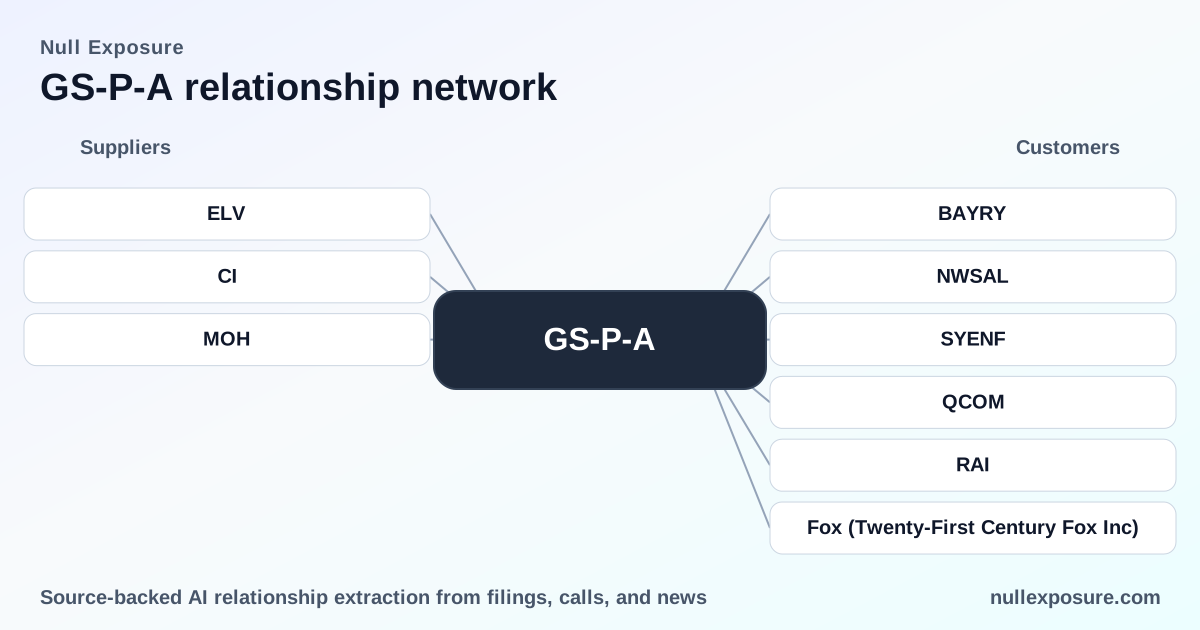
GS-P-A: What Goldman Sachs’s client plays tell preferred-holders about franchise strength
Goldman Sachs operates a diversified investment banking and markets franchise that monetizes through advisory fees, underwriting and financing roles, and proprietary balance-sheet activity; the GS-P-A depositary shares reflect exposure to that corporate parent’s capital structure rather than cash-flow from any single client. For investors and operators assessing GS-P-A, the relevant signal is how Goldman’s client engagements—advisory mandates, debt financing roles, and intra-group funding—translate into fee concentration, reputational risk, and balance-sheet commitments that support preferred holders’ downside protection.
If you want a concise tracking tool for these client dynamics, see our summary at Null Exposure.
Why Goldman’s client map matters for preferred investors
Goldman’s commercial model blends fee-based advisory work with recurring financing and capital-markets activities. That creates a set of operating characteristics investors should judge together: contracting posture (short-term mandates versus long financing holds), concentration (large-ticket M&A and buyouts versus broad retail business), criticality (advisory roles that materially affect fee flow), and maturity (one-off deals versus ongoing financing relationships). Because the data payload contains multiple high-profile advisory and financing mentions, the practical takeaway is that Goldman’s preferred-stock holders benefit from durable fee income but remain exposed to episodic reputational and legal shocks tied to specific client deals.
Client-by-client relationship snapshot
Below I cover every relationship mentioned in the available records. Each entry is a plain-English description of Goldman’s role followed by the source.
Bayer AG (BAYRY)
Goldman played a financing role in Bayer’s debt package for its acquisition of Monsanto, which positions the bank as a debt arranger on a large strategic buyout financing. According to Business Insider’s reporting on past transactions (reported in an article focused on 2016 deal activity), Goldman secured that financing role. (Business Insider, Oct 2016 — https://www.businessinsider.com/why-goldman-sachs-was-not-on-att-time-warner-2016-10)
BAYRY (duplicate record)
The duplicate entry reiterates that Goldman participated on the Bayer/Monsanto financing, reinforcing the bank’s exposure to large buyout debt placements. (Business Insider, Oct 2016 — https://www.businessinsider.com/why-goldman-sachs-was-not-on-att-time-warner-2016-10)
News Corp (NWSAL)
Goldman advised on transactional restructuring and disposals, including a 2014 $9 billion sale of European satellite TV assets and the corporate split between News Corp and Fox in 2013—mandates that generated significant advisory fees and affirmed Goldman’s media-sector capabilities. (Business Insider, Oct 2016 — https://www.businessinsider.com/why-goldman-sachs-was-not-on-att-time-warner-2016-10)
NWSAL (duplicate record)
This alternate-label record repeats Goldman’s advisory role for News Corp/British Sky Broadcasting transactions, the same commercial footprint captured in the News Corp entry. (Business Insider, Oct 2016 — https://www.businessinsider.com/why-goldman-sachs-was-not-on-att-time-warner-2016-10)
SYENF
Goldman advised Syngenta AG in a context that influenced an eventual strategic sale; the bank’s role in advising the Swiss seeds company contributed to a $43 billion transaction with ChemChina, illustrating Goldman’s ability to capture large cross-border sell-side mandates. (Business Insider, Oct 2016 — https://www.businessinsider.com/why-goldman-sachs-was-not-on-att-time-warner-2016-10)
Syngenta AG (duplicate record)
This second Syngenta-labeled entry restates Goldman’s advisory influence in the Syngenta–ChemChina deal, underlining the same sell-side advisory footprint captured above. (Business Insider, Oct 2016 — https://www.businessinsider.com/why-goldman-sachs-was-not-on-att-time-warner-2016-10)
Goldman Sachs & Co. LLC (GS)
An intra-group securities transaction shows GS Finance Corp. selling offered notes to Goldman Sachs & Co. LLC, which then purchases those notes—an example of intra-company funding and placement activity that underscores how Goldman uses affiliated entities to warehouse and distribute securities. This detail comes from a Form 424B2 pricing supplement filed in FY2025. (SEC/StreetInsider filing, FY2025 — https://www.streetinsider.com/SEC+Filings/Form+424B2+GOLDMAN+SACHS+GROUP+INC/25453466.html)
Qualcomm Inc (QCOM)
Goldman worked on advising or coordinating financing for Qualcomm’s proposed $37 billion takeover of NXP, reflecting participation in large semiconductor-sector M&A and technology-industry advisory work. (Business Insider, Oct 2016 — https://www.businessinsider.com/why-goldman-sachs-was-not-on-att-time-warner-2016-10)
QCOM (duplicate record)
This duplicate record reiterates Goldman’s role tied to Qualcomm and the NXP takeover process, reinforcing the bank’s involvement in high-value, cross-border tech transactions. (Business Insider, Oct 2016 — https://www.businessinsider.com/why-goldman-sachs-was-not-on-att-time-warner-2016-10)
RAI (Reynolds American Inc)
Goldman advised Reynolds American regarding British American Tobacco’s $47 billion offer, a landmark tobacco-sector transaction that would have generated substantial advisory fees and required complex shareholder and regulatory navigation. (Business Insider, Oct 2016 — https://www.businessinsider.com/why-goldman-sachs-was-not-on-att-time-warner-2016-10)
Reynolds American Inc (duplicate record)
The repeated Reynolds entry mirrors the prior description of Goldman’s advisory position on the BAT offer for Reynolds, underscoring that the bank occupied an advisory seat on a multi-decade strategic consolidation. (Business Insider, Oct 2016 — https://www.businessinsider.com/why-goldman-sachs-was-not-on-att-time-warner-2016-10)
1MDB
Goldman earned roughly $600 million in fees tied to bond deals with Malaysia’s 1MDB, a relationship that later resulted in material legal and settlement costs for the bank—evidence that high fees from sovereign or quasi-sovereign financings carry concentrated legal and reputational risk. (CNBC reporting on the July 24, 2020 settlement — https://www.cnbc.com/2020/07/24/goldman-sachs-agrees-to-3point9-billion-deal-with-malaysia-to-settle-criminal-probe-into-1mdb-scandal.html)
Fox (Twenty-First Century Fox Inc)
Goldman advised Twenty-First Century Fox on major asset sales and corporate splitting actions, including the 2014 satellite-TV sale and the 2013 News Corp/Fox separation, reinforcing its media-advisory franchise in large strategic restructurings. (Business Insider, Oct 2016 — https://www.businessinsider.com/why-goldman-sachs-was-not-on-att-time-warner-2016-10)
What these relationships imply for investors in GS-P-A
- Fee diversity with concentrated tails. Goldman’s work spans sectors—pharma, media, tobacco, tech—but high-dollar mandates (>$10B) concentrate revenue episodically; preferred holders benefit when fees are recurring or when the firm recycles capital efficiently.
- Balance-sheet and intra-group funding are material. The FY2025 Form 424B2 excerpt shows intra-group note placement is part of Goldman’s funding plumbing, which affects liquidity management and the capital cushion behind preferred claims.
- Reputational/legal shocks are real and quantifiable. The 1MDB episode generated both large fees and substantial settlements; such events can strain capital and impair payout flexibility for preferred securities.
There are no explicit contract-level constraints provided in the available records, so at the company level this absence signals that the data set does not disclose binding covenants or customer exclusivity clauses that would materially alter counterparty risk. Investors should therefore treat the client relationships above as commercial signals—valuable for revenue and reputation analysis—but not as evidence of legal protections that shield preferred holders.
If you’d like a concise dashboard linking these client signals to capital-structure outcomes, visit Null Exposure for model-ready summaries and scenario analysis.
Bottom line: what matters for GS-P-A holders
Goldman’s client roster demonstrates strong advisory and financing credentials across complex, high-fee transactions, which supports the franchise economics underlying GS-P-A. The counterpoint is concentrated event risk—large mandates generate sizable fees but also can expose the firm to settlement and reputational costs, which can compress capital cushions. For preferred-stock investors, the prudent view is that Goldman’s fee generation and intra-group funding mechanics are net positives for preferred credit, but vigilance on legal and event risk is essential.