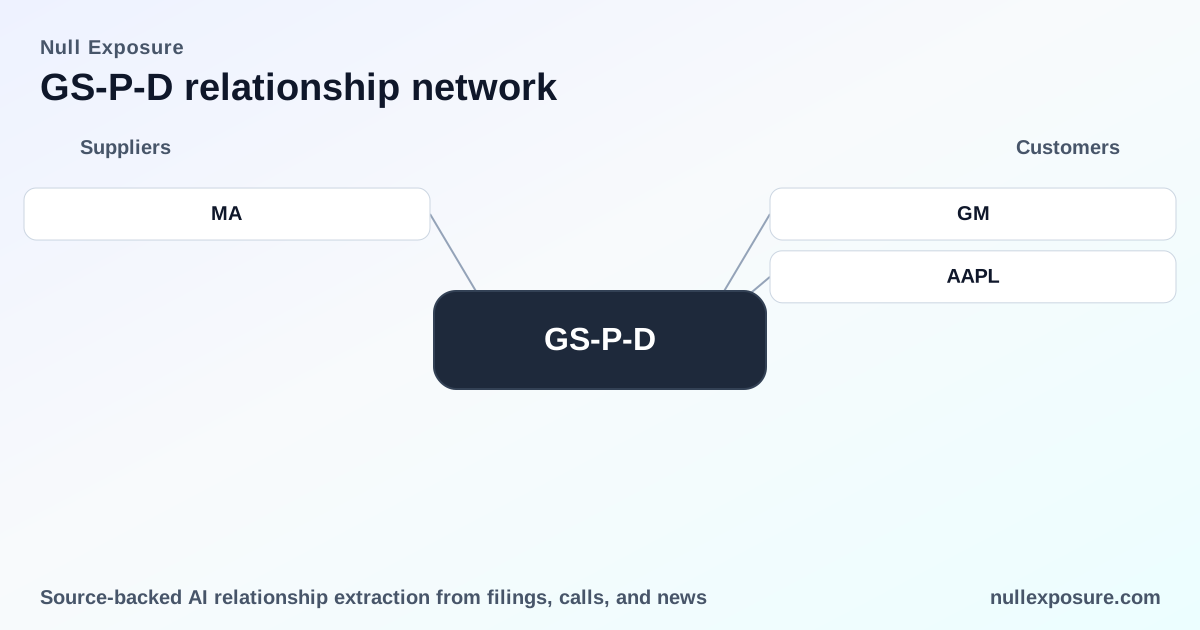
GS-P-D: Customer relationships that power Goldman Sachs' franchise
Goldman Sachs monetizes principally through fee-based investment banking, trading and markets businesses, asset and wealth management, and an expanding set of lending and consumer-finance partnerships; the preferred share GS‑P‑D reflects ownership claims on a business that earns across capital markets, credit and client platforms. For investors evaluating counterparty exposure and revenue durability, Goldman’s customer relationships signal both entrenched franchise activities (co-branded cards, underwriting, advisory) and opportunistic private finance and exchange investments that diversify non-interest income. Explore the relationship map and the implications for concentration, counterparty risk and growth optionality.
Interested in the raw relationship feed and data tools? Visit https://nullexposure.com/ for more context on coverage and methodology.
How to read these relationships: business model signals, not just names
Goldman’s customer and partner mentions in the feed reflect several company-level operating characteristics investors should internalize:
- Contracting posture: Goldman uses bilateral purchase and underwriting arrangements as well as credit facilities and minority investments; these are a mix of transactional (underwriting, note purchases) and strategic (consumer cards, alternatives leadership).
- Revenue concentration: Relationships span large corporate clients (GM, Apple) and targeted private or exchange investments (Skims, TXSE Group), indicating revenue diversification across fee pools rather than single-counterparty dependency.
- Criticality and maturity: Long-standing payer/issuer partnerships such as co-branded cards are highly strategic and durable, while newer investments and IPO mandates show active origination and advisory flows.
- Counterparty profile: The feed contains both corporate borrowers and equity/private placements; credit exposure (lines, loans) and underwriting/advisory risk coexist with origination and principal-market risk.
No explicit contract constraints or limiting excerpts were provided in the relationship feed, so the data set surfaces commercial relationships and transaction flow rather than contract disputes or covenant restrictions.
Relationship inventory: every entity mentioned in the coverage
Goldman Sachs & Co. LLC
A Form 424B2 pricing supplement (FY2026) documents that GS Finance Corp. will sell notes to GS&Co., and GS&Co. will purchase offered notes from GS Finance Corp., reflecting internal financing and capital markets placement within the Goldman group. Source: Form 424B2 pricing supplement filed in FY2026 (reported via StreetInsider).
Kennedy Wilson
Kennedy Wilson secured a substantial credit facility of approximately £500 million from Goldman Sachs, indicating Goldman’s role as a large-scale credit provider to real-estate investment companies in FY2026. Source: br.investing.com company news (FY2026).
General Motors Co
General Motors launched a co-branded credit card with Goldman Sachs and revised its rewards program, illustrating Goldman’s Marcus/consumer-finance strategy and card-serving capabilities with major automotive OEMs as of FY2022 reporting. Source: Yahoo Finance Canada / joint statement (March 2026 reporting on FY2022 activity).
GM
A duplicate feed entry reiterates the same GM‑Goldman card partnership: Goldman functions as the card issuer and partner on GM’s consumer payments product and rewards program, an enduring revenue channel for both card-servicing fees and customer credit exposure. Source: Yahoo Finance Canada (March 2026, FY2022 context).
Dolomiti Energia
Italy’s Dolomiti Energia selected Intesa and Goldman Sachs to lead a potential IPO process, positioning Goldman as an adviser/underwriter on a European utility privatization/advisory mandate in FY2026. Source: MarketScreener summarizing news (Reuters/Apr. 30 RE).
Skims
Goldman Sachs Alternatives led a $225 million financing round for Skims, increasing the company’s valuation to $5 billion and showing Goldman’s role as a lead investor in growth-stage private equity transactions in FY2026. Source: br.investing.com coverage (FY2026).
Apple Inc
Goldman launched Marcus in 2016 and has run a credit-card relationship with Apple since 2019, demonstrating Goldman’s strategic consumer-finance partnerships with technology platform partners that generate fee and interest income streams. Source: Yahoo Finance Canada (reported March 2026; historical note referencing 2016 and 2019 initiatives).
TXSE Group
Goldman Sachs, together with Bank of America, is leading a $20 million investment in TXSE Group, the company behind the Texas Stock Exchange initiative, a strategic minority investment intended to back an exchange competitor to Nasdaq and NYSE announced in FY2026. Source: br.investing.com company news (FY2026).
AAPL
The feed includes a duplicate entry for Apple under the ticker AAPL that restates Goldman’s credit-card relationship and Marcus’ consumer banking initiatives, reinforcing the Apple partnership as part of Goldman’s consumer credit platform. Source: Yahoo Finance Canada (March 2026; FY2022 context).
What these relationships imply for investors
- Diversified fee engine. The mix of advisory (Dolomiti Energia IPO mandate), underwriting/notes internal flows (GS Finance to GS&Co.), consumer partnerships (Apple, GM), private-equity style leadership (Skims), and direct credit lines (Kennedy Wilson) shows Goldman extracting fees across advisory, underwriting, lending and alternatives investing.
- Strategic co‑brand and platform exposure. Partnerships with Apple and GM reflect stable, high-margin card-servicing revenues and customer-credit exposure tied to durable consumer interactions.
- Origination and principal risk coexist. Investments in TXSE Group and Skims place Goldman in principal-investor posture, increasing balance-sheet exposure compared with pure advisory mandates.
- Counterparty diversity reduces single-name concentration risk. Coverage spans automakers, tech platforms, real-estate firms, energy utilities and exchange ventures, supporting a multi-vertical revenue mix.
Key risk vectors to monitor
- Credit exposure from bilateral credit lines and card portfolios (e.g., Kennedy Wilson line, Marcus partnerships). Monitor asset-quality and charge-off dynamics reported in regular filings.
- Regulatory and market sensitivity for exchange investments (TXSE Group) and IPO pipelines (Dolomiti Energia) that depend on market conditions.
- Balance-sheet absorption from principal investments (Skims leadership, GS‑Finance note placements) that can increase earnings volatility when markets tighten.
For deeper, ongoing tracking of counterparty mentions and relationship evolution, visit https://nullexposure.com/ to subscribe to continuous coverage and alerts.
Bottom line
Goldman Sachs’ customer relationships reflected in this feed illustrate a multi-pronged commercial strategy: durable fee-generating partnerships in consumer finance, large credit facilities to real-estate and corporate clients, and selective principal bets in private markets and exchange infrastructure. For investors focusing on revenue diversity and counterparty risk, these relationships confirm both the stability of Goldman’s core markets franchise and an active tilt toward principal investments that deserve close monitoring for balance-sheet and market-cycle sensitivity.