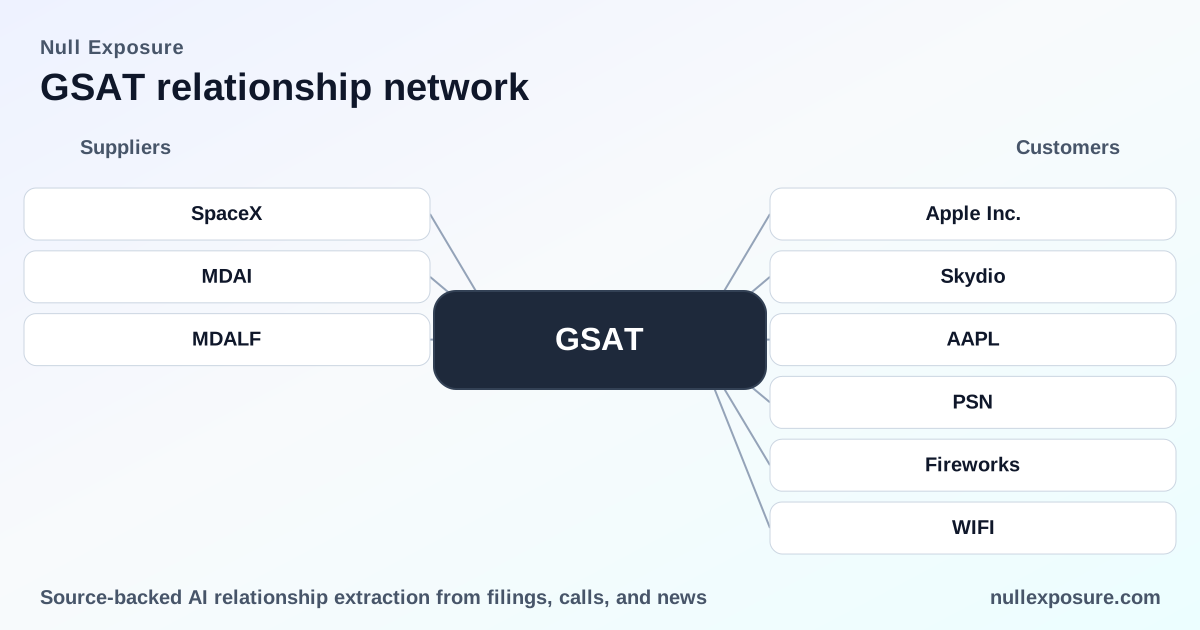
Globalstar (GSAT): Customer relationships that define the business case
Globalstar operates and monetizes a low‑Earth orbit satellite communications network by selling wholesale capacity and satellite-enabled services to large strategic customers while also distributing retail IoT and device solutions through resellers and partners. The company’s revenue profile is increasingly wholesale‑led, with a single wholesale customer responsible for the majority of growth and cash generation; that concentrated commercial posture is the central investment variable. Learn more background at https://nullexposure.com/.
How Globalstar makes money — a short commercial thesis
Globalstar sells satellite network access and related services (wholesale capacity) to large customers while simultaneously marketing end‑user products and device modules through distributors, resellers and direct channels. Revenue drivers are wholesale contracts for network capacity and growth in commercial IoT and private 5G (XCOM RAN) offerings, with device sales and distribution adding recurring subscription and hardware revenue. According to Globalstar’s 2024 Form 10‑K, its only reportable segment is Mobile Satellite Services (MSS), which bundles wholesale capacity, voice/data MSS and device distribution.
The strategic customers — who matters and why
Below I catalog every named counterparty in the source set and summarize Globalstar’s relationship with each. Each entry is short, factual and linked to the public source noted in the results.
Apple Inc.
Globalstar acts as the operator for Apple’s satellite‑enabled services under long‑running service agreements and has committed the majority of network capacity to Apple to support iPhone and Apple Watch emergency messaging features. Globalstar’s 2024 Form 10‑K identifies Apple as the wholesale Services counterparty, and multiple news reports and company disclosures describe Apple’s equity investment (roughly $1.5 billion for a ~20% stake) and an 85% allocation of Globalstar capacity to Apple, a structural revenue driver (Globalstar 2024 10‑K; Reuters and multiple outlets, 2024–2026). See the company filing and press coverage for details.
Skydio
Skydio validated compatibility between its X10 autonomous drone and Globalstar’s licensed Band n53 spectrum and XCOM RAN private 5G platform in a proof‑of‑concept flight, signaling Globalstar’s push into private 5G for robotics and defense customers. This trial was reported by SUAS News in December 2025 and demonstrates product‑level interoperability for drone OEMs (SUAS News, Dec 2025).
Amazon.com, Inc.
Public reporting in April 2026 shows Amazon entered a definitive agreement to acquire Globalstar in a cash‑and‑stock transaction, giving Amazon access to Globalstar’s satellites and spectrum for direct‑to‑device and other space connectivity ambitions; deal reporting also notes counsel and deal terms. TheDeal and follow‑on coverage summarized the announced acquisition and its strategic rationale for Amazon’s satellite ambitions (The Deal; Sahm Capital, Apr 2026).
NextPlat / NextPlats Orbital Satcom (NXPL)
NextPlat’s e‑commerce and distribution channels sell satellite connectivity products that operate on networks including Globalstar, and NextPlat’s Global Telesat Communications subsidiary reported orders that name Globalstar as a supplier for IoT hardware — a reseller/distribution relationship for Globalstar devices and modules. NextPlat press releases and PR Newswire coverage document these reseller/distributor ties (PR Newswire, Mar 2026).
Virewirx
Virewirx incorporated Globalstar’s XCOM RAN platform into its 5G solutions, indicating a partner relationship that boosts Globalstar’s defense and private‑network proposition. Coverage of the integration was noted in market news summaries covering Globalstar product applications (StocksToTrade summary, Mar 2026).
Parsons Corporation (PSN)
Globalstar references an agreement with Parsons that generated device sales and commercial IoT subscriber revenue, pointing to Parsons as a commercial partner for specialized services and government‑grade applications. The Q4 2025 earnings call transcript and media coverage list Parsons as a contributor to commercial IoT and device revenue (Globalstar Q4 2025 earnings call; The Globe and Mail transcript, Mar 2026).
Fireworks
Fireworks selected Globalstar as a technology partner and leveraged Globalstar’s XMRI5 platform as part of a joint effort to deploy next‑generation services, reflecting product‑level partnerships beyond core wholesale capacity sales. This partnership was referenced in earnings‑call materials reported by The Globe and Mail (Q4 2025 earnings call, Mar 2026).
Boingo Wireless (WIFI)
Boingo completed a proof‑of‑concept trial showing that Globalstar’s XCOM RAN can support private 5G deployments, positioning Globalstar as a supplier of private wireless infrastructure for venue and enterprise operators. The Globe and Mail coverage of Globalstar’s earnings call highlights the Boingo trial as evidence of partner engagement (Q4 2025 earnings call; Mar 2026).
Operating model constraints and what they mean for investors
Globalstar’s relationships and contract signals create four structural characteristics investors should monitor:
- High revenue concentration and criticality. Globalstar disclosed that the wholesale customer under its updated Service Agreements accounted for 58% of revenue in 2024, and the same relationship represented a material receivable exposure, which makes counterparty continuity a core value driver (Globalstar 2024 Form 10‑K).
- Long‑term contracting posture. The updated Services Agreements have no fixed expiration date in practice, with Globalstar estimating contract term based on the useful life of its satellite assets — a signal of tenure and dependence between network owner and wholesale customers (Form 10‑K, 2024).
- Global footprint with mixed end customers. Globalstar sells services and products worldwide to retail, business and governmental customers, indicating diversified geographies but concentrated counterparties at the top end (Form 10‑K; company disclosures).
- Multiple commercial roles. Globalstar functions as a service provider (wholesale capacity), seller (device and service sales), and reseller/distributor partner through third‑party channels — a hybrid B2B/B2B2C model that scales via large platform partners (Form 10‑K evidence excerpts).
Each of these characteristics amplifies both upside (durable contract cash flow if major partners renew and scale) and downside (customer concentration and single‑counterparty receivable risk).
Key investment takeaways
- Apple is the linchpin. The Apple wholesale arrangement and equity relationship underpin revenue growth and valuation re‑rating; Apple’s prepayment and capacity commitments materially change cash flow visibility (10‑K and market reporting, 2024–2026).
- Product diversification reduces single‑point risk but does not eliminate it. Private 5G trials (Boingo, Skydio, Virewirx) and commercial IoT agreements (Parsons, NextPlat resellers) broaden end markets, but no other single customer approaches Apple’s revenue share (earnings call and news coverage, 2025–2026).
- Corporate actions reshape strategic optionality. The reported Amazon acquisition alters the company’s standalone thesis by transferring spectrum and operational control to a strategic buyer, with immediate implications for minority shareholders and long‑term market positioning (deal coverage, Apr 2026).
For readers who want structured intelligence on how these customer relationships affect counterparty risk and revenue models, visit https://nullexposure.com/ for deeper analytics and filings.
The relationships above reflect all named counterparties referenced in Globalstar’s filings and contemporaneous coverage; each one is a leaver or whetstone for revenue, product validation, or strategic exit value. Investors should prioritize counterparty disclosures in the 10‑K and subsequent earnings calls to track committed capacity, prepayment balances and material receivable exposure.