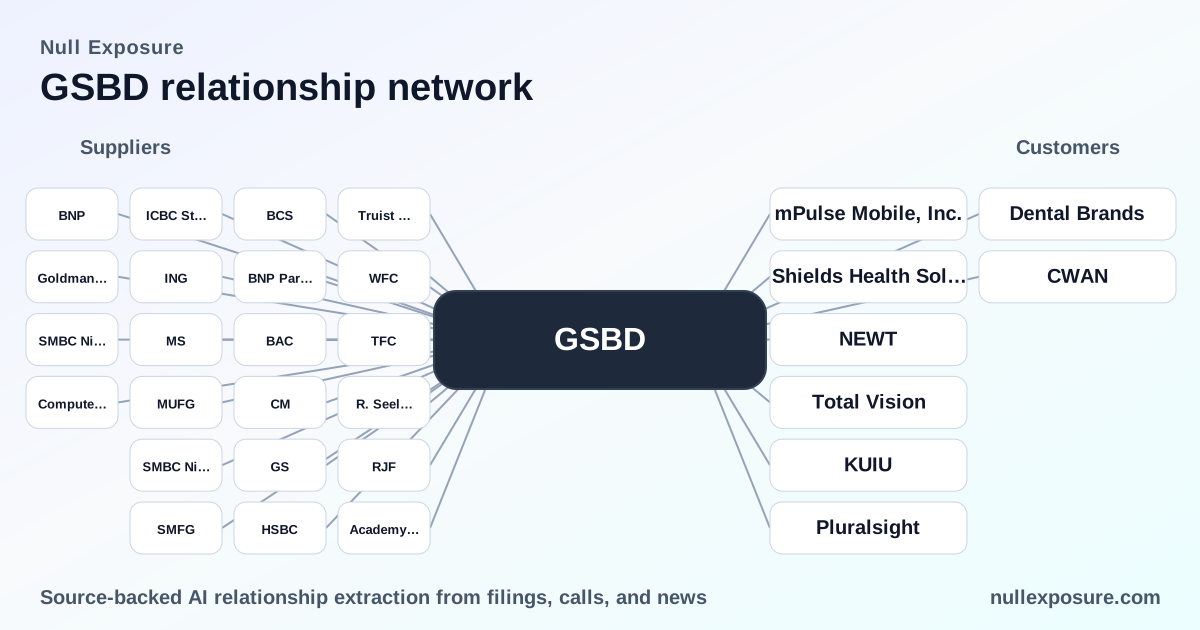
GSBD: How Goldman Sachs BDC Monetizes Private Credit and Where its Customers Fit
Goldman Sachs BDC Inc. (GSBD) originates and syndicates middle‑market private credit and selective equity co‑investments, monetizing through interest income, structuring and origination fees, and realized gains on exits, while returning cash via a robust distribution policy. The company leverages Goldman Sachs’ private credit platform for deal flow and capital markets access, targeting U.S. middle‑market borrowers with typical ticket sizes in the $10–75 million range and loan maturities usually between three and ten years. For investors, GSBD’s economics are a function of underwriting discipline, sponsor relationships inside the Goldman franchise, and the trajectory of nonaccruals in its portfolio. Explore the customer relationships below to see how those dynamics play out at the borrower and sponsor level. For more on GSBD coverage and signals, visit https://nullexposure.com/.
The operating model in plain terms: what underpins returns and risks
GSBD is a specialty finance vehicle with a concentrated, active private credit program aimed at U.S. middle‑market companies. Key business model characteristics that shape investor outcomes:
- Long‑dated exposures and structural illiquidity. GSBD targets loans with three‑to‑ten year maturities and typically deploys capital over multi‑year hold periods; this is an intentionally long‑term contracting posture that supports higher yields but reduces near‑term liquidity.
- Mid‑market counterparty profile. The firm focuses on U.S. middle‑market borrowers (companies typically between $5m and $200m of EBITDA), a segment underserved by banks and public debt markets, which creates premium spread opportunities and idiosyncratic credit risk.
- Geographic concentration in North America. The portfolio is primarily U.S.‑centric, which concentrates macro and sector exposure by region.
- Active managerial posture. As a BDC, GSBD provides managerial assistance and ongoing portfolio monitoring, aligning it more as a hands‑on debt and equity investor than a passive lender.
- Sector tilts that matter. Software and health‑care related investments are prominent, which drives both upside (higher growth borrowers) and downside (cyclical stress in software valuations).
- Ticketing and spend band. Typical investment sizes fall in the $10m–$100m band, consistent with mid‑market private credit vehicles.
These company‑level signals explain why GSBD trades at a discount to book (Price/Book ~0.80) while offering a high distribution yield (roughly 12.7% annualized based on the latest dividend information), reflecting yield pickup for credit and illiquidity risk.
Relationship ledger: every customer and counterpart named in GSBD’s disclosures
Below are every customer and portfolio/company relationship referenced in the compiled results, with concise plain‑English summaries and source references.
mPulse Mobile, Inc.
GSBD recorded the sale of Zodiac Intermediate, LLC (doing business as Zipari) to mPulse Mobile, Inc., classifying that holding as a non‑income producing security in FY2024. This is a realized disposition of a portfolio interest rather than a continuing lending relationship. According to GSBD’s 2024 Form 10‑K, the Zodiac/Zipari transaction involved mPulse Mobile as the buyer (FY2024 10‑K).
Shields Health Solutions
GSBD highlighted its role in financing the acquisition of Shields Health Solutions, demonstrating the synergy between the Goldman franchise and GSBD deal flow where the franchise’s origination capabilities are deployed to source private credit opportunities. This was noted in GSBD’s Q3 2025 earnings call transcript coverage (Q3 2025 earnings call summary reported on InsiderMonkey).
NEWT / Newtek Merchant Solutions
GSBD made a financing to support Newtek Merchant Solutions, the payments‑services subsidiary of Newtek, showing the BDC’s participation in sponsor‑backed or corporate strategic financings for financial‑services businesses. The investment was discussed in GSBD’s Q3 2025 commentary (Q3 2025 earnings call transcript reported on InsiderMonkey).
Total Vision
Total Vision—a California operator of optometry practices—repaid GSBD in full, including both a credit facility and an equity co‑investment, representing a realization event with principal recovery. Management cited the payoff as a notable collection in the quarter during the Q3 2025 earnings remarks (Q3 2025 earnings call transcript reported on InsiderMonkey).
KUIU
GSBD acted as sole lead arranger on the acquisition financing for KUIU, an e‑commerce native apparel brand focused on outdoor enthusiasts, indicating GSBD’s role as lead lender and arranger on sponsor or strategic acquisitions. This action was described in the Q4 2025 earnings commentary (Q4 2025 earnings call transcript reported on InsiderMonkey).
Clearwater Analytics (CWAN)
Two distinct interactions are disclosed: first, Goldman Sachs is a customer of Clearwater across Asset & Wealth Management and Global Banking and Markets, which signals platform level vendor relationships; second, GSBD committed to own $75 million of a unitranche financing supporting Clearwater’s take‑private by Warburg Pincus and Permira, after the GS private credit complex initially underwrote the $3.5 billion facility. Both the customer relationship and the $75 million GSBD allocation were discussed during GSBD’s Q4 2025 earnings call (GSBD Q4 2025 earnings call and the Q4 2025 transcript reported on InsiderMonkey).
Pluralsight
As of December 31, 2025, GSBD placed Pluralsight’s first lien / senior secured debt on nonaccrual status, indicating realized credit stress requiring interest stop‑accrual treatment and potential principal impairment. Management disclosed this status in the Q4 2025 earnings commentary (Q4 2025 earnings call transcript reported on InsiderMonkey).
Dental Brands
GSBD recorded a new investment on nonaccrual at Dental Brands, signposting credit deterioration in at least one portfolio company and contributing to near‑term earnings volatility. This was referenced in the Q3 2025 earnings call discussion (Q3 2025 earnings call transcript reported on InsiderMonkey).
What the relationship map implies for investors
- Active origination and sponsor partnerships are core to GSBD’s engine. The mix of lead‑arranger roles (KUIU), sponsor financings (Newtek, Shields), and syndication participation (Clearwater) reflects a business model that leverages Goldman Sachs’ distribution and underwriting platform to access middle‑market deal flow.
- Credit stress is visible but contained. Nonaccruals at Pluralsight and Dental Brands show credit volatility within the portfolio; these events increase near‑term NAV pressure but also reflect the typical risk profile of higher‑yielding middle‑market lending.
- Realizations and repayments drive realized gains/losses. Payoffs like Total Vision and asset dispositions (Zipari sale to mPulse) illustrate the path to capital recovery and recycling.
- Concentration and sector tilt matter. With sizable allocations to Software and Health Care Providers & Services, sector cycles will disproportionately affect GSBD’s mark‑to‑market and future originations.
- Sponsor and franchise backing are structural advantages and concentration risks. The Goldman platform reduces sourcing friction and distribution costs yet concentrates origination dependency inside the franchise.
Risks and monitoring priorities for operators and investors
- Watch nonaccrual trajectory and loss severity, particularly among software and health‑care credits.
- Monitor sponsor syndication activity—GSBD’s retained portions versus sell‑downs will reveal balance‑sheet appetite and concentration.
- Track liquidity and distribution sustainability, given the long maturity profile and structural illiquidity of private credit holdings.
- Assess platform reliance: the Goldman franchise is a competitive advantage but also a source of concentration risk if origination mix or pricing shifts.
Bottom line and next steps
GSBD is a yield‑oriented, Goldman‑franchised private credit vehicle with long‑term, mid‑market exposures that generate income through interest, fees and occasional realizations, while carrying credit and concentration risks inherent to the space. For deeper signal analysis and to monitor changes in GSBD’s customer and portfolio relationships over time, visit https://nullexposure.com/.
If you want a tailored briefing on GSBD’s credit exposure or a rolling watchlist of its largest portfolio credits, head to https://nullexposure.com/ for research coverage and updates.