Goosehead Insurance (GSHD): Franchise-driven distribution with usage-based royalties
Goosehead Insurance operates a franchised personal-lines insurance distribution network that monetizes through franchise fees, ongoing royalty streams tied to commissions, and direct agency commissions. The company sells the rights to operate Goosehead-branded agencies under ten-year franchise agreements, recognizes franchise revenue over that contract life, and collects usage-linked royalties—20% of new-policy commissions and 50% of renewal commissions—so revenue scales with policies in force and carrier placement activity. For relationship mapping and primary-source signals on Goosehead partner activity, see Null Exposure’s coverage at https://nullexposure.com/.
Why the model produces predictable, but growth-dependent cash flow
Goosehead’s commercial design blends the stability of long-duration contracts with the variable economics of commission-sharing. Long-term franchise terms align incentives and smooth initial franchise-fee recognition over a ten-year life, while the royalty split creates a durable annuity tied to retention and cross-sell success. According to company disclosures, franchise agreements explicitly run for ten years and the firm recognizes revenue across the life of those contracts.
Key operating-model signals investors should internalize:
- Contracting posture: Ten-year franchise agreements create multi-year revenue visibility and lock in brand economics.
- Pricing mechanics: Revenue is heavily usage-based—Goosehead receives 20% of new-business commissions and 50% of renewal commissions for franchise-originated policies.
- Concentration and geography: Goosehead derives revenue entirely from the United States and is registered as a franchisor in all 50 states, so national regulatory exposure is material but concentrated to U.S. insurance regimes.
- Role and criticality: The company functions as a distribution-first business—a seller, distributor, and service provider that aggregates carrier access for personal-lines customers.
- Maturity and scale: The firm reported 1,674,000 policies in force and 1,103 operating franchises as of December 31, 2024, with the latter declining 10% year-over-year—evidence of scale but also sensitivity to franchise economics and churn.
Those structural characteristics explain why Goosehead posts steady revenue (Revenue TTM: $382.2M; Gross Profit TTM: $183.6M) yet remains highly levered to franchise growth, retention rates, and carrier commission levels.
How to read contract-level constraints as investor signals
Goosehead’s published constraints are not operational footnotes — they are investment drivers. The ten-year franchise term reduces short-term revenue volatility but also defers upfront cash recognition and ties long-term valuation to renewal behavior and lifetime policy economics. The usage-based royalty mix amplifies the impact of policy count growth and retention: incremental policies translate directly into royalty income, while attrition erodes the annuity base. Because the business is U.S.-centric, regulatory changes or carrier commission shifts in key states can have outsized effects. Finally, the company’s classification as an insurance-distribution single segment reinforces that market share in distribution is the primary lever for margin expansion.
Customer relationships and recent partner activity
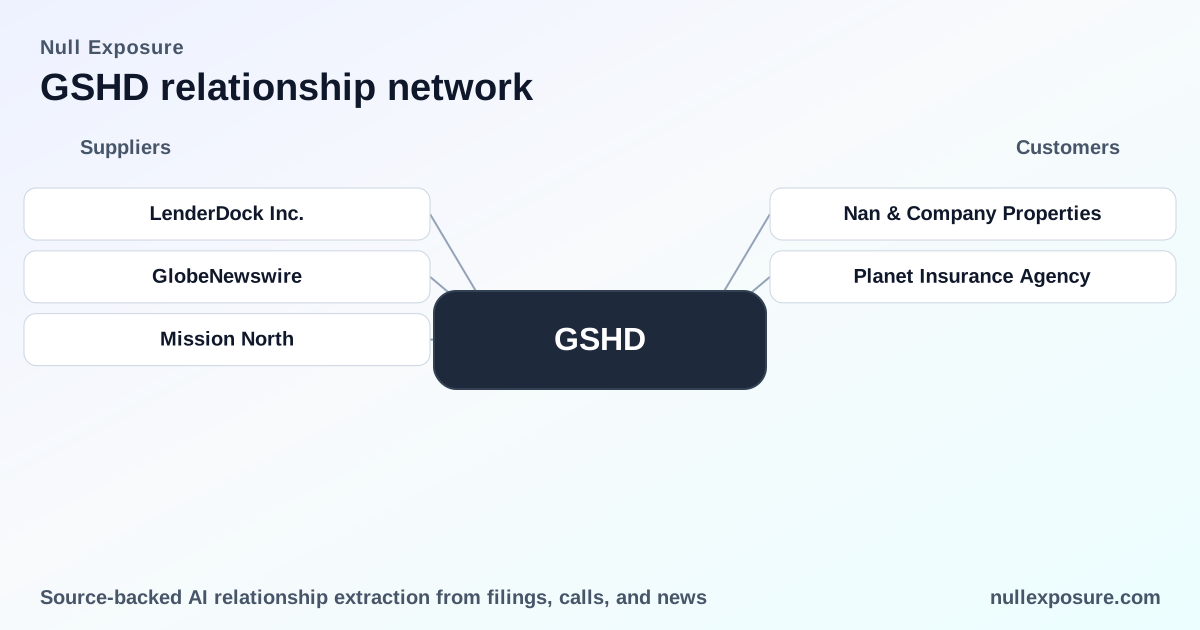
Below are the customer and partner relationships surfaced in public media and filings. Each relationship is summarized in plain English with source context.
-
Nan & Company Properties — strategic franchise expansion in Houston. Goosehead expanded a strategic franchise arrangement with Nan & Company Properties, Houston’s leading luxury real estate brokerage and the exclusive Houston affiliate of Forbes Global Properties, to enhance client experience in that market. This partnership was announced via a GlobeNewswire release in September 2025. (GlobeNewswire, Sep 18, 2025)
-
Planet Insurance Agency — new strategic franchise partner to simplify homeowners insurance shopping. Planet Insurance Agency publicly announced a strategic franchise partnership with Goosehead designed to streamline homeowners insurance buying; the tie-up received broad press distribution in February 2026 via GlobeNewswire and subsequent republications. Multiple company releases and news outlets carried the announcement. (GlobeNewswire, Feb 5, 2026; additional coverage: GlobeNewswire Feb–Mar 2026 press releases and Manila Times / QuiverQuant republishes)
-
WPM (Wheaton Precious Metals) — incidental mention unrelated to Goosehead’s agency business. A press release referencing Wheaton Precious Metals used the word “Goose” in the context of mining assets (e.g., Salobo, Peñasquito, Goose and Mineral Park) and is an incidental lexical overlap rather than an insurance relationship; it does not represent a customer or strategic partner for Goosehead Insurance. (The Globe and Mail coverage of WPM, Mar 10, 2026)
What these relationships reveal about go-to-market execution
The Nan & Company Properties and Planet Insurance Agency announcements underline the firm’s dual approach to growth: co-branded luxury distribution partnerships and expansion through independent franchise signings. Partnerships with real-estate brokerages and independent agencies accelerate customer acquisition by embedding insurance distribution into primary consumer transactions, and the Planet announcement shows Goosehead continues to execute on franchise recruitment and channel diversification in early 2026.
The Wheaton Precious Metals reference is non-operational for Goosehead and highlights the importance of human review when parsing automated mentions.
Risks, levers, and an investor checklist
Investors should weigh these dynamics when sizing exposure to GSHD:
- Levers: Franchise growth, policy-in-force expansion, renewal rates, carrier commission levels, and successful cross-sell all drive upside because of Goosehead’s royalty splits and agency commission capture.
- Risks: Declining franchise counts (a 10% drop noted in 2024), adverse changes in carrier commission structures, state-level franchisor regulation, and retention headwinds can compress the annuity base and earnings multiple.
- Financial positioning: The company’s market capitalization (~$1.55B), positive operating margin profile and 2026 forward P/E (~20.8) reflect growth expectations but require consistent execution on franchise recruitment and policy retention.
Bold takeaway: Goosehead’s value is the present value of a long-duration royalty annuity built from franchise-sourced policies; execution risk sits squarely in franchise economics and retention.
For a closer view of partner announcements and to track new relationship signals, consult Null Exposure at https://nullexposure.com/ for source-linked summaries and continuous monitoring.
Conclusion — the investor call
Goosehead is a distribution-first, franchise-led play on personal-lines insurance with clear monetization via long-term franchise agreements and usage-linked royalties. The recent partner announcements—particularly the Planet Insurance Agency franchise and the Nan & Company Properties expansion—underscore continued go-to-market activity, but investors must monitor franchise trajectory and policies-in-force retention as leading indicators for revenue cadence and margin expansion.