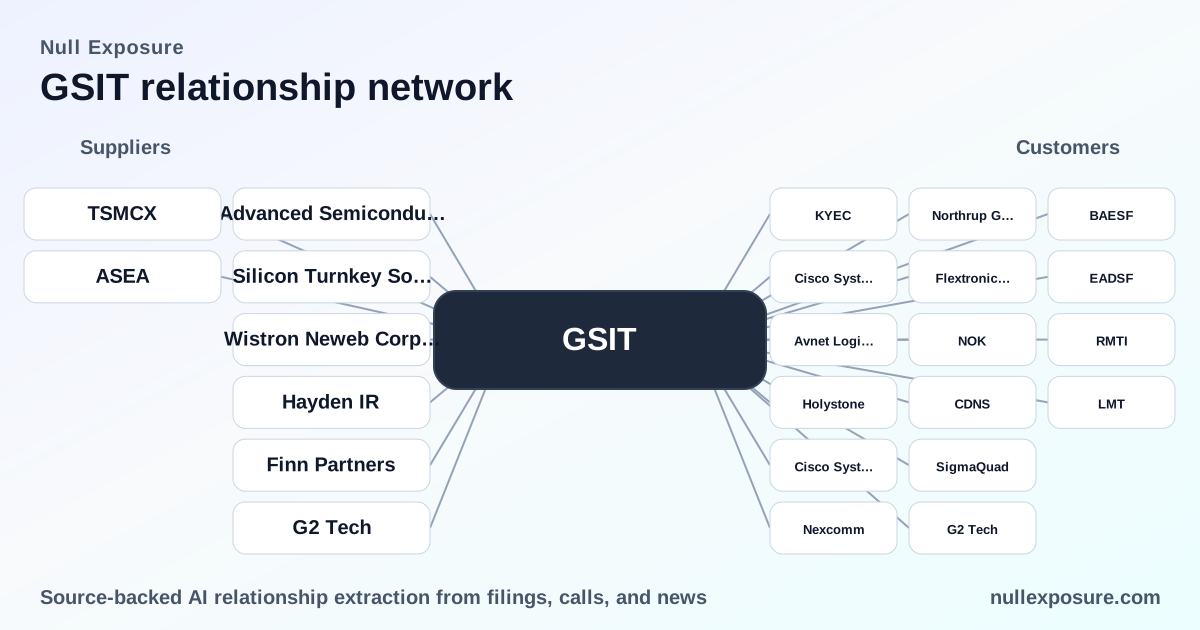
GSI Technology (GSIT): Customer Map, Concentration Risks and Commercial Signals Investors Need
GSI Technology designs and sells high‑performance SRAM and compute‑in‑memory AI chips (the Gemini series) and monetizes through hardware sales (SRAM and Gemini chips), distribution channels, direct OEM contracts and a growing APU-as-a-service cloud offering. Revenues remain concentrated in distributors and a handful of OEMs, while recent government awards and POCs expand channel diversity into defense and edge‑AI programs—an important strategic pivot for value creation.
If you want the full company overview and related analytics, see NullExposure’s research hub: https://nullexposure.com/.
What the revenue mix tells you about GSIT’s operating model
GSI runs a hybrid commercial model that is hardware‑centric, distribution‑driven and increasingly service‑focused. The FY2025 10‑K shows roughly 99% of revenue from SRAM products and a revenue split dominated by distributors (distribution ~ $18.8M of $20.5M in FY2025), which creates a contracting posture of short‑term, purchase‑order sales while the company incubates longer‑term subscription-like APU services that run in datacenters with AWS connectivity. The result: high operational leverage on chip shipments, strong channel dependency, and an early stage services path that can increase recurring revenue if scaled.
Key company‑level signals:
- Short‑term purchasing: sales primarily under one‑to‑twelve month purchase orders (company filing language).
- Distributor concentration: Avnet Logistics accounted for roughly half of net revenues in FY2025 (10‑K disclosure).
- Hardware first, services emerging: Gemini I is in production while “APU as‑a‑service” is offered on datacenter servers with AWS links (company reports).
- Global footprint: net revenues shipped to the U.S., China, Singapore, Germany, Netherlands and other regions (FY2025 revenue table).
- Government engagement: the company engages in SBIR‑funded contracts and recognizes awards under prototype agreements (company disclosure).
For additional context on GSIT’s positioning and signals, visit https://nullexposure.com/.
Relationship roster: who buys GSIT products and why it matters
Below are every customer and partner referenced in the disclosure set, each with a concise plain‑English summary and source note.
KYEC
KYEC was GSIT’s largest end‑user customer in FY2025 and continues to be a major buyer of SRAM, with meaningful quarterly sales reported (e.g., $1.1M or 17.9% of net revenues in Q3 FY2026). Source: GSIT FY2025 10‑K and Q3 FY2026 earnings disclosures and press release (Mar 2026).
Cisco Systems, Inc.
GSIT maintains a long‑standing master purchase agreement dated August 31, 2011 with Cisco, indicating multi‑year transactional terms with a large networking OEM. Source: FY2025 10‑K (contract disclosure).
Cisco Systems International B.V.
A separate master purchase agreement entry for Cisco’s international entity documents GSIT’s commercial relationships with Cisco’s global procurement footprint. Source: FY2025 10‑K (contract disclosure).
Northrup Grumman
Listed among OEM customers that purchased more than the company’s material threshold in FY2025, indicating defense OEM demand for GSIT SRAMs. Source: FY2025 10‑K (representative customer list).
Avnet Logistics
Primary distributor: Avnet Logistics accounted for approximately 49.6% of net revenues in FY2025 (roughly half the company’s sales), underscoring extreme channel concentration risk. Source: FY2025 10‑K (revenue by distributor).
Nexcomm
Named as a distributor with identifiable percent splits in disclosure tables (e.g., Nexcomm accounted for ~9.8% in a period), representing secondary distributor channel exposure. Source: FY2025 10‑K (distributor table).
Holystone
Included in distributor reporting with material percentage contributions in FY2026 reporting, representing another channel partner in distribution sales. Source: FY2025 10‑K (distributor table).
Flextronics Technology
Identified as a contract manufacturer partner (listed as "Flextronics Technology" with percent shares), indicating outsourcing of assembly for end OEMs that buy GSIT components. Source: FY2025 10‑K (contract manufacturer disclosure).
NOK (ticker entry)
Public references and earnings commentary use the ticker NOK when reporting sales to Nokia (e.g., sales of $536k or 8.5% in a prior quarter and $675k or 11.1% in Q3 FY2026). Source: Q3 FY2026 earnings call transcript and press releases (Mar 2026).
Nokia
Nokia is both an OEM customer and historically GSIT’s largest end‑user in fiscal 2024 and 2023; recent quarters show volatile but material purchases (reported $675k in Q3 FY2026). Source: FY2025 10‑K and Q3 FY2026 earnings materials (Mar 2026).
U.S. Army
GSIT was awarded a Phase‑II SBIR contract to develop a ruggedized edge AI platform using the Gemini‑II APU for tactical defense applications, a government‑funded program valued at approximately $2.0M per press reporting. Source: GlobeNewswire / ManilaTimes / Investing.com press releases (May 2026).
Cadence Design Systems (CDNS)
Cadence is a customer for AI chip emulation systems; sales swung materially from ~$1.4M in one quarter to $233k (3.8% of net revenues) in Q3 FY2026, highlighting customer demand volatility among engineering partners. Source: Q3 FY2026 earnings press release and transcript (Jan–Mar 2026).
CDNS (ticker entry)
References to Cadence under its ticker CDNS mirror the same commercial volatility and were repeated across earnings and press commentary. Source: Q3 FY2026 materials and media coverage (Mar 2026).
SigmaQuad
SigmaQuad accounted for a large portion of third‑quarter shipments (41.7% in Q3 FY2026), indicating outsourced manufacturing or a key fulfillment partner for certain production runs. Source: Q3 FY2026 press release (Jan 29, 2026).
G2 Tech
GSI has formalized a POC and agreement with Israel’s G2 Tech to integrate Gemini‑II into the "Sentinel" autonomous perimeter security system and other proof‑of‑concept integrations; multiple press reports and earnings transcripts reference this strategic partner. Source: GlobeNewswire press release and multiple media items (Jan–Mar 2026).
BAE Systems
Listed in the FY2025 10‑K among OEMs that purchased above the material threshold, signifying aerospace/defense OEM demand for SRAM products. Source: FY2025 10‑K (representative customer list).
Airbus
Named as a representative OEM customer in FY2025 filings, evidence of GSIT sales into commercial aerospace systems through OEM supply chains. Source: FY2025 10‑K (representative customer list).
EADSF
EADSF appears as the market ticker reference for Airbus in company disclosure tables, reflecting the same Airbus OEM relationship recorded in FY2025. Source: FY2025 10‑K (revenue by OEM disclosure).
Lockheed
Included on the FY2025 representative OEM list, indicating defense contractor demand for SRAM components. Source: FY2025 10‑K (representative customer list).
Rockwell
Named in the same FY2025 OEM list, representing industrial/aerospace systems demand for GSIT’s SRAM products. Source: FY2025 10‑K (representative customer list).
Strategic implications for investors
- Concentration risk is real and measurable: a single distributor (Avnet Logistics) approaches half of revenue, and a handful of OEMs account for material amounts—this constrains pricing power and operational resilience.
- Short‑term contracting dominates: most sales occur under near‑term purchase orders, heightening revenue volatility tied to order timing (10‑K language).
- Path to recurring revenue exists but is early: APU‑as‑a‑service and defense SBIR awards create a pathway to higher‑margin, recurring engagements if GSIT can commercialize and scale Gemini‑II; current references show active POCs and a Phase‑II Army contract.
- Geographic diversification vs. counterpart concentration: GSIT ships globally, but its business remains channel‑concentrated—global footprint does not eliminate counterparty risk.
Bottom line: GSIT is a small, hardware‑first semiconductor supplier with meaningful distributor concentration and emerging government and service contracts that provide upside if Gemini‑II converts. Investors should weigh near‑term top‑line volatility from short‑term orders against the strategic optionality from government SBIR awards and G2 Tech POCs.
For a deeper look at relationships and risk scoring, explore our detailed coverage at NullExposure: https://nullexposure.com/.