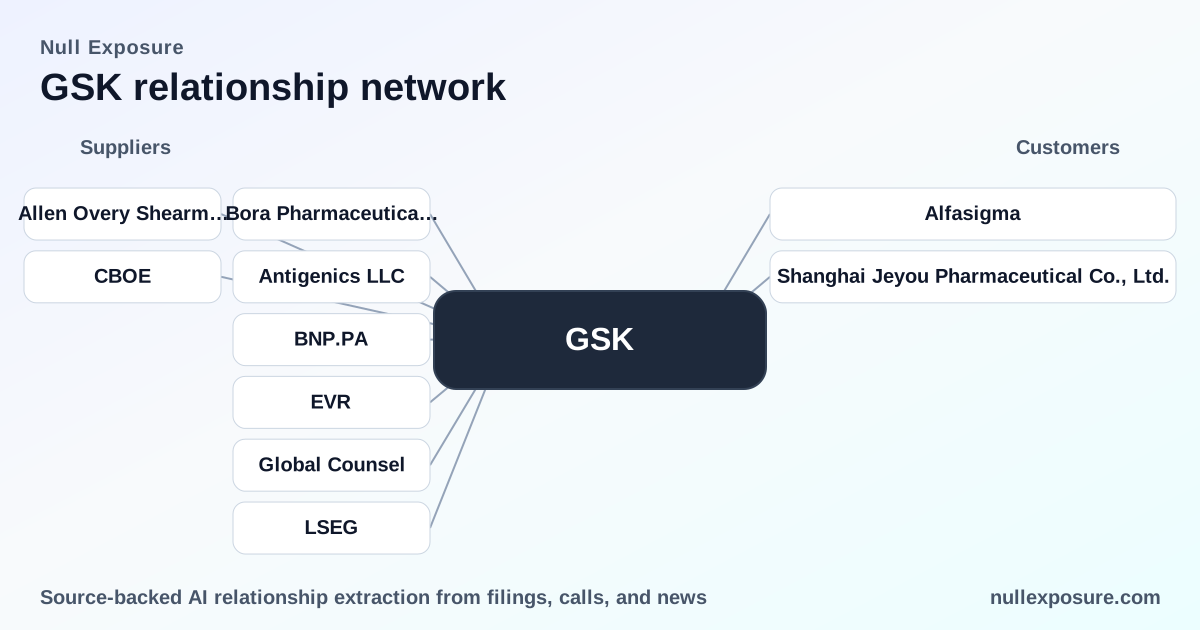
GSK’s customer web: licensing, manufacturing and co-development that drive cash flow
GlaxoSmithKline (GSK) operates as a diversified healthcare company that monetizes through three clear channels: product sales (pharma, vaccines, consumer healthcare), licensing/royalties from out‑licensed compounds, and fee‑for‑service manufacturing or collaboration income. The company’s balance of mature specialty medicines, recurring vaccine manufacturing contracts and ongoing out‑licenses creates predictable revenue while enabling strategic redeployment into next‑generation oncology and immunology assets. For investors evaluating counterparty exposure, GSK’s customer relationships illustrate a deliberate operating posture: active asset sales and licensing, selective manufacturing partnerships, and multiple clinical co‑development arrangements. Learn more at https://nullexposure.com/.
Why relationships matter: what to watch in GSK’s customer footprint
GSK’s public relationships signal several firm-level characteristics relevant to underwriting credit or equity risk:
- Contracting posture: GSK routinely executes licensing and asset‑sale transactions and takes manufacturing commitments, indicating a willingness to divest non‑core assets while retaining upside via milestones and royalties.
- Concentration and diversification: The company manages many bilateral deals across small biotechs and regional partners, reducing single‑counterparty revenue concentration but increasing operational complexity.
- Criticality: Vaccine fill‑and‑finish and clinical combination trials suggest some partnerships are high‑criticality for counterparties (and for GSK’s manufacturing capacity utilization).
- Maturity: Relationships range from early‑stage trial collaborations to multi‑year commercial licenses and acquisitions, reflecting a portfolio approach across development life cycles.
These operating signals support a view of GSK as a hybrid developer/manufacturer that leverages licensing and contract manufacturing to both monetize assets and accelerate external innovation. If you want a quick portfolio view of these customer ties, visit https://nullexposure.com/ for deeper relationship analytics.
Line‑by‑line: every customer relationship in the sample
Below are concise, plain‑English summaries of each relationship captured in the results, with a source noted for each.
Anaptys (ANAB)
Anaptys discovered and out‑licensed several therapeutic antibodies and already out‑licensed the PD‑1 antagonist Jemperli (dostarlimab‑gxly) to GSK, demonstrating GSK’s role as an acquirer/licensee of late‑stage biologics. Source: Sahm Capital JP Morgan Healthcare conference recap (Jan 2026).
Alfasigma
GSK sold rights to a drug candidate to Alfasigma for up to $690 million, an example of GSK monetizing non‑core assets through upfronts and contingent payments. Source: Finviz reporting on GSK transaction announcements (FY2026).
Novavax (NVAX)
GSK agreed to provide fill‑and‑finish capacity for 60 million doses of Novavax’s COVID‑19 vaccine for UK supply, showing GSK’s commercial manufacturing capabilities are leveraged as a revenue stream. Source: European Pharmaceutical Review (Mar 2026).
Zai Lab (ZLAB)
Zai Lab holds an exclusive license from GSK to develop and commercialize ZEJULA in mainland China, Hong Kong and Macau, illustrating how GSK outsources regional commercialization to local partners while retaining royalty upside. Source: BioSpace (reporting on NRDL updates; FY2025) and FierceBiotech coverage of Zai Lab’s licensing history (FY2026).
LIXTE Biotechnology (LIXT)
GSK is supporting clinical trials that combine LIXTE’s LB‑100 with GSK’s dostarlimab, including expanded trial sites at MD Anderson and Northwestern, indicating active trial collaboration and drug‑supply support. Source: GlobeNewswire / company press releases and related USAToday & NewMediaWire coverage (FY2025–FY2026).
Summit Therapeutics (SMMT)
Summit has partnered with GSK to evaluate ivonescimab in combination with other agents across solid tumors, reflecting GSK’s role as a clinical combination partner in oncology programs. Source: InsiderMonkey (reporting on Summit’s trial partnerships; FY2026).
Surface Oncology (SURF)
Surface Oncology maintains a license agreement with GlaxoSmithKline Intellectual Property Limited to develop and commercialize antibodies targeting SRF114, demonstrating a past licensing relationship allowing external developers to push GSK‑originated science forward. Source: Investing.com company profile (referencing FY2018 license arrangements).
Wave Life Sciences (WVE)
GSK transferred rights to WVE‑006 for alpha‑1 antitrypsin deficiency to Wave, an example of GSK reallocating development assets to specialty biotech partners. Source: Finviz commentary on program transfers (FY2026).
Tango Therapeutics (TNGX)
Tango entered a multi‑asset strategic collaboration with GSK to discover and develop DNA damage response inhibitors, giving Tango access to GSK’s libraries and development expertise while GSK expands its DDR pipeline exposure. Source: Canaccord Genuity coverage reported via MarketBeat (Apr 2026).
Alector (ALEC)
Alector is developing progranulin programs (including latozinemab / AL001 and AL101) in collaboration with GSK, reflecting a multi‑year R&D partnership in neurodegeneration. Source: StockTItaner financial release and ALS News Today background (FY2021 & FY2025 mentions).
Shanghai Jeyou Pharmaceutical Co., Ltd.
Following GSK’s acquisition of a controlling stake in RAPT Therapeutics, GSK assumed responsibility for success‑based milestone and royalty payments owed to RAPT’s partner Shanghai Jeyou, underscoring how acquisitions shift downstream payment obligations to regional partners. Source: MarketScreener coverage of GSK’s stake acquisition in RAPT (Mar 2026).
Spero Therapeutics (SPRO)
Spero closed a collaboration with GSK to advance tebipenem HBr, showing GSK’s involvement in partnering for antibiotic and anti‑infective assets. Source: CityBiz reporting on Spero’s corporate developments and the GSK collaboration (FY2023).
Investment implications and risk considerations
- Revenue optionality: GSK’s mix of asset sales, licensing royalties and contract manufacturing provides multiple near‑term cash sources, which supports free cash flow even as R&D is reweighted toward selective in‑house priorities.
- Execution risk: Manufacturing commitments (e.g., Novavax fill‑and‑finish) are operationally critical and can strain capacity during peak vaccine programs; successful execution is a material driver of near‑term cash.
- Counterparty and geographic exposure: Licensing to regional partners (Zai Lab, Shanghai Jeyou) reduces commercialization burden but creates dependency on local market execution and regulatory outcomes for royalty realization.
- Pipeline strategy: GSK’s willingness to transfer rights (Wave, Alfasigma) and engage in co‑development (LIXTE, Tango, Alector) signals a portfolio approach that favors capital efficiency and selective internal commercialization.
Bottom line
GSK’s customer relationships present a coherent commercial strategy: monetize where scale is unnecessary, manufacture where scale is valuable, and collaborate where scientific complementarity exists. For investors and operators, the key action is to track milestone schedules, royalty streams and manufacturing throughput, as these are the levers that convert partnership activity into cash and valuation. For a deeper, relationship‑level exposure map tailored to investment diligence, visit https://nullexposure.com/.