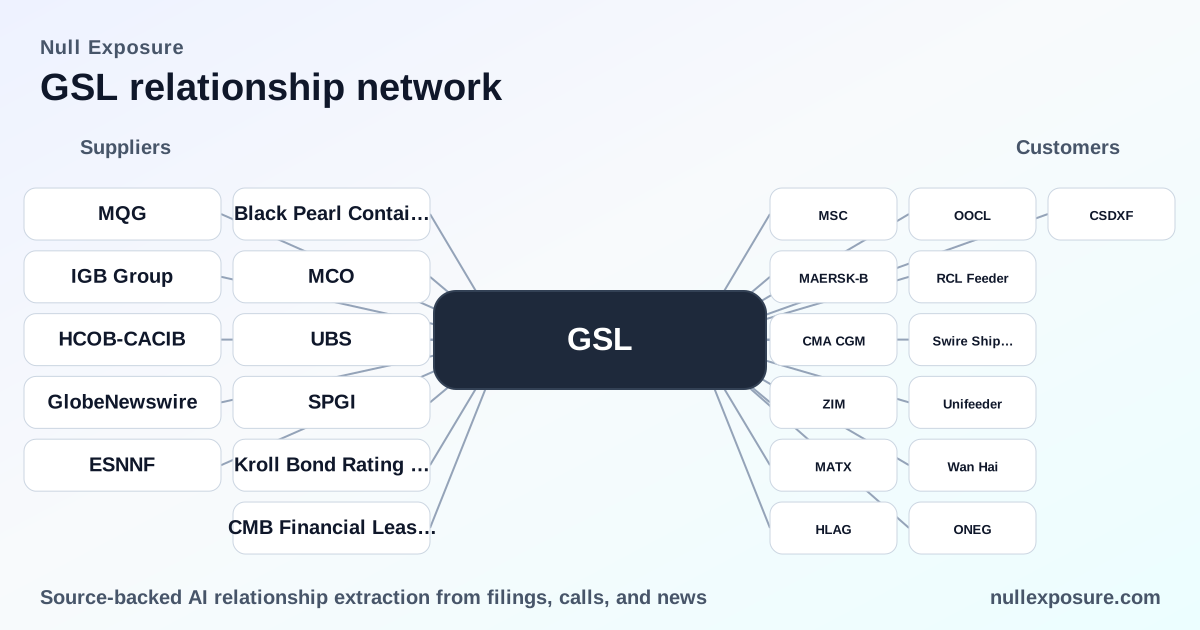
Global Ship Lease (GSL): Counterparty Map and Commercial Constraints
Thesis: Global Ship Lease (GSL) owns and leases container ships to major container carriers under fixed-rate time charters, generating predictable charter hire cash flow that underpins an above-market dividend and a capital-return profile; the business monetizes through long-duration charter revenues, asset value capture from vessel ownership, and opportunistic dividend distributions supported by strong 2025 operating margins and EBITDA. Explore the commercial relationships below to assess revenue concentration, counterparty credit exposure, and the durability of charter cash flows. Explore more on our homepage.
What GSL sells to the market: steady hire, asset-backed cash flow
GSL’s commercial model is straightforward: own container tonnage and lease it on industry-standard, fixed-rate time charters to container shipping companies, converting shipping market volatility into contracted cash flow. The company reported strong profitability and cash generation in its latest quarter (2025-12-31), with EBITDA of $467m, operating margin ~47%, and a dividend yield around 5.7%, which supports a high-distribution investor proposition. These financials reinforce the core underwriting point: charter contracts create predictable near-term cash flow while vessel values drive longer-term capital upside.
Key operating signals and business-model constraints investors should weigh
- Contracting posture: GSL uses long-term, fixed-rate time charters as its principal commercial instrument, which produces predictable revenue but links long-term upside to new charter pricing and vessel sales; this contracting stance reduces spot exposure. (See company press releases cited below.)
- Counterparty concentration: Reported charterer shares indicate heavy concentration among a few large liners—Maersk, Hapag-Lloyd, CMA CGM, MSC and ZIM together represent the majority of chartered days/value in the referenced disclosure—creating single-counterparty risk that influences underwriting and covenant design.
- Business criticality: For large carriers, leased vessels are operationally critical; these relationships are economically important to both parties—charterers need capacity; GSL needs counterparty credit quality.
- Maturity and diversity: The fleet list contains numerous named vessels across sizes and charter partners, indicating diversified asset types within a focused product (containership leases), which mitigates but does not eliminate concentration risk.
- Capital allocation posture: Management’s sustained dividend (dividend per share and recent declarations) highlights a distribution-first stance supported by current earnings and free cash flow. GSL’s valuation metrics (trailing P/E ~3.6, EV/EBITDA ~2.9) reflect both strong earnings and a cyclical asset sector discount.
If you want a linked view of these commercial relationships in a single place, visit our homepage for further context: nullexposure home.
Detailed counterparty list (every relationship in the sourced results)
- MSC — Global Ship Lease’s fleet listing explicitly includes vessels such as MSC Tianjin and MSC Qingdao, confirming MSC as a charterer in GSL’s portfolio; this is reflected in a MarketScreener dividend note from March 9, 2026 that enumerates fleet names and charterers. (MarketScreener, Mar 9, 2026)
- MSC — A GlobeNewswire recap republished by The Manila Times (Mar 5, 2026) lists MSC with an 11.25% share in the disclosed counterparty breakdown, confirming material exposure to MSC. (GlobeNewswire / Manila Times, Mar 5, 2026)
- Hapag‑Lloyd (HLAG) — The company’s reported counterparty breakdown assigns Hapag-Lloyd roughly 21.01%, making it a top-tier charter partner and a key source of contracted revenue. (GlobeNewswire / Manila Times, Mar 5, 2026)
- HLAG (duplicate entry) — The same GlobeNewswire release is indexed again referencing Hapag-Lloyd’s share in the charterer mix; the duplicate record reinforces Hapag-Lloyd’s prominence in GSL’s revenue composition. (GlobeNewswire / Manila Times, Mar 5, 2026)
- ZIM — ZIM is named among GSL’s charterers (examples include ZIM Norfolk and ZIM Xiamen) and is listed in the Manila Times breakdown at 8.76%, representing a meaningful mid‑tier exposure. (GlobeNewswire / Manila Times, Mar 5, 2026)
- Maersk (MAERSK‑B) — Maersk is the single largest counterparty in the cited breakdown at 30.26%, a concentration that materially influences GSL’s counterparty credit profile. (GlobeNewswire / Manila Times, Mar 5, 2026)
- Matson (MATX) — Matson is present in the counterparty table at a modest 0.76%, indicating limited exposure to this U.S. liner in the reported period. (GlobeNewswire / Manila Times, Mar 5, 2026)
- MATX (duplicate entry) — The duplicate listing of Matson/MATX in the same release corroborates the small but present relationship captured in the quarter‑end disclosure. (GlobeNewswire / Manila Times, Mar 5, 2026)
- Maersk (duplicate entry) — An additional indexed instance reiterates Maersk’s leading share in the charterer mix and the attendant concentration implication for revenues. (GlobeNewswire / Manila Times, Mar 5, 2026)
- CMA CGM — CMA CGM is identified among fleet counterparties (vessels such as CMA CGM Thalassa and CMA CGM Berlioz) and is assigned about 18.14% in the Manila Times summary, marking it as a top-three partner. (GlobeNewswire / Manila Times, Mar 5, 2026)
- ZIM (MarketScreener entry) — MarketScreener’s March 9, 2026 release that enumerates fleet names also includes ZIM‑chartered vessels, underscoring ZIM’s operational relationship with GSL. (MarketScreener, Mar 9, 2026)
- OOCL — The GlobeNewswire/Manila Times table groups COSCO & OOCL for China, representing 6.03% of the disclosed mix; OOCL is therefore a smaller but identifiable charterer in GSL’s portfolio. (GlobeNewswire / Manila Times, Mar 5, 2026)
- RCL Feeder — RCL Feeder appears in the Singapore group line (ONE, Swire Shipping, RCL Feeder) with the group representing 3.50%, indicating regional feeder relationships that complement larger liner counterparties. (GlobeNewswire / Manila Times, Mar 5, 2026)
- Swire Shipping — Listed alongside ONE and RCL Feeder at 3.50%, Swire Shipping is a regional counterparty in the Singapore feeder cluster. (GlobeNewswire / Manila Times, Mar 5, 2026)
- Unifeeder — Unifeeder shows up in the disclosure (Denmark/Dubai) with a small numeric allocation in the table (reported as 2 vessels/2.69 in the excerpt), signaling a limited but diversified exposure to short-sea feeder operators. (GlobeNewswire / Manila Times, Mar 5, 2026)
- Wan Hai — Wan Hai is listed with a minor share (0.29%) in the Manila Times / GlobeNewswire table, indicating a minimal direct charter exposure in the disclosed period. (GlobeNewswire / Manila Times, Mar 5, 2026)
- ONEG / ONE — The ONE group (ONE/ONEG) is listed in the Singapore grouping at 3.50%, indicating low-to-mid tier exposure to this major Asia‑Pacific carrier. (GlobeNewswire / Manila Times, Mar 5, 2026)
- ONE (duplicate entry) — A secondary index entry repeats ONE’s inclusion in the Singapore cluster, reinforcing the recorded exposure. (GlobeNewswire / Manila Times, Mar 5, 2026)
- CMA CGM (MarketScreener entry) — MarketScreener’s fleet enumeration (Mar 9, 2026) lists CMA CGM-operated vessels among GSL’s long-term charters, corroborating CMA CGM’s material role in the charterbook. (MarketScreener, Mar 9, 2026)
- COSCO — COSCO is grouped with OOCL in the China allocation (together ~6.03%), showing a modest combined exposure to state‑backed Chinese carriers. (GlobeNewswire / Manila Times, Mar 5, 2026)
- CSDXF — The CSDXF ticker appears in the same China grouping as COSCO/OOCL in the Manila Times summary, representing the indexed presence of those carriers in the client mix. (GlobeNewswire / Manila Times, Mar 5, 2026)
Investment implications — what the counterparty map means for investors
- Positive: Fixed-rate time charters and strong 2025 operating margins provide visible near-term cash flow to cover dividends; major global liner relationships support high utilization and revenue predictability.
- Risk: High customer concentration—with Maersk, Hapag-Lloyd, CMA CGM and MSC representing large shares—creates asymmetric single‑counterparty exposure that should be stress-tested in downside shipping cycles.
- Portfolio effect: Asset ownership creates a natural hedge—if charters reprice down, vessel sales or re-charters can restore value over time, but that pathway depends on ship‑price cycles and credit conditions.
Bottom line
Global Ship Lease’s business is contract-driven and asset-backed, offering predictable cash flow and a distribution-focused investor return profile, but with material counterparty concentration that requires active monitoring of liner credit quality and charter renewal schedules. For more structured counterparty analytics and to see these relationships in context, visit nullexposure.com.