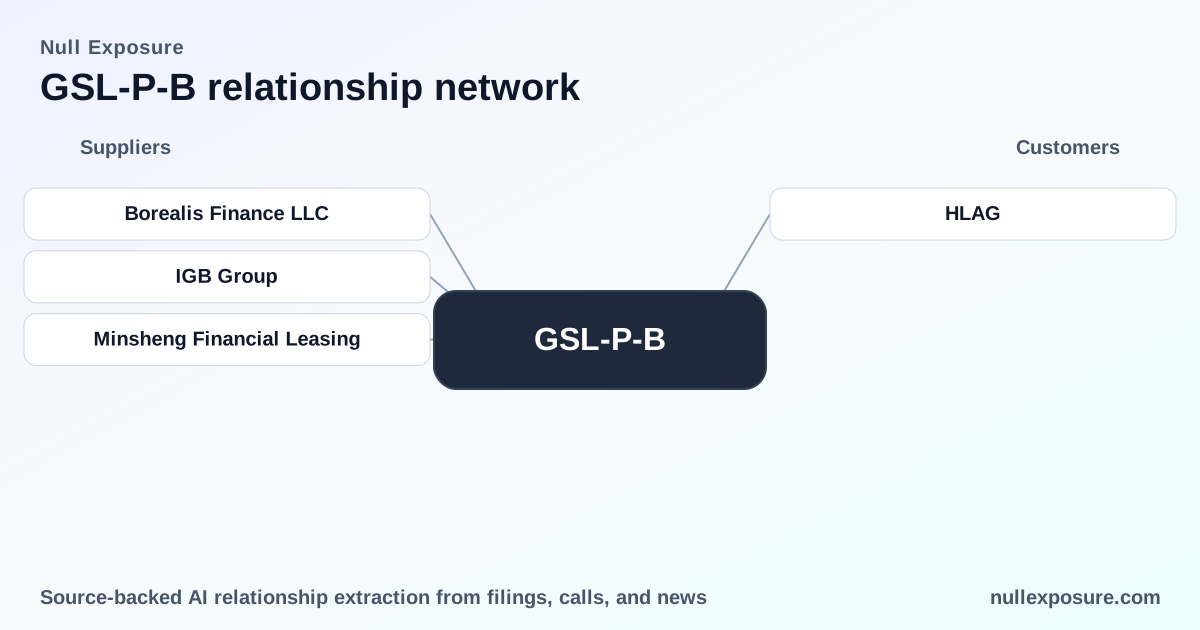
GSL-P-B: Customer map and what it says about lease economics and risk
Global Ship Lease (GSL) operates as a pure-play containership lessor that monetizes a fleet of vessels by placing them on industry-standard, fixed-rate time charters with global liner operators. The firm’s cashflow profile is driven by charter rates, contract lengths, and residual vessel values; earnings sensitivity is therefore a function of charter renewal pricing and counterparty mix rather than spot-market trading. Investors evaluating GSL-P-B should focus on charter counterparties, contract maturity ladders, and the degree to which rolling renewals expose distributable cash to a heating charter market. For more on coverage and signals, visit https://nullexposure.com/.
How GSL’s revenue engine works in plain terms
GSL buys and manages containerships and leases them to major liner companies under time charters, collecting steady charter income while retaining vessel ownership and value exposure. The business model is highly contractual: fixed-rate charters smooth near-term revenue while the company remains exposed to renewal pricing and secondhand market swings. That structure produces predictable short-term cashflows but creates leverage to macro charter rate cycles at renewal windows.
Commercial relationships you need to know (each record covered)
MSC — investing.com (FY2026)
MSC has been taking vessels from GSL as charters to Maersk Line expire, underscoring active fleet rotation and competitive renewal dynamics in the market; investors should watch the renewal pricing in a heating charter environment. According to an Investing.com earnings preview (May 2026), MSC is stepping in for some renewals, shifting counterparty mix going forward.
MSC — MarketScreener (FY2026)
GSL’s Q4 FY2026 operating commentary and fleet list published by MarketScreener confirms MSC as a named charterer for specific vessels such as MSC Tianjin and MSC Qingdao, reflecting direct bilateral relationships with the world’s largest private container operator. The MarketScreener earnings flash (Q4 FY2026) includes MSC-named vessels within GSL’s fleet roster.
HLAG (ticker HLAG) — Splash247 (FY2024)
GSL sold or acquired a boxship quartet that are on charter to Hapag‑Lloyd (HLAG) with median firm durations averaging 1.7 years and up to five years if options are exercised, highlighting staggered expiries and optionality in contract length. Splash247’s FY2024 coverage of the transaction identifies Hapag‑Lloyd as the immediate charter counterparty and provides the duration profile investors need to model near-term re-contracting exposure.
Hapag‑Lloyd — Splash247 (FY2024)
Reporting on the same transaction clarifies that German liner Hapag‑Lloyd operates the boxships under medium-term firm charters with extension options, which creates a predictable revenue window for GSL while leaving substantial optionality at later expiry points. Splash247’s March 2026 piece frames the contracts as multi-year with rollable options.
ZIM — MarketScreener (FY2026)
MarketScreener’s Q4 FY2026 summary lists ZIM-named vessels in GSL’s portfolio (for example ZIM Norfolk and ZIM Xiamen), indicating active exposure to a fleet of medium-size charters with an Israeli carrier. The company filing cited by MarketScreener confirms ZIM as a material lessee on named ships in GSL’s fleet list.
Maersk Line (ticker MAERSK‑B) — investing.com (FY2026)
Investing.com’s earnings note (May 2026) flags that some charters previously held by Maersk Line are rolling off and that MSC has taken positions after Maersk expiries, signaling that charter renewals with Maersk are an inflection point for GSL’s rate re-negotiations and stand as a benchmark for market pricing.
CMA CGM — MarketScreener (FY2026)
CMA CGM appears on GSL’s fleet list in the MarketScreener Q4 FY2026 earnings compilation (vessels such as CMA CGM Thalassa and CMA CGM Berlioz), confirming GSL’s ties to a diversified set of global liner brands and underscoring the company’s exposure to differentiated commercial terms across major carriers.
What the customer map implies for investors: operating model constraints and strengths
- Contracting posture: GSL predominantly operates under industry‑standard, fixed‑rate time charters, which creates near-term revenue visibility and concentrates renewal risk at contract expiries. The Marketscreener Q4 FY2026 release explicitly describes the firm’s use of fixed-rate time charters.
- Concentration and counterparty mix: The charter roster is weighted to large global liners (MSC, Maersk, CMA CGM, Hapag‑Lloyd, ZIM). That mix provides credit quality benefits but creates exposure to industrywide charter cycles; the company benefits from scale of counterparties but the economic fate of several contracts can move cashflow materially at re-pricing events.
- Criticality: Ships leased to major liners are mission‑critical assets for those customers; charters are strategically important to operators’ network planning, which supports contract continuity but also empowers large liners in renewal negotiations.
- Maturity and optionality: Reported median firm durations (for the Hapag‑Lloyd quartet) average around 1.7 years with option periods that extend to five years, generating a ladder of expiries that concentrate re-pricing risk over the next several reporting cycles. Splash247’s coverage provides the duration detail for those specific vessels.
Key investment implications
- Rate re‑pricing is the primary earnings lever. With fixed, time‑charter structures dominating the revenue base, forward earnings are highly sensitive to renewal pricing and the timing of expiries observed across MSC, Maersk, Hapag‑Lloyd, CMA CGM, and ZIM.
- Counterparty mix reduces default risk but not market risk. Large liner counterparties improve credit standing and operational continuity, but they also give GSL less pricing power at renewal, particularly when multiple expiries cluster.
- Optionality in charters is a double‑edged sword. Options that extend firm periods smooth short‑term cashflow but concentrate potential step‑ups or step‑downs into fewer decisive renewal moments.
Risks layered on top of the roster
- Concentrated re‑pricing windows can create episodic volatility in distributable cash if multiple contracts renew into weaker charter markets.
- Residual value exposure—secondhand ship prices and scrapping markets—remain a structural risk to long‑term NAV and loan collateral despite short‑term charter income.
- Competitive bid dynamics: As Investing.com noted in May 2026, MSC taking vessels after Maersk expiries indicates active competition for renewal slots; that bidding pressure affects achievable rates.
Bottom line and next steps
GSL’s customer list reads like a who’s‑who of container shipping, and that composition is both a strength for counterparty credit and a structural source of cyclicality at renewal windows. Investors should model renewal timing, counterparty-specific contractual options, and secondhand price scenarios to assess GSL‑P‑B cashflow durability. For a deeper examination of counterparty exposures and real‑time signal tracking, visit https://nullexposure.com/.
Sources referenced in-text include an Investing.com earnings preview (May 2026), MarketScreener Q4 FY2026 earnings flash, and Splash247 transaction reporting (March 2026).