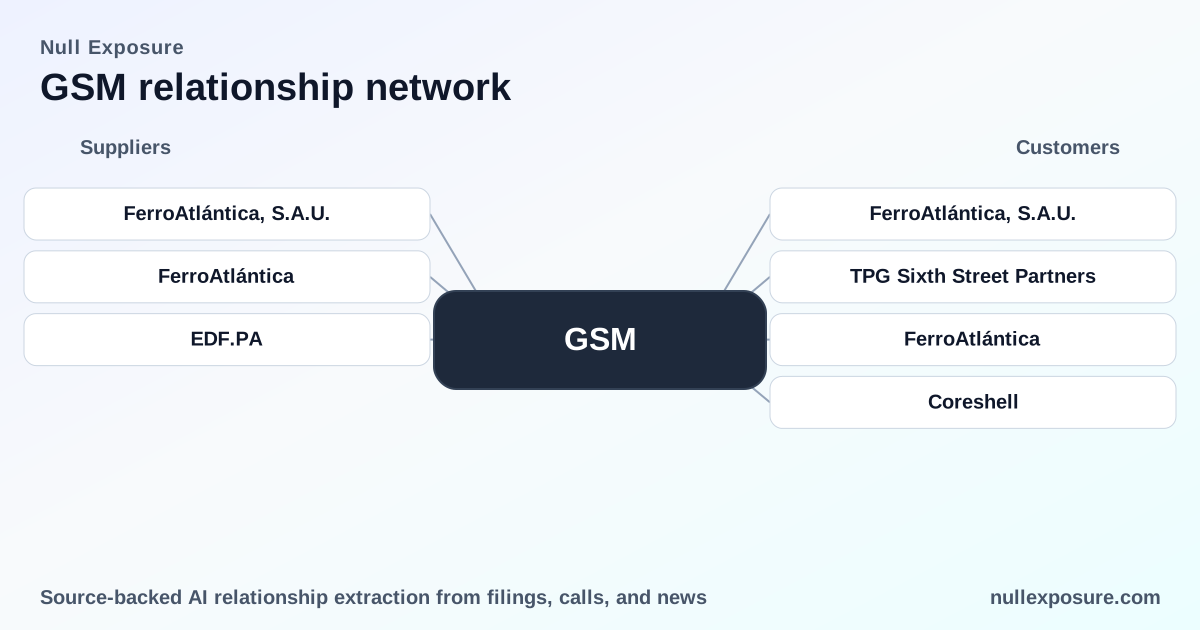
Ferroglobe (GSM) — Customer relationships that shape cash flow and strategic optionality
Ferroglobe PLC operates as a global producer of silicon and specialty metals, monetizing the business through the sale of ferroalloys, silicon products, and contract tolling arrangements with industrial customers. The company generates revenue from commodity and semi-specialty metal sales while using asset divestitures and long-term supply/tolling agreements to stabilize cash flow and limit capital intensity. Revenue trended at roughly $1.34 billion trailing twelve months with negative operating leverage reflected in recent margin and EPS metrics, underlining why customer contracts and strategic partners are central to the investment thesis. If you want a consolidated view of relationships that materially affect Ferroglobe’s commercial profile, visit https://nullexposure.com/ for full coverage.
Why customers and contracts matter more than commodity cycles right now
Ferroglobe’s business runs on two levers: commodity exposure and contractual revenue. When commodity prices compress, long-term off-take and tolling agreements provide revenue durability and optionality to monetize legacy assets without heavy capital outlay. Conversely, new technology partnerships have the potential to reshape demand mix if commercialization succeeds. The company’s recent history of asset sales combined with retained commercial linkages demonstrates a deliberate contracting posture that prioritizes cash generation and operational flexibility over owning every node of the value chain.
Relationship roll call — what investors should know (all items in the record)
Below I cover each recorded relationship from the public results and explain the commercial implication in plain English, with sources.
FerroAtlántica, S.A.U.
Ferroglobe completed the sale of its 100% interest in FerroAtlántica in August 2019 and, in the transaction, committed to supply FerroAtlántica with key raw materials under an exclusivity arrangement, preserving a commercial outlet for finished goods and upstream feedstock sales. According to a GlobeNewswire release on September 3, 2019, the exclusivity included long-term supply commitments tied to the divestiture: https://www.globenewswire.com/news-release/2019/09/03/1910350/0/en/Ferroglobe-Completes-the-Sale-of-Spanish-Hydro-Facilities-and-One-Ferroalloys-Plant-to-TPG-Sixth-Street-Partners.html.
TPG Sixth Street Partners
TPG Sixth Street Partners acquired FerroAtlántica from Ferroglobe in the August 2019 transaction, which left Ferroglobe with ongoing commercial arrangements rather than the asset itself; the sale converted asset ownership into contractual revenue exposure while transferring operating responsibility to investment vehicles affiliated with TPG Sixth Street. The company announced the closing on August 30, 2019 in a public release covering the transaction: https://www.globenewswire.com/news-release/2019/09/03/1910350/0/en/Ferroglobe-Completes-the-Sale-of-Spanish-Hydro-Facilities-and-One-Ferroalloys-Plant-to-TPG-Sixth-Street-Partners.html.
FerroAtlántica (tolling / off-taker agreement)
Simultaneous with the sale, Ferroglobe signed a long-term tolling agreement under which it became the exclusive off-taker of FerroAtlántica’s finished goods, converting what would be asset-backed production revenue into contracted processing and offtake economics. Sixth Street’s announcement of the arrangement highlights the tolling and exclusivity structure that anchors the post-sale commercial relationship: https://sixthstreet.com/investment_announce/ferroglobe-announces-the-sale-of-spanish-hydro-facilities-with-one-ferroalloys-plant-to-tpg-sixth-street-partners/.
Coreshell
Ferroglobe made an investment and formed a partnership with Coreshell focused on silicon-based battery anodes, with commercial sampling and initial supply agreements projected by late 2025 as part of the company’s technology diversification strategy. This relationship represents a potential growth vector away from commodity ferroalloys and toward higher-value battery materials should the commercialization timetable proceed as public reporting projected in 2025: AlCircle coverage referenced progress and an expected sampling/commercialization window following the Q1 investment disclosure (FY2025 reporting): https://www.alcircle.com/news/ferroglobes-rebound-depends-on-tariffs-tech-gains-and-demand-revival-114947.
What these relationships imply for the operating model
- Contracting posture: Ferroglobe demonstrates a hedged approach—selling operating assets while preserving commercial ties through tolling and long-term supply contracts. That structure converts capital-intensive ownership into contractual revenue with lower cash capex requirements.
- Concentration and criticality: The exclusivity and off-taker arrangements around FerroAtlántica create a concentrated revenue channel; this concentration is a double-edged sword because it delivers predictable volumes but increases counterparty importance.
- Maturity and optionality: The TPG Sixth Street sale and ensuing tolling are mature, executed transactions that de-risk balance-sheet exposure; the Coreshell engagement is an earlier-stage commercial relationship that provides optional upside tied to battery-anode adoption timelines.
- Commercial versus operational exposure: The company’s moves illustrate a shift from owning production capacity to securing cash flows through contractual arrangements—a deliberate trade of operational complexity for revenue certainty.
Financial context that conditions these partnerships
Ferroglobe’s recent results and capital structure inform how important these relationships are:
- Revenue TTM roughly $1.34 billion with gross profit of $401.6 million, yet operating margins and EPS remain negative (Operating Margin TTM -20.3%, Diluted EPS -0.91), indicating the business requires either operational improvement or contractual revenue stability to restore profitability.
- Market capitalization around $876 million with EV/EBITDA at ~3.48, demonstrating investor valuation sensitivity to earnings recovery prospects.
- Insider ownership is high (~37%) with institutional ownership at ~61%, signaling concentrated stakeholder alignment on strategic moves like asset sales and partner agreements.
These financial signals explain why Ferroglobe pursues long-term supply and tolling agreements: to protect margins and conserve capital while pursuing selective technology partnerships that could re-rate the revenue mix.
Key investment takeaways and risk considerations
- Takeaway: The FerroAtlántica sale plus long-term exclusivity and tolling positions Ferroglobe to convert asset value into contracted revenue streams while reducing capex exposure. That strategy improves near-term cash flow resilience.
- Growth optionality: The Coreshell partnership is a strategic pivot into battery anode materials; successful commercialization could materially increase margins and diversify demand channels away from cyclical ferroalloys.
- Risk: Contracts create counterparty concentration; the loss or renegotiation of exclusivity/tolling terms would have outsized revenue impact. Additionally, current negative margins and EPS require operational improvements or favorable commodity cycles to restore profitability without asset monetization.
If you want a deeper breakdown of how these relationships influence valuation scenarios and counterparty risk, visit https://nullexposure.com/ for the full analytical package.
Short final read
Ferroglobe’s commercial playbook converts ownership into contractual revenue where practical, preserving access to production volumes while lightening capital demands. Investors should value the resale and tolling arrangements as de-risking mechanics and treat the Coreshell engagement as optional upside tied to commercialization execution. All material relationship history and reporting cited above inform that stance.