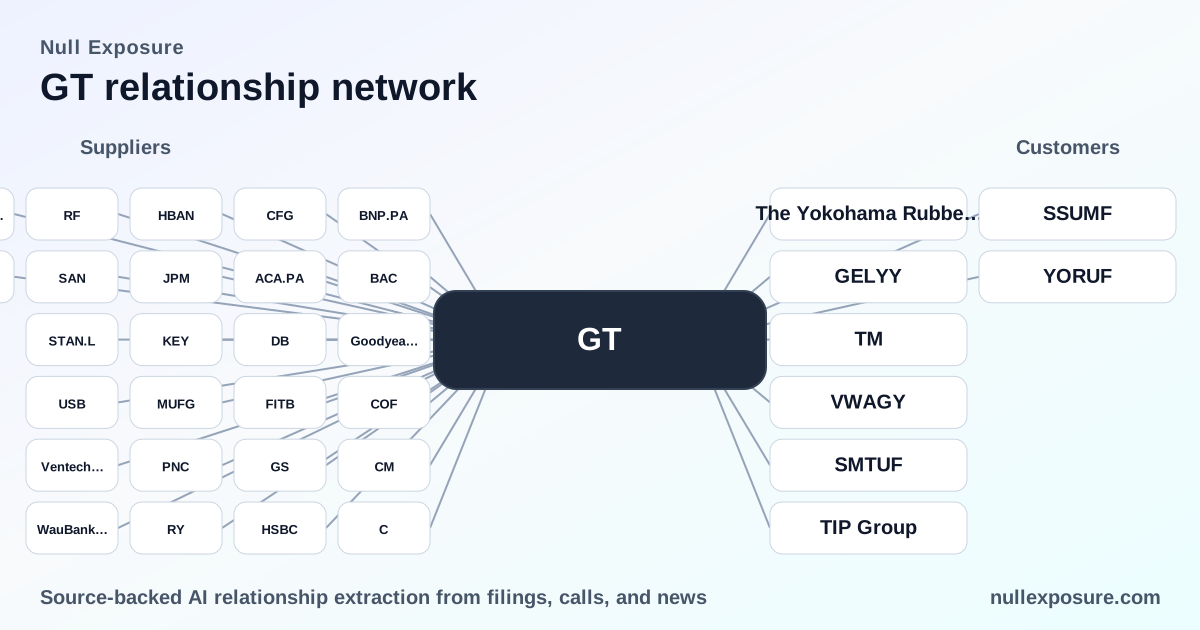
Goodyear (GT) — Customer Relationships That Drive Revenue and Risk
Goodyear manufactures, distributes and sells tires and mobility services globally, monetizing through original-equipment (OE) fitments, high-margin replacement sales, wholesale distribution and direct retail services; the company also extracts value through licensing and transition agreements tied to divestitures. Investors should weight accelerating OEM fitments and long-term supply/license deals against brand divestitures and concentrated counterparty commitments. For a concise company signal view, see Null Exposure’s coverage at https://nullexposure.com/.
Why these customer links matter to shareholders
Goodyear’s customer relationships are not peripheral sales channels — they are structural levers. OE fitments with large automakers deliver recurring, higher-margin replacement flows over vehicle life cycles; long-term product supply and trademark licensing agreements convert divestitures into multi-year revenue streams and reduce integration risk when assets transfer to third parties. Conversely, brand sales and transition offtake agreements produce temporary revenue and change Goodyear’s mix from branded manufacturer to licensor/seller in those categories.
Operating model signals investors should absorb
- Contracting posture: Goodyear uses a mix of long-term product supply contracts and trademark licensing (including explicit 5–10 year term language in its filings), which converts one-time asset sales into multi-year cash flows and obligations.
- Concentration and reach: The company reports a global footprint with 49 manufacturing facilities across 19 countries and three regional segments (Americas, EMEA, APAC), indicating diversified geographic exposure but meaningful regional revenue buckets.
- Role flexibility: Goodyear acts as manufacturer, licensor, seller and distributor depending on the agreement — a sign of business-model maturity but also of operational complexity across channels.
- Criticality: OEM fitments (Volkswagen, Toyota, Geely) and commercial accounts (DAF Trucks, fleet retread partners) are strategically important because they drive replacement demand and services revenue over time.
If you want the full product of our relationship mapping, visit https://nullexposure.com/ to learn more.
Relationship matrix — every reported customer link, one by one
The Yokohama Rubber Company, Limited (news)
Goodyear sold certain assets including Nippon Giant Tire and Goodyear Earthmover Pty, and Yokohama completed the acquisition of those assets from Goodyear, crystallizing a strategic divestiture. Source: Simply Wall St coverage of the transaction (FY2026) — https://simplywall.st/stocks/us/automobiles/nasdaq-gt/goodyear-tire-rubber.
TWI (Titan International Inc)
Titan expanded a licensing agreement with Goodyear to broaden Goodyear’s footprint in off‑highway segments, reinforcing Goodyear’s strategy to monetize IP and extend product reach via licensees. Source: Chemanalyst report on the Titan agreement (FY2025) — https://www.chemanalyst.com/NewsAndDeals/NewsDetails/titan-international-broadens-goodyear-footprint-into-diverse-off-highway-segments-36312.
Geely
Geely is cited among OEM partners where new OE fitments are ramping, supporting future high‑margin replacement sales once those vehicles enter the market. Source: Finviz coverage describing OEM fitment ramps (FY2026) — https://finviz.com/news/302313/the-goodyear-tire-rubber-company-gt-a-bull-case-theory.
Toyota
Toyota is listed as a major new OEM fitment customer that will contribute to future replacement demand and elevated margin mix as fitments move to aftermarket. Source: Finviz coverage on OEM fitments (FY2026) — https://finviz.com/news/302313/the-goodyear-tire-rubber-company-gt-a-bull-case-theory.
Volkswagen
Volkswagen is another OEM where fitments are ramping, an important channel for sustained replacement revenues and brand presence on mainstream vehicle platforms. Source: Finviz OEM fitment summary (FY2026) — https://finviz.com/news/302313/the-goodyear-tire-rubber-company-gt-a-bull-case-theory.
VWAGY (duplicate VW listing)
An additional mention of VWAGY reiterates Volkswagen’s role in Goodyear’s OE pipeline and underscores market commentary linking Volkswagen fitments to Goodyear’s margin outlook. Source: Finviz (FY2026) — https://finviz.com/news/302313/the-goodyear-tire-rubber-company-gt-a-bull-case-theory.
DAF Trucks
Goodyear was recognized by DAF Trucks as an SPM master supplier for a fifth consecutive year, reflecting a stable commercial-fleet partnership that supports truck tire and mobility services revenue. Source: Goodyear Europe news release (May 2026) — https://news.goodyear.eu/goodyear-recognized-by-daf-trucks-as-spm-master-supplier-for-fifth-consecutive-year/.
Sumitomo Rubber Industries
Goodyear completed the sale of its rights to the Dunlop brand (consumer, commercial, specialty in Europe, North America and Oceania) and transferred associated IP and inventory to Sumitomo, transforming part of Goodyear’s branded portfolio into transition revenue and licensing exposure. Source: WorkTruckOnline report on the Dunlop sale (FY2025) — https://www.worktruckonline.com/10240859/goodyear-completes-sale-of-dunlop-brand-for-735m.
SMTUF (duplicate Sumitomo entry)
The SMTUF-listed mention reiterates the Dunlop rights sale to Sumitomo Rubber Industries and emphasizes the financial proceeds and transition arrangements tied to that transaction. Source: WorkTruckOnline (FY2025) — https://www.worktruckonline.com/10240859/goodyear-completes-sale-of-dunlop-brand-for-735m.
TANNL (TravelCenters of America / Retread Center)
TravelCenters of America opened a retread center as part of the Goodyear Authorized Retread Network, allowing customer‑owned casings to be retreaded with Goodyear treads and supporting service revenue and fleet uptime. Source: Trucking Info report on the TA retread center (FY2026) — https://www.truckinginfo.com/news/travelcenters-of-america-opens-first-retread-center.
TIP Group
Goodyear extended and expanded a five‑year sustainability partnership with TIP Group for eco‑focused tire materials and service solutions across Europe, signaling a push into service and circularity offerings with a major fleet partner. Source: Simply Wall St reporting on the TIP extension (FY2026) — https://simplywall.st/stocks/us/automobiles/nasdaq-gt/goodyear-tire-rubber/news/goodyear-tariff-lawsuit-and-tip-deal-reframe-valuation-and-r.
SSUMF (TradingView / Moneycontrol reference to Sumitomo)
A TradingView/Moneycontrol note references the Dunlop brand sale to Sumitomo for approximately $700M — corroborating market commentary on the transaction value and strategic reallocation of Goodyear’s consumer brand assets. Source: TradingView summary citing MoneyControl (FY2025) — https://www.tradingview.com/news/moneycontrol:be123f32c094b:0-goodyear-launches-sale-process-for-indian-arm-s-farm-tyre-business-engages-citi/.
Sumitomo (SSUMF duplicate)
Another mention of Sumitomo reiterates the same Dunlop acquisition detail and underscores the market’s focus on how that sale affects Goodyear’s branded portfolio and transitional revenue streams. Source: TradingView/MoneyControl (FY2025) — https://www.tradingview.com/news/moneycontrol:be123f32c094b:0-goodyear-launches-sale-process-for-indian-arm-s-farm-tyre-business-engages-citi/.
YORUF (Yokohama reference in Goodyear 10‑K)
Goodyear’s FY2025 10‑K discloses that OTR tire sales in 2025 primarily consist of tires sold to Yokohama pursuant to a product supply agreement, establishing a formal multi‑year supplier relationship following the asset sale. Source: Goodyear 2025 10‑K filing (filed FY2025) — gt‑2025‑12‑31 (Goodyear FY2025 10‑K).
Yokohama (10‑K duplicate)
The 10‑K reiterates a package of ancillary agreements tied to the OTR divestiture, including a trademark license (ten years) and a product supply agreement (up to five years) with Yokohama, defining Goodyear’s ongoing roles as both licensor and seller under explicit term lengths. Source: Goodyear 2025 10‑K (FY2025) — gt‑2025‑12‑31 (Goodyear FY2025 10‑K).
Constraints translated into investment implications
- Long-term contracting orientation: The company-level evidence shows Goodyear converts divestitures into long-dated license and supply revenue (10‑year trademark license; up to 5‑year supply commitments). This reduces near‑term execution risk and smooths cash flows.
- Role complexity increases operational burden: Acting simultaneously as manufacturer, licensor, seller and distributor increases margin variability and requires disciplined channel management.
- Global scale with regional concentration: Goodyear’s operations span NA, EMEA and APAC; revenue segmentation creates exposure to regional demand cycles but diversifies risk across geographies.
- Customer criticality: OEM and large fleet partnerships are strategically critical for recurring high‑margin replacement sales and services revenue.
Bottom line for investors
Goodyear’s customer map shows a deliberate pivot to monetizing intellectual property and long-term supply relationships while leaning on OEM ramps and fleet partnerships to rebuild margins. The Dunlop divestiture and Yokohama supply/license package convert capital into structured revenue but shift the company’s risk profile toward contract performance and partner execution. Monitor OEM fitment rollouts and the cadence of transition supply revenue; these will determine whether Goodyear sustains its path to steadier margins.
For a deeper dissection of counterparties and contract terms, review our platform at https://nullexposure.com/ — we catalog filings and deal specifics that matter for valuation and operational risk.