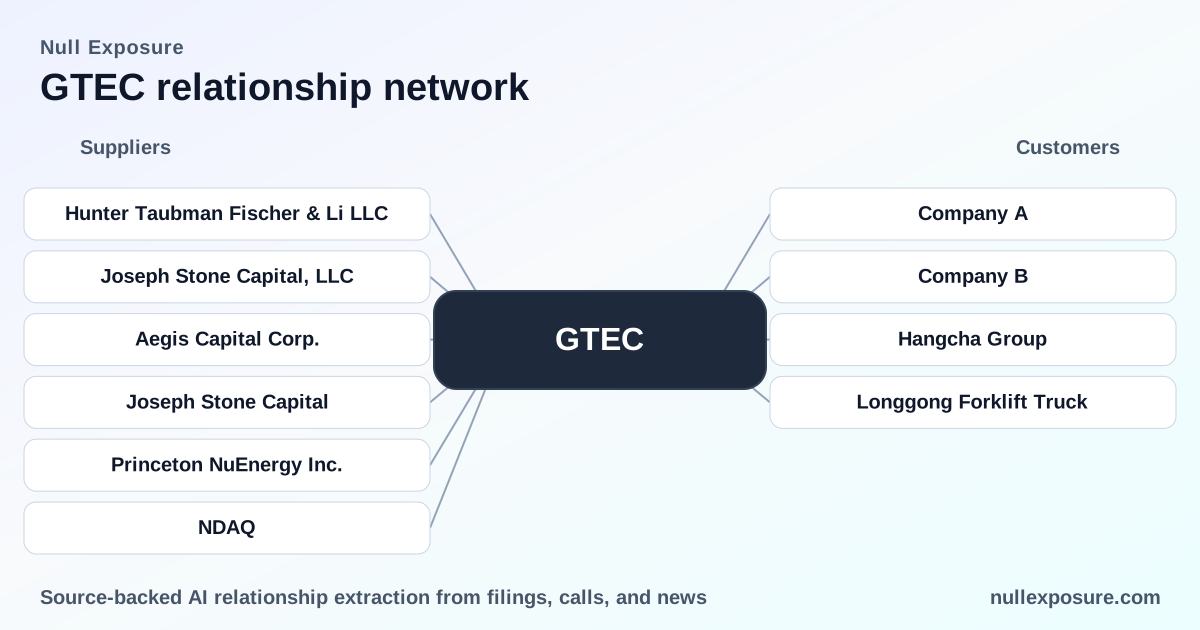
Greenland Technologies (GTEC): Customer Concentration and Counterparty Risk Profile
Greenland Technologies is a component manufacturer that monetizes by designing, manufacturing and selling transmissions and powertrains to material‑handling OEMs and electric industrial vehicle makers, with sales concentrated in the PRC and selective product availability in the U.S. The company’s revenue model is driven by high-volume OEM supply contracts and a small set of large customers that together account for a meaningful share of sales—making counterparty relationships the principal operational risk and a key lens for investor due diligence. For an ongoing feed of counterparty intelligence, visit https://nullexposure.com/.
Key takeaways for investors
- High customer concentration: Greenland’s five largest customers contributed roughly 40.6% of revenue in FY2024, creating clear exposure to a handful of counterparties.
- APAC OEM focus with U.S. distribution: The company sells predominantly in the PRC while maintaining product availability in the U.S., producing a dual‑market mix that influences revenue and operational cadence.
- Direct OEM seller: Greenland sells transmissions directly to forklift and material‑handling manufacturers, embedding the company in OEM supply chains rather than retail channels.
- Operational scale and stability: Greenland shipped roughly 149,600 sets of transmission products in both 2023 and 2024, signaling consistent manufacturing throughput and stable order flow.
The customer roster: four named relationships you need to know
Below are every named counterparty disclosed in Greenland’s FY2024 filing. Each entry is a concise, plain‑English investor summary with the source cited directly.
Hangcha Group — the single largest customer
Hangcha Group was Greenland’s largest customer in both 2024 and 2023, accounting for 14.19% of revenue in FY2024 and 14.98% in FY2023, according to Greenland’s 2024 Form 10‑K. This concentration makes Hangcha an essential revenue driver and a material counterparty for revenue continuity (Greenland 10‑K, FY2024).
Company A — a major account with material revenue share
Company A is listed in the 10‑K as a major customer that generated $11.9 million (14.19% of revenue) in FY2024 and $13.5 million (14.98%) in FY2023, per the company’s major‑customer disclosure. The numbers match those assigned to Hangcha in the filing, underlining that Company A represents one of Greenland’s largest single revenue contributors (Greenland 10‑K, FY2024).
Longgong Forklift Truck — a top OEM customer
Longgong Forklift Truck is identified as Greenland’s second‑largest customer, contributing 11.94% of revenue in FY2024 and 11.75% in FY2023, making it another materially important OEM partner in the company’s revenue base (Greenland 10‑K, FY2024).
Company B — another notable OEM account
Company B is disclosed among the major customers with $10.0 million (11.94% of revenue) in FY2024 and $10.6 million (11.75%) in FY2023, according to the same 10‑K disclosure. Those percentages correspond to the figures disclosed for Longgong, indicating Company B occupies a top‑tier slot in Greenland’s customer mix (Greenland 10‑K, FY2024).
What the disclosures imply about operating constraints and risk posture
The company filing and supporting disclosures reveal structural characteristics investors must weigh when modeling Greenland’s business.
-
Concentration risk is intrinsic to the model. Greenland’s top five customers accounted for 40.60% of revenue in FY2024 (down from 45.06% in FY2023), which imposes a persistent counterparty risk premium. Loss or attrition of any large account would produce a meaningful earnings and liquidity impact (Greenland 10‑K, FY2024).
-
Regionally concentrated exposure drives demand cyclicality. Greenland sells most transmission products to more than 100 PRC forklift manufacturers and ships electric industrial heavy equipment to the U.S., establishing APAC as the core market with selective North American exposure. This geography split shapes revenue sensitivity to PRC industrial cycles and U.S. conversion opportunities (Greenland 10‑K, FY2024).
-
Customer composition skews toward large enterprises. The company states it supplies leading manufacturers and PRC subsidiaries of blue‑chip international brands, indicating a buyer base that is large, sophisticated, and capable of negotiating scale discounts and performance requirements—a contracting posture that favors established OEMs over small resellers (Greenland 10‑K, FY2024).
-
Direct OEM selling increases strategic importance and bargaining dynamics. Greenland’s model is to sell transmissions directly to forklift‑truck manufacturers, embedding the company in OEM line cards and making product quality, on‑time delivery and customization critical levers in contract renewal and pricing (Greenland 10‑K, FY2024).
-
Operational maturity is evident in stable volumes. Greenland shipped roughly 149,597 sets in 2024 and 149,543 in 2023, showing repeatable production scale and consistent order fulfillment performance, which supports gross margin stability even amid concentrated customer exposure (Greenland 10‑K, FY2024).
Investment implications and monitoring checklist
Investors should treat Greenland as a manufacturing OEM supplier with concentrated counterparty exposure and stable production throughput. Key questions to track on a quarterly basis:
- Are the top customers’ percentages rising or falling relative to total revenue (trend in top‑five concentration)?
- Do named large customers (Hangcha, Longgong, Company A/B) increase share or shift purchasing patterns?
- Is Greenland expanding its U.S. product availability into larger commercial channels, which would reduce geographic concentration?
- Are there any changes in contractual terms, lead times, or credit arrangements with the largest counterparties?
For investors and operators that require ongoing counterparty monitoring and risk scoring, further coverage is available at https://nullexposure.com/.
Bottom line
Greenland’s revenue model is OEM‑driven, regionally concentrated and dependent on a compact set of large buyers. This structure delivers scale and predictable manufacturing volumes but imposes concentrated counterparty risk and creates negotiating dynamics with large enterprise buyers. Active monitoring of the top customers and geographic sales mix is essential for risk‑adjusted valuation and operational planning.