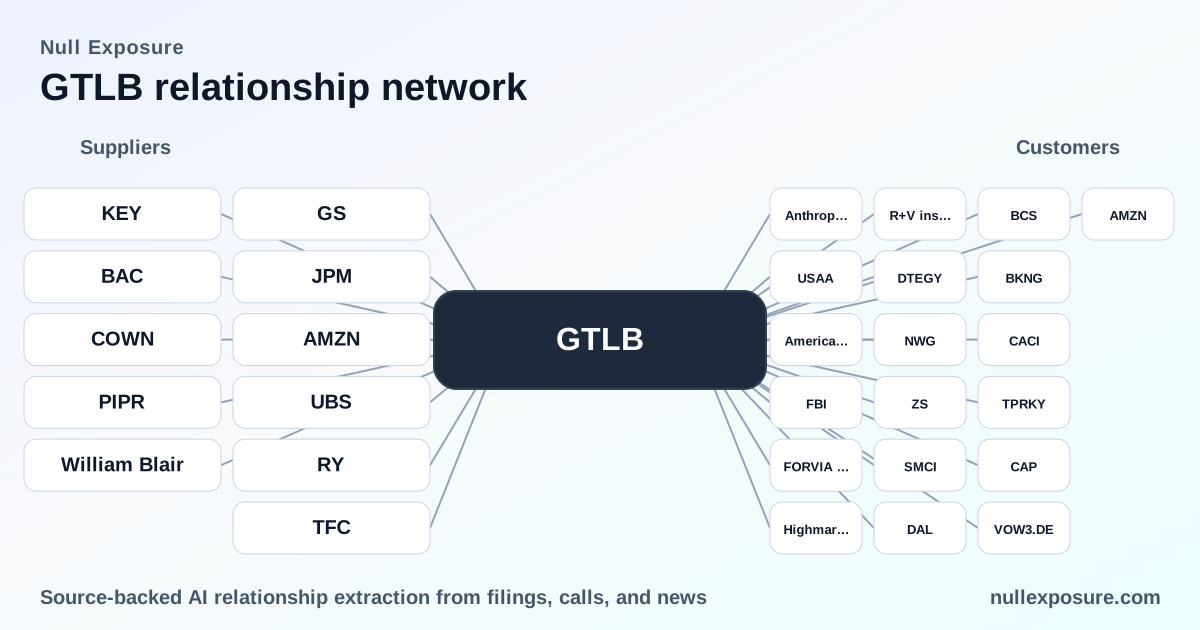
GitLab (GTLB) — Customer Relationships That Drive Revenue Growth
GitLab sells a unified DevSecOps platform to software teams worldwide and monetizes primarily through recurring subscriptions (SaaS and self‑managed), with a smaller licensing business for self‑hosted deployments; enterprise customers and public sector contracts anchor revenue and drive large expansion opportunities via add‑on modules like Duo Enterprise and GitLab Dedicated. For investors, the growth story is expansion-led: GitLab converts free users and small teams up the stack, then extracts meaningful ARR through enterprise renewals and targeted product upsells. For a deeper look at how these customer ties translate into revenue risk and upside, visit https://nullexposure.com/.
How GitLab’s commercial model shapes customer relationships
GitLab’s filings and recent calls establish a clear commercial posture. Subscriptions dominate the top line—about 89% of FY2025 revenue labeled as subscription—while licensing is a secondary, shorter‑term revenue source (roughly 11%). GitLab operates as both a licensor (self‑managed licenses) and a service provider (cloud hosting, support), meaning customers can be either long‑term SaaS clients or one‑time license purchasers that still generate recurring support and expansion revenue.
- Customer concentration and criticality: GitLab serves very large enterprises—more than half of the Fortune 100—and derives a large share of ARR from public sector and enterprise accounts, making individual expansions and renewals materially important to growth and retention.
- Global footprint with U.S. revenue concentration: GitLab reports customers in 152 countries, but the U.S. accounted for ~82% of revenue in recent years, creating a geographic concentration risk despite global adoption.
- Contract posture and seasonality: The company recognizes subscription revenue over time and experiences renewal seasonality, with renewals and new large contracts often clustered in the final two fiscal quarters.
- Product motion: Growth follows a land‑and‑expand pattern—Free → Premium/Ultimate → Dedicated and Duo Enterprise—so wins that move customers off the free tier or onto Dedicated deployments are high‑value signals.
If you need a concise commercial map for portfolio diligence, explore available analysis at https://nullexposure.com/.
What the recent customer calls and press releases reveal
Below are the reported relationships in GitLab’s disclosures and earnings calls. Each entry is a one‑to‑two sentence plain‑English note followed by the public source.
-
R+V insurance — R+V, a top‑five German insurer, expanded its GitLab deployment by implementing Duo Enterprise in a regulated environment, signaling traction in highly regulated financial services. (Q1 2026 earnings call, March 2026)
-
USAA — USAA was cited among more than fifty engaged customers during investor outreach, demonstrating GitLab’s continued presence in the insurance and financial services vertical. (Q4 2025 earnings call, FY2025 Q4)
-
Anthropic — GitLab closed a deal with Anthropic in Q4, underscoring adoption by large AI platform customers that require secure, production‑grade software delivery tools. (Q4 2025 earnings call, FY2025 Q4)
-
FORVIA HELLA — FORVIA HELLA purchased GitLab Dedicated and Duo Enterprise in Q1, an example of automotive supplier customers moving to single‑tenant enterprise offerings. (Q1 2026 earnings call, March 2026)
-
Highmark Health / enGen — Highmark Health and its healthtech subsidiary enGen added Duo Enterprise onto an existing GitLab Ultimate deployment, illustrating vertical expansion within healthcare. (Q1 2026 earnings call, March 2026)
-
American Family Mutual Insurance Company — GitLab reported a significant expansion at American Family, reinforcing the company’s position as a DevSecOps vendor of choice in insurance. (Q1 2026 earnings call, March 2026)
-
FBI — The FBI recorded a significant expansion with GitLab in Q1, highlighting GitLab’s penetration into sensitive government and law‑enforcement workloads. (Q1 2026 earnings call, March 2026)
-
Deutsche Telekom — Deutsche Telekom was listed among new and expansion customers in GitLab’s FY2022 financial release, indicating early carrier and telecom adoption. (Company financial release, March 14, 2022)
-
DTEGY (Deutsche Telekom ticker reference) — The FY2022 release also lists the same Telekom engagement under the ticker reference DTEGY, confirming the carrier deal was a disclosed FY2022 customer win. (Company financial release, March 14, 2022)
-
SMCI (Supermicro) — Supermicro upgraded from the free tier and doubled its software team in Q1, converting from a free user to a paying customer, a classic land‑and‑expand move. (Q1 2026 earnings call, March 2026)
-
Zscaler (ZS) — Zscaler selected GitLab in a competitive win, demonstrating GitLab’s ability to displace or consolidate point solutions at cloud‑security vendors. (Q4 2025 earnings call, FY2025 Q4)
-
NWG (NatWest group reference, Q1 2026) — NatWest expanded its investment with GitLab in Q1, indicating continued adoption among major UK banks. (Q1 2026 earnings call, March 2026)
-
NatWest (detailed FY2025 Q4 mention) — NatWest expanded in Q4 by adopting GitLab Dedicated and Duo Enterprise, showing migration toward dedicated, high‑security deployments. (Q4 2025 earnings call, FY2025 Q4)
-
Barclays (BCS) — Long‑time customer Barclays further expanded its use of GitLab in Q4, reinforcing high retention and expansion dynamics within large financial institutions. (Q4 2025 earnings call, FY2025 Q4)
-
Booking.com (BKNG) — Booking.com was named among the customer engagements during executive outreach, an example of GitLab’s footprint in tech‑heavy consumer Internet companies. (Q4 2025 earnings call, FY2025 Q4)
-
BKNG (ticker reference for Booking.com) — The same Q4 mention references Booking.com under its ticker BKNG, emphasizing the engagement’s inclusion in executive customer review. (Q4 2025 earnings call, FY2025 Q4)
-
CACI — CACI consolidated seven point solutions onto GitLab, showing the platform’s ability to replace multiple niche tools in government‑contractor environments. (Q4 2025 earnings call, FY2025 Q4)
-
Supermicro (duplicate listing) — Supermicro’s upgrade from the free tier in Q1 was reiterated in disclosures, a repeat confirmation of the account motion. (Q1 2026 earnings call, March 2026)
-
Delta Airlines (DAL) — Delta moved from GitLab Ultimate to GitLab Dedicated as part of cloud transformation, an example of enterprise‑grade migration driving higher contract values. (Q4 2025 earnings call, FY2025 Q4)
-
Travis Perkins (TPRKY) — Travis Perkins was named in the FY2022 release as a new/expansion customer, showing retail/industrial adoption in earlier years. (Company financial release, March 14, 2022)
-
NatWest (duplicate FY2025 Q4 entry) — The FY2025 Q4 disclosure separately reiterated NatWest’s expansion into Dedicated and Duo Enterprise, confirming a multi‑phase buy. (Q4 2025 earnings call, FY2025 Q4)
-
Capgemini (CAP) — Capgemini selected GitLab as its platform upgrade, signaling a strategic relationship with a global engineering and R&D services leader. (Q4 2025 earnings call, FY2025 Q4)
-
Volkswagen Digital Solutions (VOW3.DE) — An early access participant, Volkswagen Digital Solutions reported productivity gains from joint capabilities, demonstrating vendor adoption in automotive software teams. (Q1 2026 earnings call, March 2026)
-
VOW3.DE (ticker reference for Volkswagen Digital Solutions) — The same Q1 2026 note appears under the VOW3.DE label, confirming the Volkswagen Digital Solutions early access results. (Q1 2026 earnings call, March 2026)
-
CAP (Capgemini duplicate) — Capgemini’s selection of GitLab was repeated in Q4 disclosures, reflecting a confirmed enterprise win. (Q4 2025 earnings call, FY2025 Q4)
-
AWS Professional Services / AMZN — AWS Professional Services moved from the free tier to GitLab Ultimate in Q4, showing GitLab traction even inside cloud vendor professional services organizations. (Q4 2025 earnings call, FY2025 Q4)
-
AMZN (ticker reference for AWS Professional Services) — The Q4 disclosure also references the AWS engagement under AMZN, reaffirming the move to Ultimate. (Q4 2025 earnings call, FY2025 Q4)
Key investment takeaways
- Enterprise and government expansions drive high‑value ARR growth via product add‑ons and Dedicated deployments. The Q4/Q1 disclosures show multiple financial institutions, insurers, and government entities expanding their contracts.
- Subscription resilience is strong, with nearly 90% subscription mix supporting predictable revenue recognition, but U.S. revenue concentration (~82%) and reliance on large enterprise renewals constitute primary risk vectors.
- Upsell cadence matters: converting free and open‑source users to Ultimate/Dedicated and selling Duo Enterprise materially increases contract size; the recent Supermicro, Delta, and FORVIA HELLA motions are illustrative.
For portfolio diligence, these relationship threads should be modeled as high‑impact expansion events rather than marginal churn — and for more structured client relationship mapping and trend charts, see available resources at https://nullexposure.com/.