Gray Television (GTN): Customer relationships that drive distribution and cash flow
Gray Television operates and monetizes a national portfolio of local television stations, digital properties and production services. The company generates primary revenue from broadcast and digital advertising and retransmission consent fees, supplements cash flow with production and sports-rights partnerships, and leverages station scale across 113 television markets that reach about 37% of U.S. TV households. This commercial mix produces a hybrid contracting posture—short-term ad sales layered on top of multi-year retransmission and licensing deals—that shapes both opportunity and headline risk for investors. For a concise vendor- and partner-focused briefing on GTN relationships, visit https://nullexposure.com/.
H2: Why relationships matter now Gray’s value proposition is access and audience: local ad inventory, carriage agreements with MVPDs and streaming aggregators, and production capacity for sports and entertainment. Retransmission consent and carriage negotiations are the most financially consequential relationships because they drive recurring fees and audience reach, while sports and production partnerships expand programming that drives advertising demand. Recent disputes and new rights deals have moved stock volatility and demonstrate how partner dynamics translate directly into revenue and perception.
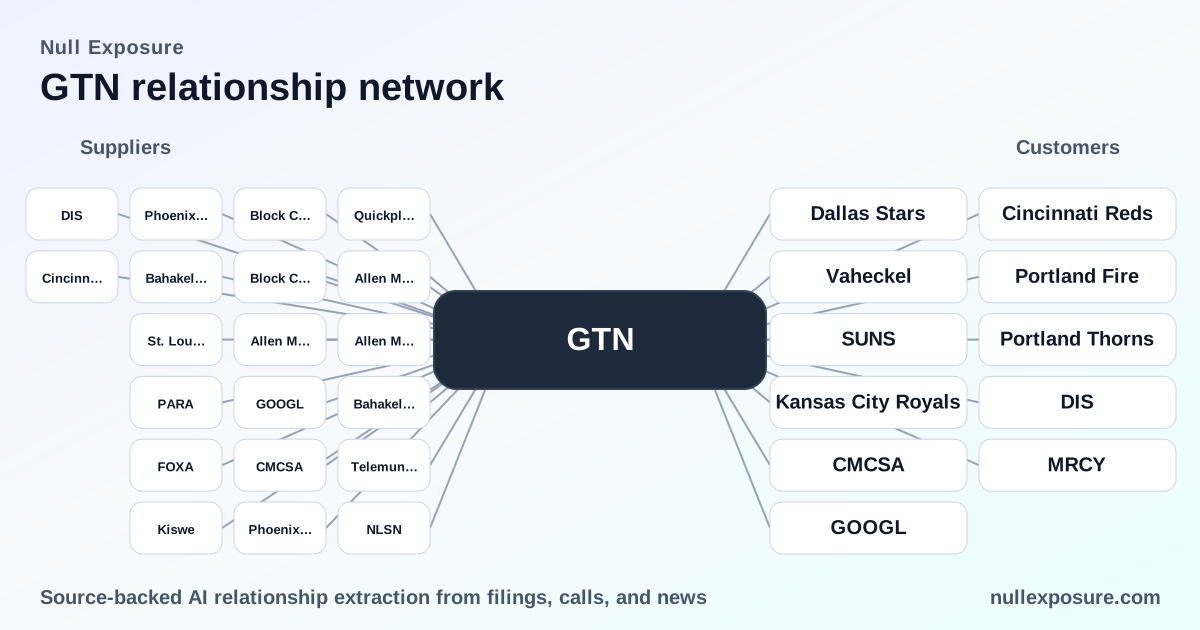
H2: Relationship roll‑call — what every investor should know Below is a concise, plain-English summary for every partner named in GTN’s public results. Each entry links the fact to the underlying public source.
-
Vaheckel — Gray completed the acquisition of WBBJ‑TV in Jackson, Tennessee from Vaheckel for $25 million, integrating a local asset into its station footprint. This was disclosed on GTN’s 2025 Q4 earnings call. (GTN 2025 Q4 earnings call, Mar 2026)
-
Dallas Stars — Gray expanded its sports portfolio to include the Dallas Stars for distribution in outer markets, extending regional sports exposure on its stations. (GTN 2025 Q3 earnings call, Mar 2026)
-
Suns (SUNS) — Gray renewed its partnership with the Phoenix Suns and Mercury, maintaining a multi-team sports broadcast relationship that anchors local sports inventory. (GTN 2025 Q3 earnings call, Mar 2026)
-
Dish Network (DISH) — Dish dropped Gray’s stations after carriage negotiations failed, triggering blackouts in multiple markets and a stock price reaction; this is a material carriage dispute investors must monitor. (FinancialContent/Markets coverage; news reports March 2026)
-
Gwinnett Stripers — Gray renewed a regional broadcast partnership to televise the Gwinnett Stripers’ home games across the Southeast in 2026, reinforcing local sports content offerings. (PeachtreeTV report, Mar 2026)
-
Spectrum (CHTR) — Peachtree Sports Network distribution includes Spectrum in Atlanta, indicating cable carriage for Gray’s regional sports programming. (PeachtreeTV report, Mar 2026)
-
NBCUniversal (CMCSA) — GTN referenced a strong partnership with NBCUniversal, which supplies programming and anchor content to Gray stations and local programming slots. (GTN 2025 Q3 earnings call, Mar 2026)
-
Google / GOOGL — Gray’s digital operation is migrating apps and websites to the Quick Play platform powered by Google Cloud, signaling a technology and cloud services relationship for digital distribution. (GTN 2025 Q4 earnings call, Mar 2026)
-
BravesVision — BravesVision selected Gray’s Raycom Sports to produce season-long non-national games, creating a content-production tie and simulcast arrangements. (Yahoo Finance/TVTechnology/GlobeNewswire releases, Mar 2026)
-
CMCSA (Comcast / NBCUniversal referenced separately in results) — Comcast carriage is identified for regional sports network distribution (WPCH/Peachtree Sports Network), pointing to distribution agreements with major cable operators. (PeachtreeTV report, Mar 2026)
-
DIS / Hulu (Disney) — Gray cited a Hulu renewal for a third season of a production that will utilize Gray’s studio capacity, demonstrating studio production demand from streaming platforms. (GTN 2025 Q3 earnings call, Mar 2026)
-
Hulu — Same as above: Hulu renewed content that will occupy Gray’s stages and production resources, underlining production revenue streams. (GTN 2025 Q3 earnings call, Mar 2026)
-
Atlanta Braves — Gray entered a multi‑year agreement to simulcast 25 regular-season Braves games across Gray stations, aligning team-owned and local broadcast distribution to broaden reach. (GlobeNewswire / Yahoo Finance March 2026)
-
Mercury (MRCY) — Gray renewed its partnership with the Mercury (WNBA) as part of a broader renewal of local sports relationships. (GTN 2025 Q3 earnings call, Mar 2026)
-
Cincinnati Reds — Gray and WXIX FOX19 partnered to bring free, over‑the‑air Reds games, expanding local baseball content and advertiser-friendly inventory. (Finviz summary, Mar 2026)
-
Portland Fire — Gray’s KPDX entered a partnership to broadcast Portland Fire matches, broadening local sports engagement. (Finviz summary, Mar 2026)
-
Portland Thorns — KPDX also entered a partnership to broadcast Portland Thorns matches, furthering regional women’s professional sports coverage. (Finviz summary, Mar 2026)
-
Kansas City Royals — Gray extended and expanded its partnership with the Royals for the 2026 season, reinforcing regional MLB rights and local programming. (GlobeNewswire/ManilaTimes coverage, Feb–Mar 2026)
-
Comcast — Comcast carriage supports distribution of regional sports network content and over‑the‑air simulcasts, strengthening cable distribution channels. (PeachtreeTV report, Mar 2026)
-
Fubo (FUBO) — Gray’s Peachtree Sports Network is available on Fubo as part of streaming distribution for regional sports. (PeachtreeTV report, Mar 2026)
-
YouTube TV (GOOGL) — Gray’s regional sports network content is carried on YouTube TV, expanding OTT reach for live sports. (PeachtreeTV report, Mar 2026)
-
EchoStar (SATS) — Coverage referenced EchoStar in the context of channel blackouts and wholesale carriage; EchoStar/Echostar‑related distribution issues are part of the broader carriage landscape. (Finviz coverage, Mar 2026)
-
Allen Media Group — Gray and Byron Allen’s Allen Media Group closed previously announced transactions, indicating consolidation activity and strategic asset movement in the broadcast space. (GlobeNewswire press release, Apr 2026)
H2: Constraints and what they signal about GTN’s operating model The public evidence in GTN’s filings and calls describes a mixed contracting posture that shapes risk and predictability:
-
Contracting posture: Advertising revenue is predominantly short‑term, often running for weeks, while retransmission consent contracts are typically multi‑year (three years)—creating a dual cadence of revenue that blends cyclicality with periodic renegotiation events.
-
Pricing and structure: MVPD agreements are usage‑ and subscriber‑linked, reflecting sales‑based licensing mechanics where fees scale with distribution and subscriber counts.
-
Geographic scale and concentration: Gray is nationally distributed, operating in 113 markets and reaching roughly 37% of U.S. TV households, which reduces single-market exposure but elevates aggregate carriage negotiation importance.
-
Materiality: Company disclosures highlight that retransmission consent fees are a material revenue component (the excerpted figure shows a 41% attribution in the cited context), while at the same time no single advertising customer accounted for more than 5% of broadcast ad revenue—indicating customer-level ad concentration is limited.
-
Business segments: Broadcasting is the core product and dominant revenue driver, with production and services providing incremental, higher-margin contribution and usage of studio assets.
H3: Investment implications — clear tradeoffs
-
Upside: Scale in local markets, breadth of sports and team partnerships, and distribution across cable and streaming platforms create diversified revenue channels and leverage in ad monetization. Production demand and studio utilization from streamers and networks improve margin capture.
-
Downside: Carriage disputes (Dish and EchoStar coverage) can cause abrupt audience loss and short‑term revenue hit; retransmission fees are material so negotiation outcomes matter. Short-term ad booking schedules make near-term revenue volatile and dependent on ratings and local economic cycles.
-
What to watch next: renewal dates for major MVPD contracts, any escalation or resolution of the Dish carriage dispute (reported March 2026), and the cadence of sports-rights renewals and production deals.
For a structured feed of partner‑level signals and ongoing updates on GTN counterparties, visit https://nullexposure.com/ to explore how partner dynamics translate into financial exposure and operational risk.
Bold final takeaway: Gray’s scale and diversified distribution provide durable monetization levers, but retransmission carriage and short-term ad cycles expose the company to episodic headline risk that directly affects revenue and investor sentiment.