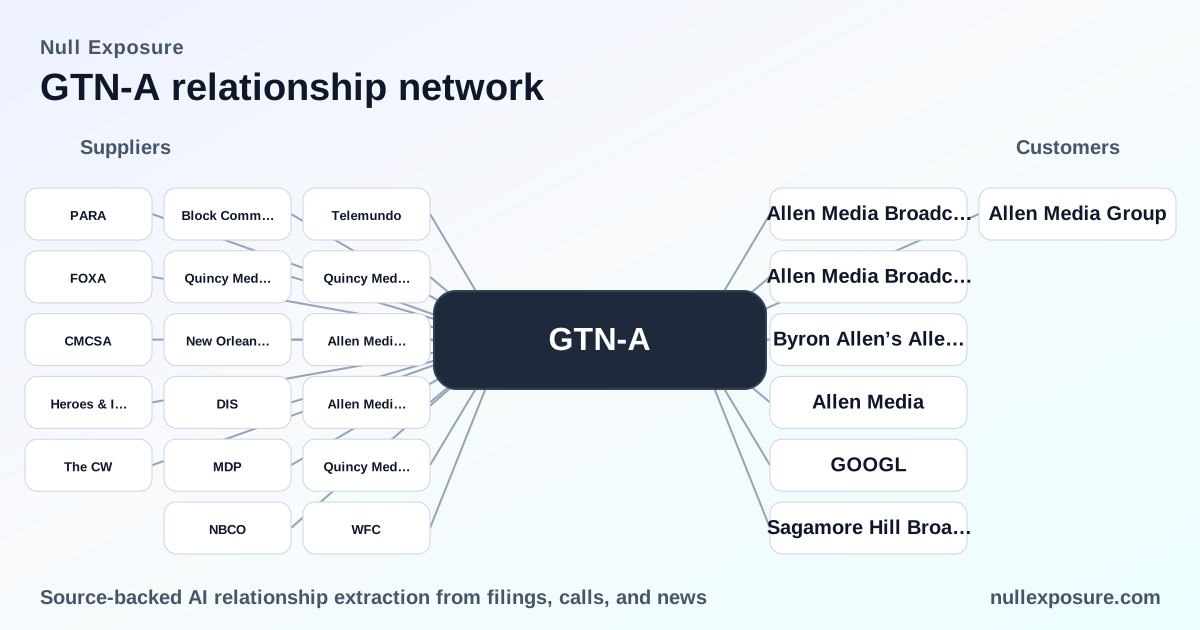
Gray Television (GTN-A) — Customer Relationships and Commercial Constraints
Gray Television operates and monetizes a nationwide portfolio of local broadcast stations and digital properties by selling advertising inventory, licensing retransmission rights to MVPD/OTT distributors, and selectively divesting station and tower assets; retransmission consent and advertising form the core recurring revenue engines, while station sales and infrastructure deals create episodic cash inflows. Learn more at https://nullexposure.com/.
Why these customer relationships matter to investors
Gray is a hybrid media operator: a licensor of broadcast rights to distributors (retransmission consent), a short-term seller of advertising inventory, and an active participant in station and tower transactions. Contracting mixes long-term, usage-based licensing (three-year retransmission cycles) with short-term ad sales, producing stable fee-based revenue alongside cyclical advertising exposure. Concentration risk is sectoral (services advertisers) rather than client-specific, and infrastructure monetization provides balance-sheet flexibility.
Relationship map — one-line takeaways with sources
- Allen Media Broadcasting — Gray sold seven TV stations as divestitures tied to its Quincy Media acquisition for $380 million in cash. (Deadline, April 2021)
- Suns (SUNS) — Gray renewed media partnerships with the Phoenix Suns and the Mercury and expanded its sports portfolio to include the Dallas Stars in outer markets. (Earnings call transcript, Q3 2025 via Investing.com)
- Allen Media Broadcasting (Hollywood Reporter) — Byron Allen’s group acquired seven Gray divestiture stations for $380 million as part of transactional carve-outs. (The Hollywood Reporter, April 2021)
- Allen Media Broadcasting, LLC (GlobeNewswire) — Gray reached agreement to divest certain Quincy Media stations to Allen Media for $380 million in cash. (GlobeNewswire press release, April 29, 2021)
- Allen Media Broadcasting (KSN Local4) — Regional reporting confirmed Gray’s sale of Quincy-owned stations to Allen Media for $380 million. (KSN Local4, April 2021)
- Google / GOOGL (earnings call) — Gray’s digital team is migrating all apps and websites to the Quick Play platform powered by Google Cloud, positioning Gray as Google’s first broadcast partner for Quick Play. (Gray Q4 2025 earnings call transcript)
- Google (duplicate earnings-call entry) — Management emphasized the Quick Play migration and Gray’s partnership status with Google Cloud for personalized streaming. (Gray Q4 2025 earnings call transcript)
- Allen Media (Madison365) — Gray agreed to sell several Quincy stations including ABC affiliates in Madison, Wausau and La Crosse to Allen Media as part of divestitures. (Madison365, FY2021 reporting)
- Allen Media Group, LLC (SimplyWall) — Allen Media Group completed acquisition of SJL Holdings, LLC from Gray for $70 million. (SimplyWall summary, FY2025)
- VCY America (SimplyWall) — VCY America acquired KTXC-FM 104.7 from Gray for approximately $0.65 million. (SimplyWall summary, FY2025)
- Allen Media (Variety) — Public reporting captured Byron Allen’s agreement to buy seven Gray stations for $380 million in cash. (Variety, April 2021)
- Byron Allen’s Allen Media Broadcasting, LLC (CityBiz) — Corporate press reports document the Quincy divestitures sold to Allen Media for $380 million. (CityBiz, FY2021 reporting)
- Sagamore Hill Broadcasting, Inc. (GlobeNewswire Q2 2025 release) — Gray agreed to acquire SGH’s WLTZ (NBC) and KJTV (FOX) for a combined purchase price under $2 million, after providing back-office services to those stations. (Gray Q2 2025 press release)
- The E.W. Scripps Company (QuiverQuant) — Gray announced a station swap with Scripps that will transfer Gray’s KKTV in Colorado Springs to Scripps to create market duopolies. (QuiverQuant transaction summary, FY2025)
- Cincinnati Reds (SimplyWall) — Gray and WXIX FOX19 agreed to simulcast 10 regular-season Reds games per year across seven states under a two‑year partnership. (SimplyWall client announcements, FY2025)
- St. Louis Cardinals (SimplyWall) — Gray launched the Home Plate package to provide free over-the-air access to Cardinals content across multiple Midwestern markets. (SimplyWall client announcements, FY2025)
- Memphis Grizzlies (SimplyWall) — Gray, the Memphis Grizzlies, and FanDuel Sports Network renewed a simulcast partnership for seven Memphis NBA games across multiple markets. (SimplyWall client announcements, FY2025)
- Dallas Stars (SimplyWall) — Gray partnered with Victory+ to simulcast 17 Dallas Stars NHL games across 15 television markets, expanding reach in outer markets. (SimplyWall client announcements, FY2025)
- Hulu (Investing.com) — Management noted that Hulu renewed a third season on a production that will utilize Gray’s studio stages, signaling content production revenue potential. (Earnings call transcript, Q3 2025 via Investing.com)
- NBC Universal (Investing.com) — Gray described a strengthened content relationship with NBCUniversal, which supplies programming into Gray’s stations. (Earnings call transcript, Q3 2025 via Investing.com)
- Atlanta Braves (SimplyWall) — Gray secured a multiyear agreement to simulcast 25 regular-season Braves games across 24 markets, with Raycom Sports handling live production for BravesVision starting March 27, 2026. (SimplyWall client announcements, FY2025)
- Mercury (Investing.com) — Gray renewed its partnership with the Mercury alongside the Suns relationship noted in the earnings call. (Earnings call transcript, Q3 2025 via Investing.com)
- YouTube TV (Investing.com) — Management flagged a distribution dispute with YouTube TV that resulted in certain ABC stations being dropped from the service. (Earnings call transcript, Q3 2025 via Investing.com)
- Dallas Stars (Investing.com duplicate) — Earnings call commentary reiterates expansion of sports coverage to include Dallas Stars outer markets. (Earnings call transcript, Q3 2025 via Investing.com)
- Braves (Investing.com) — Company commentary confirmed renewal of the Hawks deal and a Braves agreement set to commence in March with favorable ratings history. (Earnings call transcript, Q3 2025 via Investing.com)
- Hawks (Investing.com) — Gray confirmed renewal of its Hawks broadcast deal as part of its regional sports strategy. (Earnings call transcript, Q3 2025 via Investing.com)
Contracting posture, concentration and commercial constraints
- Licensing is primary and structured: Gray contracts retransmission consent rights with MVPDs/OTT providers as license agreements; these are usage‑based and sales‑based, tied to the number of subscribers and negotiated on a multi-year cadence. (Company filings: retransmission consent language)
- Multi-year election cycles create medium-term revenue visibility: Retransmission consent contracts operate on a three‑year election cycle (current cycle 2024–2026), establishing a long-term contractual rhythm for carriage fees and negotiations. (Company filings: retransmission consent elections)
- Advertising is short-term and cyclical: Most advertising contracts run only a few weeks, which creates earnings volatility tied to macro ad demand despite broad geographic reach. (Company filings: advertising contract terms)
- Geographic footprint is U.S.-centric and large: Gray reaches roughly 37% of U.S. TV households across 113 markets, exposing the company to U.S. advertising cycles and regulatory dynamics rather than international diversification. (Company filings: market reach)
- Materiality is sector-driven: No single advertiser exceeds 5% of broadcast ad revenue, but a material portion of non‑political ad revenue derives from the services sector, concentrating exposure by industry. (Company filings: client concentration)
- Seller/licensor role and infrastructure monetization: Gray acts as both seller of ad/time and licensor of signal rights, and it has monetized tower interests and third‑party lease rights (transactions initiated in December 2024 expected to yield ~$35 million). This highlights active asset management and non-operating cash generation. (Company filings: tower site agreements, Dec 2024 disclosures)
Explore a consolidated view of Gray’s counterparty footprint at https://nullexposure.com/ to support underwriting and competitive analysis.
Investment implications — concise conclusions
- Revenue mix balances steady retransmission fees with volatile ad demand, so underwriting should expect stable baseline cash flows tempered by advertising cyclicality.
- Sports partnerships and platform deals (Google Quick Play) strengthen content distribution and local engagement, increasing monetization optionality for both advertising and direct-to-consumer streams.
- Transaction activity (station and tower sales) provides episodic liquidity that management uses to optimize the balance sheet and redeploy capital.
- Key risks: carriage disputes (e.g., YouTube TV), concentrated industry exposure in advertisers, and the short-term nature of ad contracts that amplify macro sensitivity.
Final takeaway: Gray’s commercial relationships combine long-term licensing stability with short-term advertising upside and discrete transactions that augment cash — investors should value the stock for its retransmission annuity plus optionality from sports rights and platform partnerships, while monitoring ad cycles and carriage negotiations.