Getty Realty (GTY) — customer relationships that define a net‑lease growth story
Getty Realty is a specialized net‑lease REIT that acquires, develops and finances single‑tenant retail properties—primarily convenience stores, petroleum distributors and automotive service sites—and monetizes through long‑term, triple‑net leases that produce recurring Annual Base Rent (ABR) and predictable cash flow. The company leverages sale‑leasebacks and targeted equity raises to fund acquisitions and debt reduction while extending portfolio WALT through unitary lease amendments. For an aggregated view of tenant signals and capital partners, see https://nullexposure.com/.
How Getty’s model actually works for investors
Getty operates as a capital allocator to real estate cash flows: it buys or finances freestanding retail properties, signs long‑duration triple‑net leases that pass operating costs to tenants, and extracts rent and contractual escalations as its primary earnings stream. Stability comes from long initial terms and renewal options; growth comes from sale‑leasebacks and targeted acquisitions financed by forward equity sales and bank underwriters. Getty’s reported metrics—high gross margin and a 10‑plus year weighted average lease term after recent amendments—reflect that operating posture.
The customer map — the counterparties that matter now
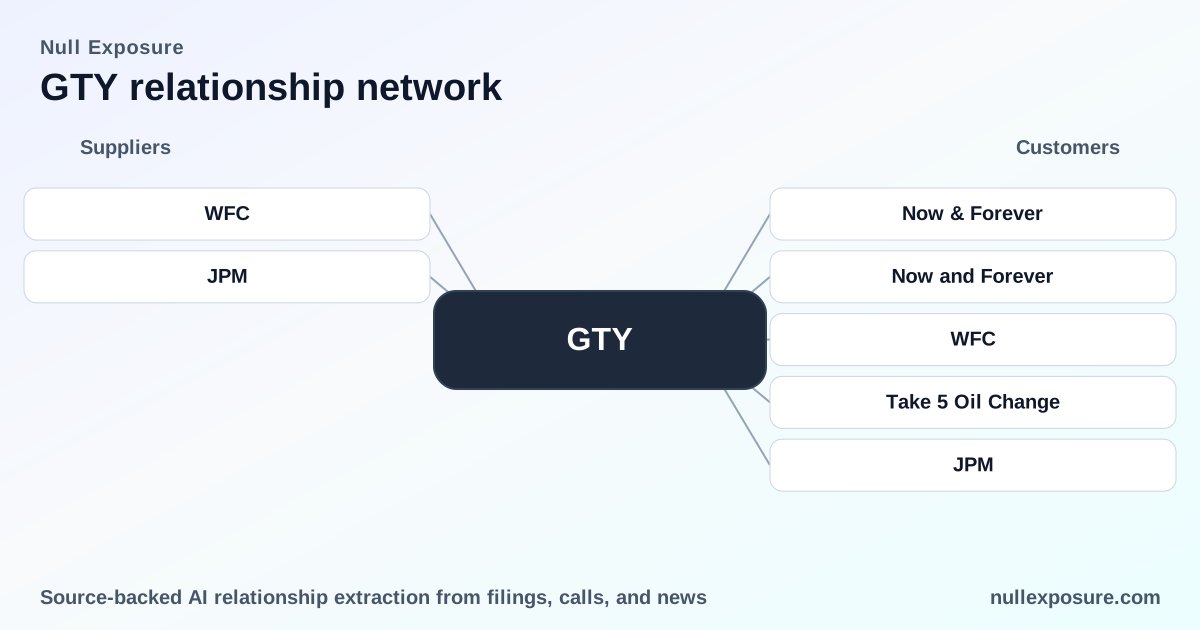
Below are every customer and counterparty referenced in public filings and press releases in the reviewed reporting window, with concise plain‑English takeaways and source citations.
Now & Forever (regional convenience chain)
Getty completed a sale‑leaseback and leases assets to Now & Forever, positioning the chain as a growing regional convenience operator concentrated in Houston submarkets. This relationship is a direct operator lease and a recent $100 million, 12‑unit sale‑leaseback underscores Getty’s use of capital markets to source inventory tied to regional convenience store growth. (Getty 2025 Q4 and 2025 Q3 earnings calls, Oct–Dec 2025; MarketBeat summary, 2026).
CrossAmerica Partners LP (CAPL)
CrossAmerica agreed to amend unitary lease terms that extended expiration dates by ten years and converted some variable rent to fixed amounts, increasing ABR and lengthening WALT contribution. CrossAmerica’s amendments materially extend Getty’s near‑term cash flow visibility and raised ABR by roughly $0.5 million on the amended leases. (GlobeNewswire press release / Getty leasing update, Mar 11, 2026; Investing.com coverage, May 2026).
BP Products North America (BP)
BP exercised renewal options on two unitary leases, pushing expirations out to December 2037 and preserving roughly $2.9 million ABR associated with its unitary relationship. BP’s renewals reduce Getty’s 2026–2027 ABR exposure and demonstrate retention among major petroleum distributors. (GlobeNewswire leasing update, Mar 11, 2026; The Globe and Mail, May 2026).
CPD Energy
CPD agreed to amended lease terms that extended the expiration of one unitary lease by ten years to December 2040 and reduced the number of properties under that lease from 17 to nine, reshaping the footprint covered by the unitary agreement. The CPD amendment trades a wider footprint for deeper tenure on a subset of sites—an example of Getty optimizing term structure across a tenant portfolio. (GlobeNewswire leasing update, Mar 11, 2026; Investing.com, May 2026).
Shahani, Inc.
Shahani accepted amended lease terms that extended its unitary lease to July 2041 and increased properties covered from 12 to 18 after Getty transferred six properties from CPD into Shahani’s agreement. This extension both lengthens WALT contribution and consolidates assets under a single counterparty, increasing predictability for a portion of ABR. (GlobeNewswire / leasing update, Mar 11, 2026).
Take 5 Oil Change (franchisee)
Rent commenced in 2025 on a redeveloped Philadelphia‑area property leased to a Take 5 Oil Change franchisee under a long‑term triple‑net lease. This is an example of Getty redeveloping and leasing to non‑fuel automotive service operators to diversify tenant types within its net‑lease portfolio. (GlobeNewswire full year results, Feb 11, 2026).
J.P. Morgan / J.P. Morgan Securities LLC / JPMorgan Chase Bank
J.P. Morgan served as a forward purchaser/underwriter for Getty’s follow‑on equity offering, structured as separate forward sale agreements to raise proceeds for acquisitions, debt repayment and corporate purposes. Large investment banks like JPM anchored Getty’s $129.9M equity raise via a 4.0M share forward sale at ~$32.48 per share, reflecting institutional distribution support for Getty’s capital plan. (QuiverQuant / GlobeNewswire offering notices, Feb–Mar 2026; SimplyWallSt coverage, Mar 2026).
Wells Fargo Bank / Wells Fargo Securities, LLC
Wells Fargo acted alongside J.P. Morgan as a forward purchaser and underwriter on the 4.0M share offering, participating in forward sale agreements to fund Getty’s near‑term growth and balance‑sheet objectives. Wells Fargo’s role mirrored JPM’s: underwriting and forward sale liquidity to enable acquisition and debt reduction activity. (QuiverQuant / GlobeNewswire offering notices, Feb–Mar 2026; SimplyWallSt, Mar 2026).
What the constraints tell an investor (operating posture and risk profile)
The disclosed constraints and excerpts describe Getty’s business model characteristics as signals rather than isolated facts:
- Long‑term contracting is foundational. Getty’s leases commonly have initial terms of 15–20 years with renewal options, which underpins predictable cash flow and high portfolio WALT.
- Short‑term capital instruments also appear. Forward sale equity agreements create short‑term settlement obligations and introduce execution risk around share delivery or cash/net settlement.
- Geographic scale is national but state‑concentrated. Properties span 44 states plus D.C., yet Texas and New York together generate ~32% of ABR, signaling geographic concentration risk despite broad national coverage.
- Customer role is primarily landlord (seller/service provider). Getty operates as a triple‑net landlord across single‑tenant retail formats—a low‑touch operating model with tenant‑borne capex and opex.
- Relationship maturity is high and active. The portfolio is active with long remaining terms, and recent amendments increased WALT, pushing near‑term expirations materially lower.
- Segment exposure is services/retail focused. The portfolio’s economic sensitivity ties to convenience, petroleum and automotive retail end markets.
Investment implications and final takeaways
Getty’s strategy emphasizes contractual durability and capital recycling: long triple‑net leases provide steady ABR while sale‑leasebacks and equity forwards fund growth and liability management. Recent unitary lease extensions with CrossAmerica, BP, CPD and Shahani increased WALT and reduced 2026–2027 expirations to under 2.8% of ABR pro forma, a constructive signal for near‑term cash flow stability (GlobeNewswire leasing update, Mar 2026). The Now & Forever sale‑leaseback highlights Getty’s ability to source growth via regional operators.
Primary risks are state concentration (TX/NY) and the execution profile of forward sale settlements, which introduce timing and settlement modality considerations for equity raises. For a focused review of tenant relationships and capital counterparties, explore Getty’s public releases and underwriting notices.
For a full view of how these signals are aggregated across tenants and capital partners, visit Null Exposure: https://nullexposure.com/.
Bold takeaway: Getty’s portfolio is engineered for long‑dated cash flow with tactical capital market activity to fund portfolio rotation—creditworthy unitary tenants and bank underwriters underpin the model, but state concentration and forward sale execution are active risk vectors.