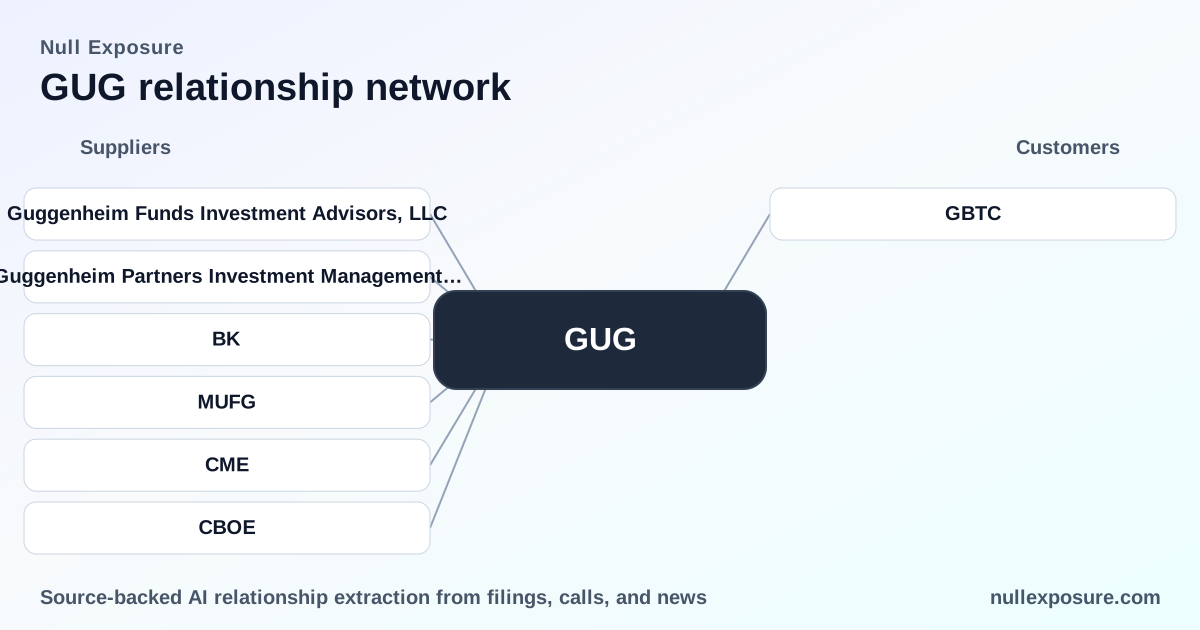
Guggenheim Active Allocation Fund (GUG): Strategic customers, asset allocation signals, and what investors should price in
Guggenheim Active Allocation Fund is an actively managed allocation vehicle that rebalances between equities and fixed income with the explicit objective of delivering superior risk-adjusted returns for institutional investors. The fund extracts value through management and advisory economics tied to assets under management and NAV performance, while using event-driven corporate access and targeted allocations to differentiate returns. For a concise feed of relationship intelligence and counterparty signals, visit https://nullexposure.com/.
How GUG operates in plain investor terms
GUG operates as a nimble, institutionally oriented allocation fund listed on the NYSE with a market capitalization of roughly $525.7 million and a trailing P/E of 12.45. The strategy is actively managed allocation rather than passive indexing, so revenue and investor returns are driven by asset flows and performance-linked management economics rather than operating revenue lines. The fund reports no conventional operating revenue or dividends; value to shareholders materializes through NAV appreciation and fee capture embedded in the product wrapper.
Customer relationships that shape strategy and risk
Below I cover every customer relationship returned in the review dataset and explain the investor implications in straight language.
GBTC — exposure to Grayscale Bitcoin Trust via Macro Opportunities Fund
Guggenheim launched a Macro Opportunities sleeve that allocated 10% of its holdings to bitcoin exposure through Grayscale’s Bitcoin Trust, signaling an explicit willingness to accept concentrated crypto exposure within a traditional allocation vehicle. According to a Blockworks report (March 2026) that recounts the November 2020 positioning, the move established a precedent for alternative-asset sizing inside Guggenheim-managed sleeves.
Grayscale’s Bitcoin Trust — the vehicle used for bitcoin exposure
Guggenheim’s use of Grayscale’s Bitcoin Trust (GBTC) functioned as the operational conduit for bitcoin exposure in the Macro Opportunities allocation, effectively outsourcing custody/market access while keeping portfolio decision-making internal. Blockworks documented that the November 2020 programmatic allocation to GBTC comprised roughly 10% of the Macro Opportunities sleeve, underscoring a tactical approach to alternative risk exposure (Blockworks, March 2026).
SGMT (Sagimet Biosciences) — corporate access and sector pipeline
Guggenheim ran investor events that included participation by Sagimet Biosciences at its 2nd Annual Healthcare Innovation Conference (Nov 10, FY2025), demonstrating the fund’s role as a corporate access and deal-flow generator within healthcare. A QuiverQuant news release (May 2026) lists Sagimet’s participation in Guggenheim’s November 2025 conference, confirming the firm’s ongoing role as a convenor for small-cap healthcare issuers and investor audiences.
What these relationships mean for investors and operators
- Strategic flexibility is a core competency. The GBTC allocation is evidence that Guggenheim will allocate material weight to non-traditional risk factors when the investment team judges expected risk-adjusted return attractive. That increases return upside but amplifies idiosyncratic volatility for shareholders.
- Third-party vehicles are the operational norm. Using GBTC for bitcoin exposure reduces custody and trading overhead for the fund but imports the structural and liquidity characteristics of the underlying trust into GUG’s NAV dynamics.
- Guggenheim markets and conferences serve as revenue and pipeline levers. The Sagimet participation shows the firm leverages investor events to create visibility and sourcing advantages for allocators and issuers alike; this is a recurring value-extraction mechanism beyond pure portfolio returns.
- Reputational and regulatory externalities are non-trivial. Public allocations to crypto and visible sponsorship of small-cap healthcare events expose the fund to intense public scrutiny and regulatory focus, which can affect distribution, retail access, or institutional appetite.
Operating model constraints and business-model signals
Although no explicit contractual constraints were provided in the dataset, the company-level facts convey several actionable signals for investors and operations teams:
- Contracting posture and maturity: Listed on the NYSE with a clear fiscal calendar (FY end: May) and a stable market cap, GUG operates with the governance and disclosure expectations of a mature exchange-listed fund.
- Concentration and investor profile: Institutional ownership stands at roughly 31.8%, suggesting a meaningful institutional shareholder base that drives sensitivity to quarterly NAV performance and product-level messaging.
- Criticality of third-party providers: The reliance on externally managed instruments such as GBTC indicates operational dependence on third-party product structures for alternative exposures; this is a structural feature, not a one-off.
- Revenue and payout profile: The fund shows no dividend payout and no conventional operating revenue, so investor returns track NAV performance and capital appreciation; capital allocation discipline and active strategy execution are therefore the primary drivers of shareholder value.
- Valuation anchors: A trailing P/E of 12.45 and a price-to-book near 0.95 provide valuation reference points for investors assessing the premium (or discount) for active execution versus passive alternatives.
Tactical takeaways for investors and operators
- For allocators: stress-test portfolio exposure to alternative vehicles like GBTC when modeling GUG’s volatility, and account for event-driven reputational spikes when sizing positions.
- For operations and compliance: prioritize counterparty monitoring for third-party vehicles and maintain robust disclosures about material allocations to non-traditional assets.
- For research teams: monitor conference calendars and investor presentations—Guggenheim’s corporate-access activities are a leading indicator of the small-cap deal flow and sector emphasis the fund will underwrite.
Visit https://nullexposure.com/ for ongoing coverage and signal feeds that track these relationship dynamics.
Final assessment
GUG is a tactically nimble allocation fund that monetizes through asset management economics and event-driven client engagement. Its use of third-party vehicles like GBTC for alternative exposure and its role as a corporate-access platform for issuers such as Sagimet are durable strategic choices that materially influence risk, return, and investor composition. Investors should underwrite those choices explicitly when sizing GUG exposure and calibrating performance expectations.