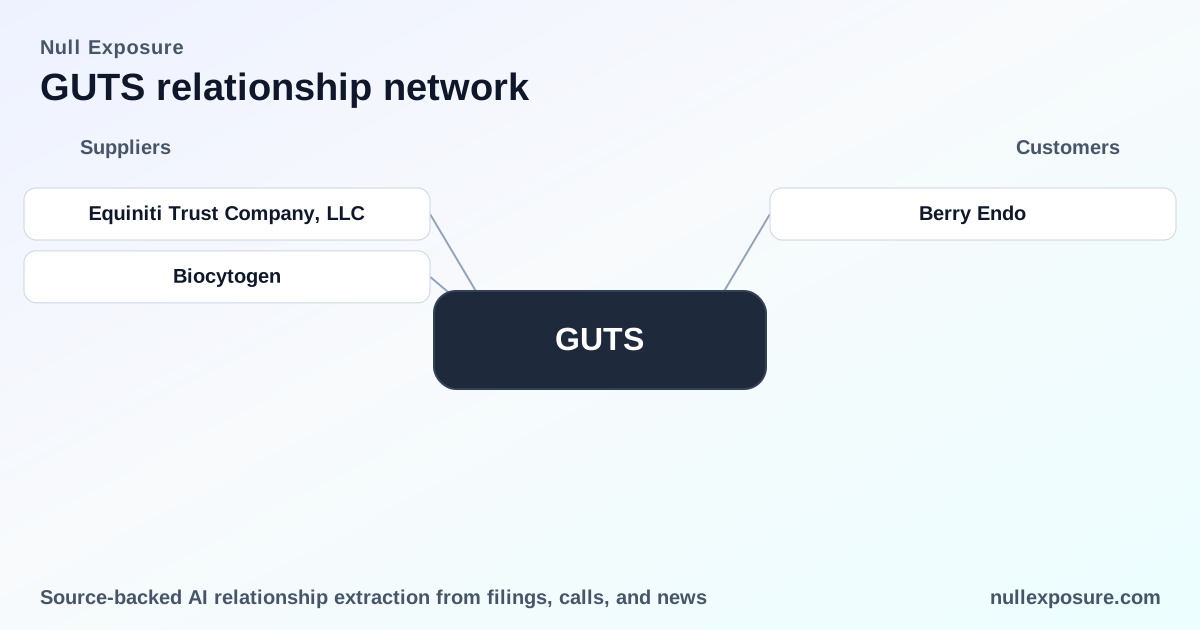
Fractyl Health (GUTS): How customer relationships shape the Revita rollout
Fractyl Health (ticker: GUTS) develops Revita, a metabolic endoscopic therapy for type 2 diabetes and obesity, and monetizes through a mixed hardware-plus-consumable model: an installed Revita console sold to hospitals and endoscopy centers plus a single‑use Revita DMR catheter for each procedure. The company is pursuing a hub‑and‑spoke commercialization strategy that targets centers of excellence and specialist endoscopists while executing limited pilot commercialization in Germany; commercial scale depends on expanding hospital buyers, securing reimbursement, and converting specialist clinicians into routine customers. For a concise access point to our customer mapping and signals, visit https://nullexposure.com/.
Executive takeaways for investors
- Commercial model: equipment sales + recurring consumables. Revita’s revenue profile is inherently dual—capital sales for consoles and recurring per‑procedure revenues from single‑use catheters, aligning incentives with procedure volume.
- Early revenue is highly concentrated and immature. The company has recorded revenue in Germany from a pilot launch but has not generated commercial revenue in the U.S. to date.
- Go‑to‑market focuses on specialists and large hospital systems. Sales and training efforts are targeted at diabetologists, gastroenterologists and interventional endoscopists and at hospitals that can add a profitable service line.
- Key partner relationships are operational enablers, not broad commercialization scale yet. Partners such as Berry Endo provide access to high‑volume endoscopy centers but do not alone substitute for a national sales force and payer coverage.
The named relationship: Berry Endo and access to high‑volume centers
Berry Endo: During the company’s 2025 Q3 earnings call, management stated that partnerships “like Berry Endo” give Fractyl a ready‑to‑activate footprint at several of the highest‑volume endoscopy centers in the U.S., signaling an on‑the‑ground distribution/clinical access relationship that supports initial adoption. (GUTS 2025 Q3 earnings call, transcript dated March 8, 2026).
What company disclosures collectively reveal about counterparties and channels
The public disclosures and management commentary consistently describe a two‑pronged buyer universe: individual clinicians (specialist endoscopists and diabetologists) and large healthcare institutions (hospitals and endoscopy centers). The company explicitly states it will concentrate sales, marketing, and training on specialists while also integrating Revita into hospital workflows as a new service line, which implies a hybrid contracting posture—direct clinician engagement plus negotiated hospital procurement. This is a company‑level commercial signal based on management statements in investor disclosures.
- Counterparty mix: Management guidance highlights targeting both individuals (clinicians) and large enterprise buyers (hospitals and systems), signaling the need for both clinical advocacy and formal institutional contracting (company disclosures).
- Geographic footprint: Fractyl has generated revenue in Germany following a limited pilot launch and Real‑World Registry study beginning in Q1 2023, while it has not yet generated U.S. revenue pending regulatory progress and commercial approvals (company filings and commercial updates through FY2025).
- Relationship role and stage: Hospitals and healthcare providers are positioned to be buyers of the Revita system; current commercialization is in pilot stage with selective early revenue in Germany and pilot customers elsewhere (company disclosures).
- Product economics and criticality: The company declares dependence on its lead product Revita; the product architecture (console + single‑use catheter) creates a classic razor/razor‑blade revenue dynamic where consumable volume drives recurring revenue (company product disclosure).
How these signals translate into operating constraints and strategic implications
- Contracting posture: Expect a mix of clinician adoption programs (training, proctorship) and formal hospital procurement negotiations; rollouts require both clinical champions and institutional buy‑in. Management’s hub‑and‑spoke plan reinforces this dual focus (company guidance).
- Concentration and criticality: Fractyl’s business is substantially dependent on Revita as the core product; commercial success is concentrated in a single therapy line, raising execution risk if adoption stalls. The hardware plus consumable model amplifies upside if procedure volumes scale, but downside is acute if hospital adoption is tepid (company filing disclosures).
- Maturity: Commercial activity is early—pilot revenue in Germany and a Real‑World Registry are positive validation steps, but U.S. revenue is absent pending regulatory and reimbursement milestones; investors should treat current customer relationships as formative rather than mature revenue streams.
- Geographic risk profile: Early revenue concentration in EMEA (Germany) provides a limited proof point, but the company must replicate reimbursement and training success at scale in larger markets, especially the U.S., to shift enterprise value meaningfully.
Commercial rollout and go‑to‑market posture: what to watch next
Fractyl’s stated playbook is to engage centers of excellence and specialist endoscopists first, then extend reach through hospital service‑line adoption and payer reimbursement. This implies near‑term metrics investors should track:
- Number of installed Revita consoles and active procedure sites.
- Rate of consumable (catheter) usage per installed console.
- Reimbursement milestones across jurisdictions, particularly expanded coverage beyond Germany.
- New named partnerships that convert pilot access into contracted buyers.
A mid‑cycle investor checkpoint is whether pilots and partner access (e.g., Berry Endo) convert into repeat hospital purchases and consumable volume, which unlocks the recurring revenue thesis.
For further context on channel activation and partner mapping, see our platform at https://nullexposure.com/.
Investment implications and principal risks
- Upside: If Fractyl scales hospital adoption and achieves recurrent catheter volumes, the installed‑base plus consumable model generates durable, procedure‑linked revenue with strong operating leverage. Clinical validation and payer coverage expansion would materially de‑risk the path to commercial scale.
- Downside: Concentration on a single product, nascent commercial footprint outside Germany, and reliance on specialist adoption create execution risk; failure to secure broader reimbursement in major markets would limit revenue even with clinical demand. Financials reflect the early stage: negligible trailing revenue and negative operating margins (company financials through FY2025).
- Operational cadence: The company’s customer relationships will pivot on execution of training, proctoring, and hospital contracting—elements that are operationally intensive and time‑consuming relative to software models.
Final read for investors
Fractyl’s customer relationships are real but embryonic. Partnerships such as Berry Endo provide critical access to high‑volume sites and validate the hub‑and‑spoke approach, but they do not yet constitute a broad commercial channel. The next 12–24 months will determine whether pilot conversions, reimbursement expansion, and consumable volume can convert an early technical win into a scalable medical device business. For investors focused on commercialization cadence and partner conversion metrics, monitoring installed base growth and catheter utilization rates will be decisive.
If you want a concise investor briefing and customer signal map for GUTS, visit https://nullexposure.com/ for more.