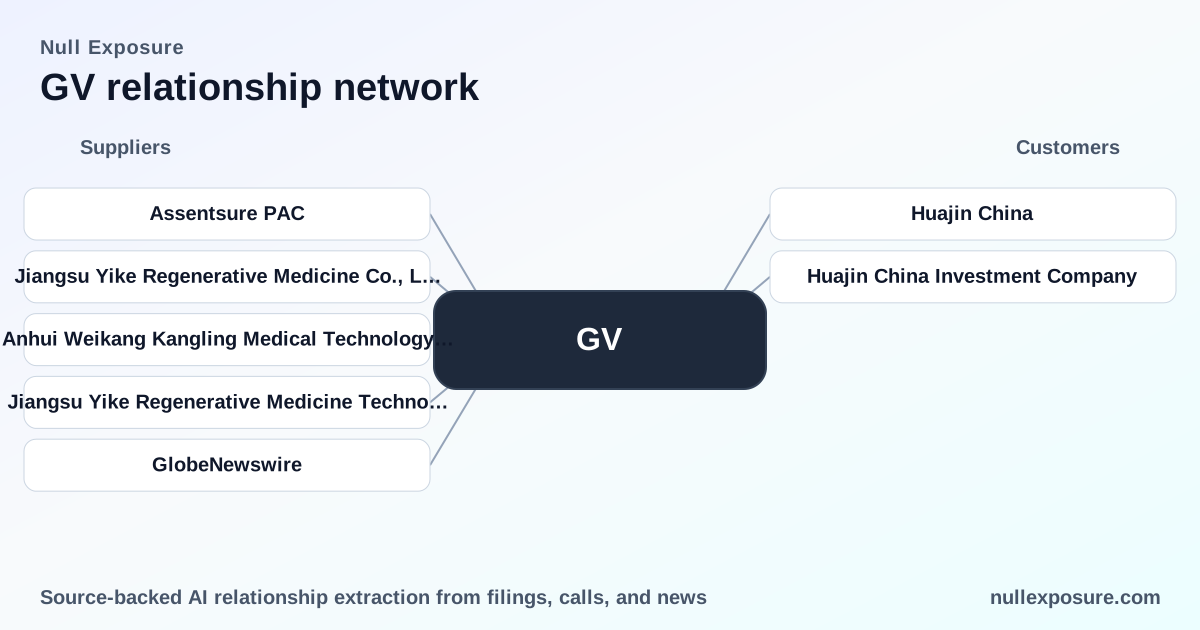
GV (Visionary Education Technology Holdings): Customer relationships and what they mean for revenue and risk
Visionary Education Technology Holdings (ticker GV) has pivoted from legacy education services toward a product-led healthcare and anti‑aging commercialization strategy, monetizing through exclusive distribution agreements and regional partnerships that carry short-term revenue guarantees. Investors should treat the company as an early-stage commercial operator that is attempting to convert product IP into contracted sales through a small set of commercial partners rather than broad retail rollouts. That concentrated go‑to‑market posture creates clear revenue visibility if contracts execute, and concentrated counterparty risk if they do not. Learn more at https://nullexposure.com/.
Why this matters: a strategic shift from education to healthcare revenue
GV’s recent announcements show a deliberate reallocation of capital and management focus: the company has approved the divestiture of its non‑core education business and simultaneously signed exclusive distribution deals for its anti‑aging product line targeted at China. These moves convert narrative change into near-term revenue levers — in particular a US$12 million contracted sales target embedded in one distributor deal — while reducing legacy operating drag. The firm now looks operationally smaller but commercially sharper, with most near-term upside tied to execution against a handful of counterparties.
Customer counterparties: the partners on record
Below are every customer relationship surfaced in the reporting set, with a concise plain‑English summary and source reference for each.
Huajin China Investment Company
Visionary’s wholly owned subsidiary, Visionary Health Technology Group Limited, entered an exclusive distribution agreement that sets a minimum contracted sales target of US$12 million within 12 months, positioning Huajin as the principal channel for the flagship Premier Regenerative Complex in China. According to a company announcement published by QuiverQuant (March–May 2026), the agreement also accompanied a Board‑approved divestiture of non‑core education assets. (QuiverQuant, March/May 2026: https://www.quiverquant.com/news/Visionary+Holdings+Inc.+Signs+%2412+Million+Exclusive+Distribution+Agreement+for+Premier+Regenerative+Complex+Amid+Strategic+Business+Shift)
Huajin China
Multiple outlets report the same commercial commitment under the shortened name “Huajin China,” noting an explicit minimum sales target and 12‑month performance window that materially improves revenue visibility compared with purely aspirational distribution announcements. Intellectia.ai summarized the deal as a $12 million exclusive distribution pact with a defined minimum sales target within 12 months (Intellectia.ai, March 2026: https://intellectia.ai/news/stock/visionary-holdings-establishes-three-subsidiaries-in-china).
Zhejiang Chushanji Digital Technology Co., Ltd.
Visionary signed a strategic cooperation agreement with Zhejiang Chushanji to distribute its V‑series anti‑aging products in China, adding a secondary channel to the company’s China commercialization plan and expanding go‑to‑market footprint beyond the primary Huajin partner. The cooperation was reported by Investing.com in early May 2026 (Investing.com, May 2026: https://in.investing.com/news/company-news/visionary-holdings-signs-cooperation-pact-for-china-antiaging-project-93CH-5317106).
Cai Dao Trading Ltd.
As part of the strategic refocus, GV’s Board approved the transfer of 100% equity interests in Visionary Education Services & Management Inc. to Cai Dao Trading Ltd., completing the company’s planned exit from its legacy education operations and simplifying the corporate structure in preparation for product commercialization. This corporate divestiture was disclosed in the same tranche of announcements and reported by Bitget (May 2026: https://www.bitget.com/amp/news/detail/12560605249328).
How to read GV’s operating model: four practical signals for investors
At a company level, the recent deals and corporate actions produce a coherent operating profile:
- Contracting posture — Transactional and short‑dated. The headline US$12 million arrangement includes a 12‑month minimum sales target, indicating GV prefers short, measurable commercial commitments over long multi‑year, low‑visibility licensing.
- Concentration — High counterparty concentration. A small number of named partners will drive near‑term revenue; that concentration amplifies upside if partners hit targets and magnifies downside if they do not.
- Criticality — Revenue outcomes hinge on distribution execution. The commercial partners are critical: their sales performance will determine whether the company’s strategic pivot converts into recognized revenue and cash.
- Maturity — Early commercial stage. These agreements are early commercial milestones rather than evidence of broad market penetration; expect execution risk, evolving product positioning, and active management of channel partnerships.
These are company‑level signals derived from the publicized contracts and structural corporate changes; they should guide modeling assumptions around revenue timing, counterparty risk and required working capital.
Investment implications: upside, risks, and catalysts
GV’s repositioning creates a classic concentrated upside trade with a handful of clear near‑term catalysts.
- Upside: Contracted revenue visibility from the US$12 million minimum and additional China distribution deals translates into a discrete near‑term revenue target that can be tracked against reported sales.
- Risks: Execution and concentration risk are material — distributor performance, regulatory clearance, and on‑the‑ground commercialization in China will determine realization. The transfer of the education unit reduces legacy drag but also reduces diversification.
- Catalyst set: first quarter sales against the Huajin minimum, expansion of distribution agreements beyond Zhejiang Chushanji, and any public order confirmations or shipment notices will be binary value drivers.
Final read for investors
GV has converted strategic narrative into contracted commercial commitments. The company now derives its near‑term valuation sensitivity from a small set of external partners that control access to China sales. If the Huajin and Zhejiang partners execute against the 12‑month targets, GV will show material revenue progress; if they do not, downside from concentration and early‑stage execution risk is the dominant story.
For a concise tracking framework and to monitor subsequent partner disclosures and shipment confirmations, visit https://nullexposure.com/.
Bold, measurable milestones over the next 12 months — contract performance data, monthly/quarterly sales updates, and any expansion or replacement of distribution partners — will decide whether GV’s pivot is a successful commercial scaling or a high‑probability execution gamble.