Granite Construction (GVA) — customer relationships that drive a public‑works growth story
Granite Construction builds and supplies U.S. infrastructure: it contracts directly with federal, state and local governments as a prime or JV partner and also sells construction materials to private contractors and end users. The company monetizes through awarded fixed‑price and cost‑plus construction contracts, long‑term joint ventures and materials sales; public-sector project awards account for the majority of Construction segment revenue and create large, lump‑sum cash flows tied to execution and milestone billing. For an investor evaluating customer concentration and counterparty risk, the relationship map is simple and highly public‑sector weighted.
Visit Null Exposure for more coverage: https://nullexposure.com/
Why the customer list matters for valuation
Granite's revenue profile is transactional but durable — projects are large, contractually defined, and often federally or state funded. That structure produces predictable backlog conversion when projects progress, but it also concentrates credit and execution risk. The company's 2025 disclosures put the public sector at the core of its business and show material single‑counterparty exposure within that public base; investors must price both award cadence and execution risk into multiples and forward margin assumptions.
All active customer relationships (concise summaries)
The relationships below capture every unique counterparty cited in Granite's customer coverage during FY2025–FY2026.
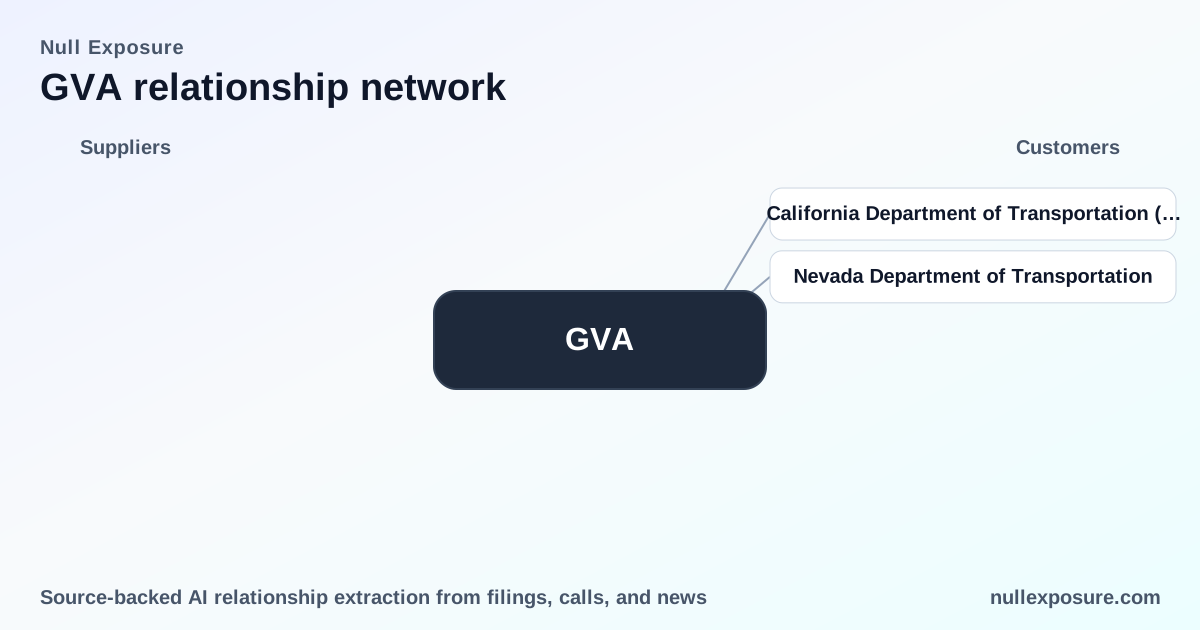
California Department of Transportation (Caltrans)
Caltrans is Granite's largest volume customer across 2023–2025, and Granite has continued to win programmatic Highway 101 work, including multiple segment awards in 2026 totaling multi‑tens of millions of dollars. According to Granite’s 2025 Form 10‑K, Caltrans was the largest volume customer for the three years ended December 31, 2025, and press coverage in 2026 reports awards such as a $20 million rehabilitation package and a $114 million Segment 4E North contract for the Carpinteria–Santa Barbara program. (Company 2025 Form 10‑K; ConstructionOwners and IndexBox coverage, March–May 2026.)
U.S. Customs and Border Protection (CBP)
Granite secured a large federal tactical infrastructure contract from CBP — reported at approximately $495 million — for border infrastructure work in southern Texas, reflecting the firm's ability to win sizable federal procurements. Media reports in March–May 2026 documented the award and described its scale and strategic importance to Granite’s federal backlog. (Reports in Investing.com, EquipmentWorld and MarketScreener, March–May 2026.)
Nevada Department of Transportation (Nevada DOT)
Nevada DOT selected Granite for preconstruction services on a future Interstate 80 east‑widening project, a contract reported around $19 million that positions Granite at the front of a multi‑phase corridor program. Coverage of Granite’s strong 2025 results and this selection appeared in February–March 2026 reporting, which emphasized the preconstruction scope and corridor planning role. (SimplyWall.St, SahmCapital and Intellectia.ai reporting, Feb–Mar 2026.)
How these relationships define Granite’s operating constraints
Granite’s customer map is not a random set of clients — it reveals a company structured around public infrastructure procurement with a clear set of operating constraints that shape cash flow and risk.
- Contracting posture: Granite operates primarily as a prime contractor and JV participant on large public projects, capturing both construction services and materials margins. The 10‑K notes the firm includes executed awards in unearned revenue and records project revenue as milestones are met, indicating a billing model tied to contract performance and funding triggers.
- Concentration: The business exhibits high concentration in the U.S. public sector; the company states most customers and receivables are U.S.‑based and that roughly 70% of Construction segment revenue in 2025 derived from government‑funded contracts. This concentration reduces currency and geographic diversification but increases sensitivity to U.S. fiscal and transportation budgets.
- Criticality: Projects are mission‑critical infrastructure—highways, border tactical infrastructure, and major corridor widenings—so Granite’s services are essential to counterparties; however, that criticality translates into high performance expectations and liquidated damages exposure if schedules slip.
- Maturity and scale: Granite is an established, vertically integrated contractor with recurring placements on large programs; recent awards (including $100m+ project segments and a reported $495m federal award) signal the company competes successfully at scale and that a material portion of backlog sits in the 100m+ spend band.
- Counterparty mix: While public sector customers dominate, Granite also sells materials to contractors, landscapers and homeowners, indicating a secondary retail/wholesale materials channel that diversifies revenue streams modestly away from pure contracting.
These constraints are company‑level signals drawn from Granite’s disclosures and public reporting; they explain why investors should value Granite more like a project‑driven engineering firm than a recurring‑revenue industrial supplier.
Where investor risk premium should be applied
Investors must price several execution and market risks into Granite’s valuation:
- Award concentration risk: Large wins (e.g., a reported $495m CBP award) are value‑accretive but raise single‑award exposure. One or two delayed or unprofitable large projects can swing annual results materially.
- Execution and margin pressure: Public contracts deliver revenue but compress margins when schedules or input costs shift; Granite’s mixed operating margin history requires scrutiny of backlog margin assumptions.
- Funding and timing: Government funding certainty governs cash flow timing; even awarded contracts contain funding and permitting dependencies that affect when Granite can bill and recognize revenue.
- Backlog composition and JV accounting: A significant portion of revenue can come through joint ventures and unconsolidated contracts, increasing complexity in backlog conversion and cash collection.
Bottom line — placement in a portfolio and next steps
Granite is a specialist contractor whose growth and cash generation are driven by public infrastructure awards and large federal and state clients; that profile supports a premium multiple only if management demonstrates consistent, on‑budget execution across its largest projects. For investors focused on counterparty credit and project risk, Granite’s public‑sector footprint is both a competitive moat and a concentration source to monitor.
For deeper relationship and project‑level tracking, Null Exposure maintains ongoing coverage of major public‑works awards and counterparty exposures: https://nullexposure.com/
If you want granular alerts on new awards and counterparty changes for GVA, review the Granite dossier on our site.