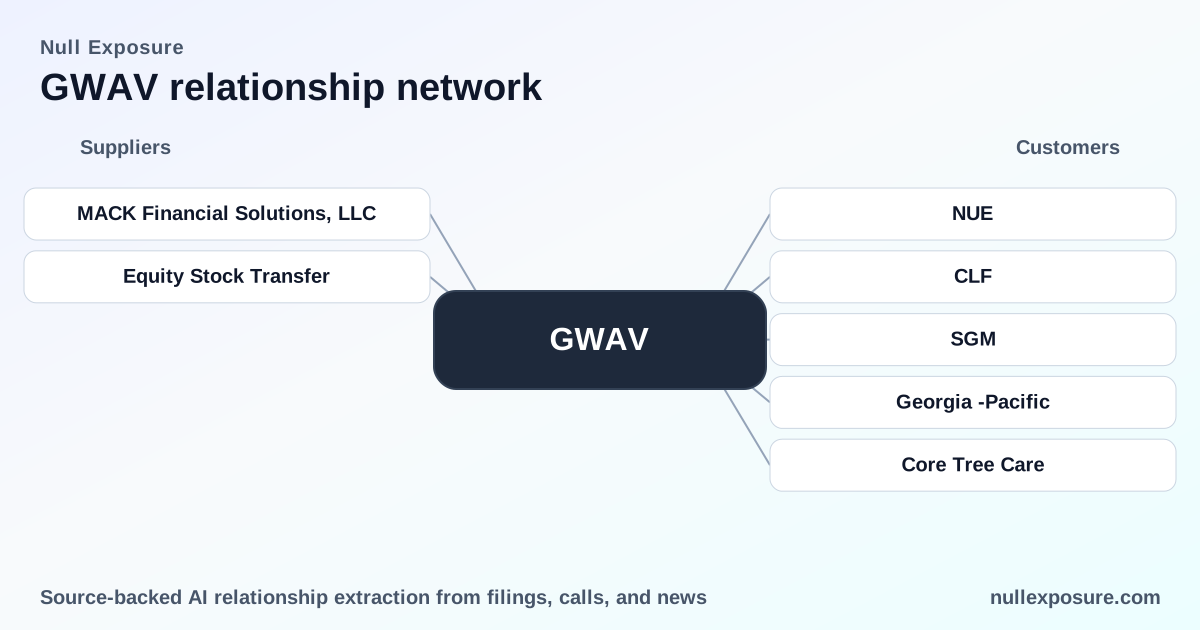
Greenwave Technology Solutions (GWAV): customer map, revenue drivers, and concentration risks
Greenwave Technology Solutions operates a network of metal recycling and processing facilities that monetize by buying scrap, processing ferrous and non‑ferrous metals, and selling finished scrap products to steelmakers and large industrial buyers; the company also generates ancillary revenue from hauling services. Revenue is driven by commodity volumes and price spreads with a small number of large industrial customers accounting for a majority of sales, making customer relationships the primary operational lever and the principal risk for investors. Explore more on vendor and customer intelligence at NullExposure.
How Greenwave actually earns money — a concise operating thesis
Greenwave purchases scrap metal, processes it across regional yards, then sells domestically‑sourced ferrous metal into the downstream steel and industrial supply chain while offering hauling services to select clients. The company’s economics are commodity‑driven: margins expand when scrap prices diverge favorably versus replacement values and when large customers lock in volumes. Core revenue is product sales (ferrous metal) with services as a secondary revenue stream, and reported customer concentration indicates that a handful of buyers determine cash flow volatility.
Company‑level commercial characteristics that matter to investors
- Contracting posture — short‑term pricing: Buyers adjust scrap prices on short cadences (monthly or bi‑weekly), so Greenwave operates with variable pricing and limited long‑term price protection. This is a company‑level signal reflecting how revenue realization tracks commodity cycles.
- Geography — mixed footprint: The business sells both regionally in Virginia and northeastern North Carolina and to international end customers across Asia, the Mediterranean, and the Americas; this creates exposure to both local supply disruptions and global demand swings.
- Customer concentration — critical and material: For FY2024 two customers together accounted for approximately $18.65M and $1.68M of revenue (about 55.99% and 5.05% of total revenues), indicating high concentration and single‑counterparty dependency.
- Role and segment: Greenwave is primarily a seller of ferrous metal (core product) with a meaningful but smaller hauling/services line.
- Contract size signal: Reported large customers fall into the $10M–$100M spend band at company confidence levels, consistent with the concentration figures above.
These company‑level constraints shape the investment case: volume growth and stable offtake from a few large industrial buyers will determine margin expansion or contraction, and short‑term pricing increases operating leverage to commodity cycles.
Customer relationships: who buys Greenwave’s metal (explicit citations)
Below are each of the named customer relationships surfaced in public reporting, with a plain‑English summary and the cited source.
Nucor Corporation / Nucor (NUE)
Greenwave supplies Nucor’s Hertford facility with steel feedstock that is used in heavy infrastructure applications — including bridge components and naval shipbuilding — positioning Nucor as a priority industrial buyer. According to a Yahoo Finance interview with Greenwave’s CEO (March 2026), the Hertford facility is a named end customer; PR Newswire releases also list Nucor among Greenwave’s industry‑giant customers (PR Newswire, March 10, 2026; Yahoo Finance, March 2026).
Cleveland‑Cliffs, Inc. (CLF)
Cleveland‑Cliffs is listed among the major buyers receiving domestically sourced scrap metal from Greenwave’s facilities, reflecting standard steel‑sector offtake relationships. PR Newswire and Yahoo Finance reporting identify Cleveland‑Cliffs as a named purchaser of Greenwave scrap (PR Newswire, March 10, 2026; Yahoo Finance, March 2026).
Sims Limited / Sims Metal Management (SGM / Sims / SGM)
Sims is reported as a major trading partner, with Sims Metal Management attributed as purchasing approximately $20 million annually in scrap from Greenwave, making it one of the largest single commercial channels for processed material. PR Newswire’s FY2024 release quantifies Sims’s annual purchases and lists Sims among Greenwave’s key customers (PR Newswire, March 10, 2026).
Georgia‑Pacific
Georgia‑Pacific is named among the industrial buyers receiving domestically sourced scrap metal from Greenwave, placing the company within Greenwave’s portfolio of large downstream industrial partners. PR Newswire identifies Georgia‑Pacific as a customer in FY2024/FY2025 disclosures (PR Newswire, March 10, 2026).
Core Tree Care
Core Tree Care is associated with a contract valued between $15M and $35M through March 2026 that relates to a prime contract awarded by the U.S. Army Corps of Engineers; Greenwave’s public commentary references Core Tree Care in the context of that contract. The PR Newswire release (March 10, 2026) includes the Core Tree Care contract reference and the estimated band value.
Montauk Renewables (MNTK)
Montauk reported beginning to monetize joint‑venture RNG through Greenwave’s transportation pathways, indicating Greenwave provides logistical or transport services that enable Montauk’s renewable natural gas commercialization. TradingView reporting on Montauk (May 3, 2026) cites Montauk’s use of Greenwave’s transportation pathways for RNG commercialization.
What the customer map implies for operations and valuation
- High counterparty concentration is the largest single operational risk. The FY2024 revenue split showing two customers accounting for roughly 56% and 5% of revenues is a critical signal that Greenwave’s cash flows are highly sensitive to the retention and pricing behavior of a very small set of buyers.
- Short‑term pricing increases revenue volatility. With buyers adjusting prices monthly or bi‑weekly, Greenwave’s margins expand or compress quickly with market movements — this creates opportunity during favorable scrap cycles but also downside in weak cycles.
- Mixed geography reduces single‑market shock but increases exposure to global steel cycles. Selling both regionally and internationally diversifies demand sources, but global steel demand swings can transmit quickly through export channels.
- Service revenue and transportation pathways are meaningful optionality. Hauling services and logistics relationships—such as the Montauk linkage—provide incremental revenue streams that are less commodity‑price sensitive and can support volume growth if expanded.
For investors, the valuation case rests on two levers: securing stable offtake from the top industrial customers (Nucor, Sims, Cleveland‑Cliffs, Georgia‑Pacific) and demonstrating consistent margin capture amid volatile scrap prices. Given the scale of the concentration signal, any change in those buyer relationships will have outsized P&L effects.
If you want a deeper mapping of GWAV’s counterparty concentration and contract structure, NullExposure builds relationship profiles and signal‑led briefs that trace offtake exposure across reporting windows — visit the site for a tailored report. NullExposure homepage
Bottom line — what to watch next
- Monitor PR Newswire and management commentary for updates to the Core Tree Care contract status and any disclosures that name the two large FY2024 customers by counterparty.
- Track short‑interval scrap price settlements and offtake announcements from Nucor, Sims, and Cleveland‑Cliffs to gauge margin directionality.
- Watch whether Greenwave scales services and transportation pathways (e.g., Montauk linkage) as a pathway to diversify revenue away from pure commodity sales.
Key takeaway: Greenwave is a commodity‑exposed seller with meaningful servicing optionality, but customer concentration and short‑term pricing mechanics are the dominant drivers of near‑term cash flow risk and upside potential.