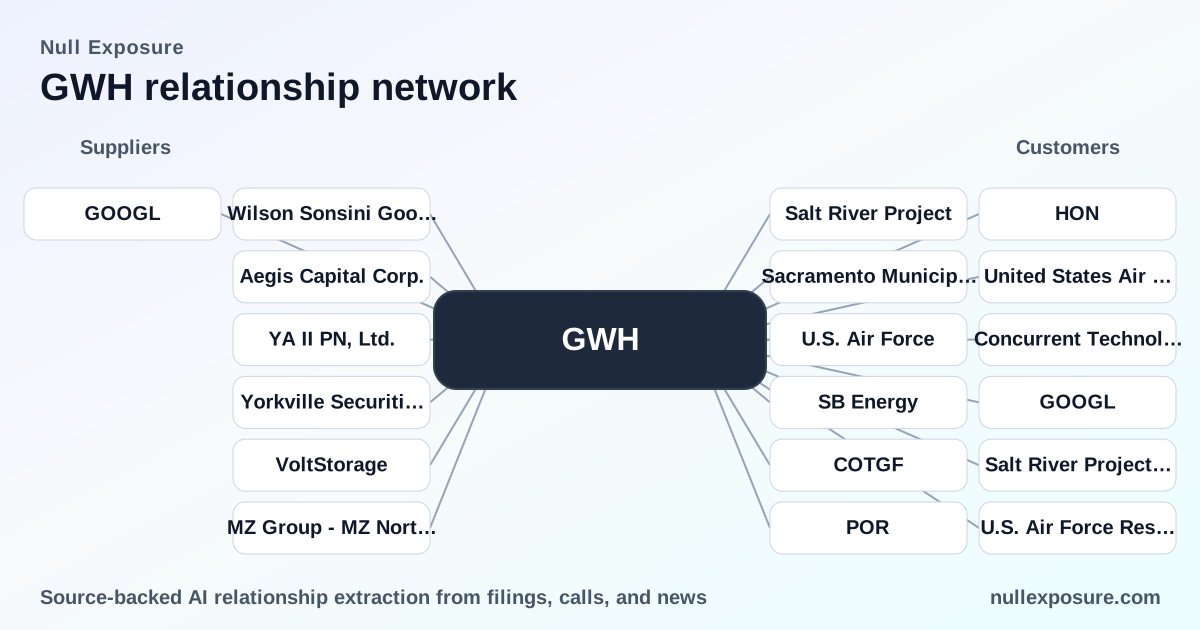
ESS Tech (GWH): Customer Relationships That Drive Commercial Validation
ESS Tech builds and sells iron‑flow long‑duration energy storage systems, monetizing through hardware sales, extended warranties, and service contracts to utilities, commercial offtakers and government programs; its commercial progress hinges on a small number of Tier‑1 pilots and framework engagements that convert into multi‑year, high‑value orders. For investors, the critical lens is whether these marquee relationships scale into the high‑spend bands management cites while the company moves from pilot to repeatable manufacturing and revenue recognition.
For a concise company‑level view and ongoing coverage, visit https://nullexposure.com/.
How ESS is contracting and where that matters
ESS is operating with a mixed contracting posture that combines long‑term commercial frameworks and pilot deployments. Management routinely frames its commercial funnel as a Tier‑1 pipeline that includes utilities, hyperscalers and defense customers — a structure that implies high contract concentration, elevated strategic criticality for select partners, and material upside if framework deals convert.
- Contracting posture: Company disclosures and call commentary show extended warranty options and framework agreements that create sticky economic relationships and potential future warrants or prepayments tied to large orders.
- Concentration and spend: Management and filings reference framework opportunities in the >$100M range and targeted multi‑year purchase bands between $10M–$300M, signaling that a handful of customers could represent the majority of future revenues if converted.
- Geography and scalability: Revenue recognition to date is concentrated in North America, but the product is positioned as globally deployable — a signal that commercial expansion depends on utility procurement cycles and international permitting.
- Relationship maturity: The pipeline mixes active (delivered or in‑delivery) projects, pilots for verification, and prospects under framework agreements, so near‑term revenue visibility is uneven despite high strategic validation from marquee partners.
Relationship map — who is buying ESS systems (and why it matters)
Below are every customer or offtaker relationship referenced in public company commentary and news coverage. Each entry is a plain‑English snapshot with the most relevant source cited.
Salt River Project (SRP)
ESS announced multiple SRP engagements including a 50 MWh Energy Base pilot and a Project New Horizon deployment (a 5 MW / 50 MWh system at SRP’s Copper Crossing center), establishing SRP as a strategic utility partner for Southwestern grid resilience. According to ESS’s Q3 and Q4 2025 earnings calls and subsequent news coverage, SRP is a cornerstone utility customer in Arizona driving both pilot validation and a decade‑long supply narrative (Q3 and Q4 2025 earnings calls; news reports March–May 2026).
SB Energy (SBE)
ESS references a framework relationship with SB Energy that establishes ongoing commercial collaboration but, as of filings, has not produced firm orders; management counts SBE among its Tier‑1 relationships. The company’s April 2021 framework agreement with an affiliate of SBE is documented in SEC disclosures and was reiterated on the Q3 2025 call (Q3 2025 earnings call; framework agreement disclosure).
Honeywell (HON)
Honeywell has purchased and paid for system sale and start‑up work with ESS, representing an industrial client that has already generated recognized revenue through equipment sale and reimbursable expenses. Management lists Honeywell among Tier‑1 customers on the Q3 2025 call and in investor materials (Q3 2025 earnings call; revenue recognition disclosures FY2024).
Portland General Electric (POR)
Portland General Electric is cited by management as a Tier‑1 utility relationship, included in the list of existing customers validating the product for grid‑scale applications. The Q3 2025 earnings call lists PGE among named utility customers (Q3 2025 earnings call).
Sacramento Municipal Utility District (SMUD)
SMUD appears alongside other utilities as a named Tier‑1 customer, indicating municipal utility interest in non‑lithium long‑duration systems for resilience and load optimization. Management referenced SMUD on the Q3 2025 call (Q3 2025 earnings call).
United States Air Force Research Laboratory (AFRL) / U.S. Air Force
ESS secured a $9.9 million contract (via Concurrent Technologies Corporation) to deploy long‑duration storage at a Clear Space Force Station in Alaska, marking an early defense sector win and mission‑critical validation for reliability at military installations. This award was announced in a January 29, 2026 press release and reiterated in earnings commentary and news articles (Business Wire / Yahoo Finance Jan 29, 2026; Q4 2025 earnings call).
Concurrent Technologies Corporation (CTC / COTGF)
CTC acted as the contracting vehicle through which ESS executed the $9.9 million award with AFRL for the Alaska deployment, serving as prime contractor/partner on the defense work. Market reports and the company press release document the CTC arrangement (Business Wire / MarketScreener Jan 29, 2026; news coverage March 2026).
Google (GOOGL)
Google is confirmed as an offtaker and cost‑sharing partner on Project New Horizon, providing multiyear operational testing and partial cost sharing that accelerates commercial validation in a hyperscaler use case. Management referenced Google’s role on the Q4 2025 call and in subsequent news coverage describing Project Horizon (Q4 2025 earnings call; Finviz / InsiderMonkey May 2026).
What these relationships imply for revenue and risk
- High upside if framework agreements convert: Management explicitly links framework arrangements (notably the SBE framework) to >$300M revenue opportunity; if even a fraction converts, the company’s top line would scale materially.
- Revenue today is small; validation is the near‑term value driver: ESS recognized modest revenue in recent years while securing pilots and government awards — commercial wins are strategically important but not yet large enough to stabilize cash flow (company filings and FY2024 revenue commentary).
- Customer mix reduces commercial risk but increases single‑deal exposure: Utility, hyperscaler and defense anchors diversify buyer types, but each engagement carries high dollar concentration, so conversion timing drives valuation sensitivity.
- Contract structure favors long‑term economics: Extended warranties and multi‑year testing arrangements create recurring service potential and stickiness, supporting aftermarket revenue if systems scale.
Key takeaways for investors
- Commercial validation is strong but early. Tier‑1 names (SRP, Google, AFRL, utilities) provide strategic endorsement that lowers technology risk.
- Economic outcomes depend on conversion of frameworks and pilot scale‑up. The SBE framework and other cited spend bands suggest large latent upside; execution and delivery timing control near‑term revenue realization.
- Defense contracts de‑risk reliability claims and open a new procurement channel, as demonstrated by the $9.9M AFRL award via CTC.
- Geographic footprint is North‑America‑centric today, with stated global applicability, so international expansion hinges on regulatory and utility procurement cycles.
Bottom line: ESS has moved from product proof‑point to revenue‑earning pilot and small commercial projects with Tier‑1 validation; the stock’s upside is a function of converting frameworks into firm orders and scaling manufacturing to meet large, concentrated demand.
For ongoing tracking of customer developments and primary‑source monitoring, see https://nullexposure.com/.