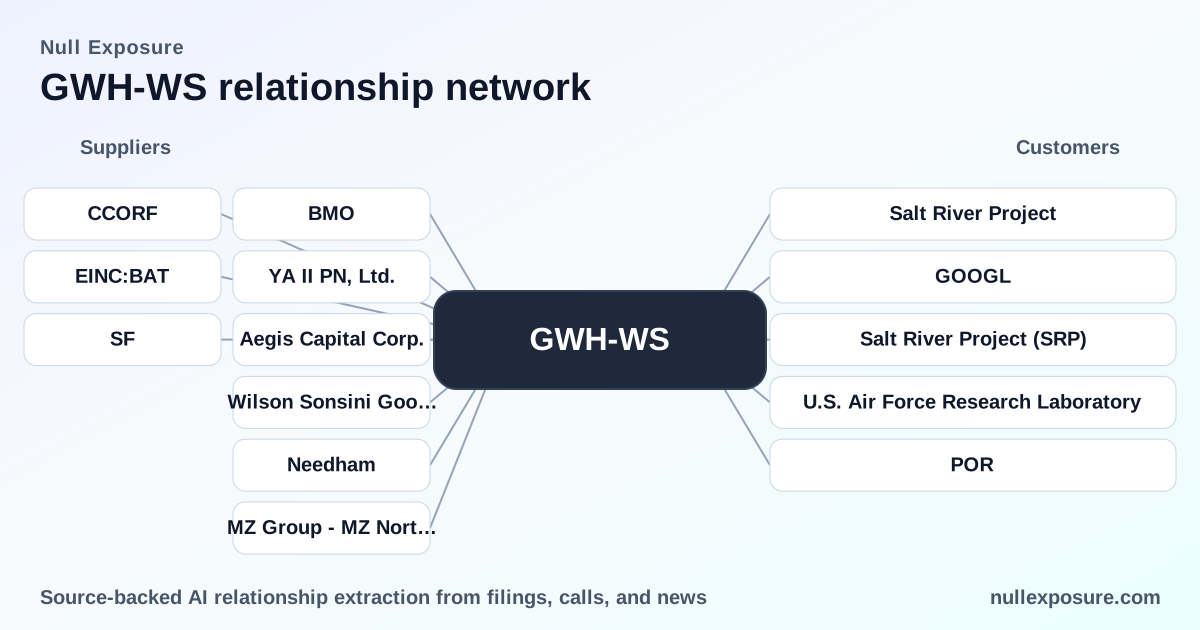
GWH-WS: Customer map and what it means for revenue durability
GWH-WS operates in the sustainable-transportation and EV infrastructure space, generating revenue through sales and deployment of charging and energy-management hardware plus recurring services and deployment partnerships with large utilities and enterprise partners. Its customer signals show a deliberate pivot toward utility-scale, long-duration energy projects and strategic co-development with hyperscalers and defense customers—an approach that converts product sales into multi-year validation and potential recurring services revenue. For investors, the customer list reads like a proof-of-concept pipeline: large, referenceable partners that accelerate commercialization and reduce technology adoption friction. Learn more about coverage and relationship analytics at https://nullexposure.com/.
Why the customer roster matters to valuation and risk
GWH-WS’s customers are not transactional retail accounts; they are institutional partners that provide operating scale, regulatory footprint and credibility. From the relationships in public reporting, several operating-model characteristics are evident as company-level signals:
- Contracting posture: Public disclosures emphasize multi-year or pilot-to-scale deployments with utilities and enterprise partners, suggesting negotiated, project-structured contracts rather than simple point-of-sale transactions.
- Concentration: A small number of large utility and corporate customers dominate cited deployments, implying revenue concentration risk if a small set of customers accounts for meaningful future backlog.
- Criticality: Projects described are grid-scale or defense-focused, indicating higher technical or operational criticality and higher switching costs once systems are live.
- Maturity: References to pilot projects and “first large-scale deployment” language indicate the company is transitioning from demonstration to early commercial scale; revenue recognition will increasingly depend on successful operations and follow-on rollouts.
No explicit contractual constraints or counterparty clauses were included in the dataset, so these are company-level signals derived from disclosed customer activity rather than contract excerpts.
Relationship roll call — who’s on the list and what they mean
Salt River Project (SRP): flagship utility validation
GWH-WS is publicly linked to a 5 MW / 50 MWh iron flow battery deployment at SRP’s Copper Crossing Energy and Research Center and a 50 MWh Energy Base pilot that SRP financed as a utility-scale evaluation of GWH-WS’s next-generation platform. According to investing.com and Yahoo Finance reporting in March–May 2026, SRP’s engagement functions as a major commercial validation and includes a long-term agreement structure described in coverage of the New Horizon project (FY2025–FY2026). These SRP projects represent a material reference point for utility customers and a pathway to larger procurement (Investing.com, May 3, 2026; Yahoo Finance, Mar 10, 2026).
Portland General Electric (POR): operational scale testing
GWH-WS is operating two systems with Portland General Electric that have executed daily cycling and transacted roughly 158 MWh of energy, giving the company hands-on operational learnings at commercial scale. This disclosure, reported in first-quarter results coverage (Markets FinancialContent, Mar 10, 2026), signals early commercial operation and system-level revenue generation tied to grid services—critical for proving lifetime economics and O&M revenue streams.
Google (GOOGL): cost-sharing and performance evaluation partner
Google is participating in a cost-sharing arrangement alongside SRP to evaluate the real-world operational performance of GWH-WS’s non-lithium long-duration energy storage (LDES) platform, signaling a hyperscaler’s interest in grid resiliency and renewable integration. Intellectia’s March 2026 coverage describes Google’s role as co-funder and technical evaluation partner for the 5 MW / 50 MWh deployment, which represents a powerful commercial endorsement and potential route to corporate-scale procurement (Intellectia.ai, Mar 10, 2026).
U.S. Air Force Research Laboratory: defense sector contract
GWH-WS is reported to have secured a $9.9 million contract with the U.S. Air Force Research Laboratory, marking a strategic entry into defense-related deployments. That award, noted in March 2026 news coverage, establishes a government contracting footprint that diversifies revenue exposure and creates higher-barrier sales opportunities (Intellectia.ai, Mar 10, 2026).
Alsym Energy: large-scale distribution partner for non-lithium BESS
A partnership with Alsym Energy is reported to cover delivery of approximately 8.5 GWh of non-lithium battery energy storage solutions, positioning GWH-WS to scale installations through a third-party channel. The announcement of this partnership, captured in May 2026 reporting, suggests an aggregator/distributor strategy to accelerate geographic deployment and scale without expanding direct sales headcount (ADVFN / EDGAR2, May 3, 2026).
What investors should watch next
- Conversion of pilots into recurring revenue. The difference between pilot validation and sustained revenue lies in follow-on purchases, long-term service agreements, and site-level uptime performance. Investors should prioritize updates on contract extensions and service revenue bookings.
- Customer concentration and contract terms. Several cited deployments are large and referenceable, but they point to concentration risk; monitor disclosure of revenue by customer or project to assess dependency.
- Operational performance metrics. Data on cycle counts, round-trip efficiency, availability and warranty claims for deployed systems (especially the SRP and POR sites) will drive the company’s ability to win utility-scale follow-ons.
- Defense and hyperscaler pipelines. The U.S. Air Force and Google relationships serve different go-to-market channels; success converting these into repeat business would materially de-risk projections.
For deeper coverage on how customer relationships translate into valuation signals, see our platform at https://nullexposure.com/.
Bottom line: validation is underway, but scaling is the next test
The publicly disclosed customer relationships for GWH-WS demonstrate clear commercial validation with utilities, an enterprise hyperscaler and a defense customer, plus a channel partnership to scale deployments. These relationships materially improve the company’s go-to-market credibility and create pathways to recurring services and larger procurements. The central question for investors is execution: converting pilots and validated reference sites into repeatable, contracted revenue streams while managing concentration risk. Monitor operational KPIs and contract roll-offs closely; those will determine whether validation translates into durable growth and improved valuation multiples.