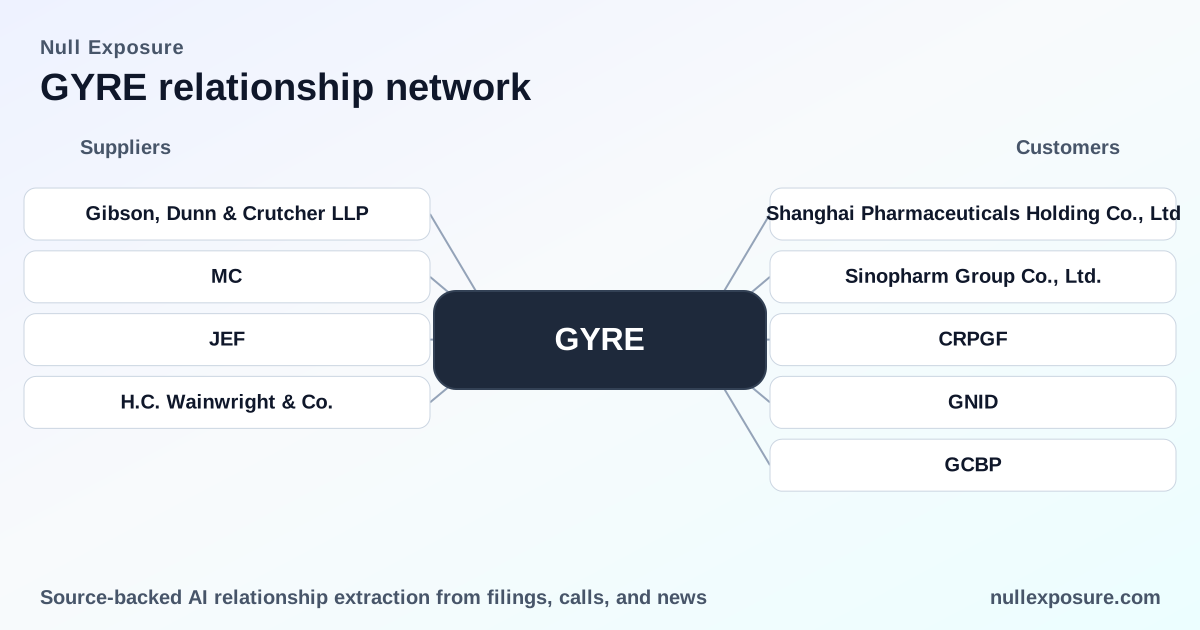
Gyre Therapeutics (GYRE): customer profile and concentration risk for investors
Gyre Therapeutics operates as a commercial-stage biopharmaceutical company that manufactures and sells small‑molecule therapies—most notably ETUARY (pirfenidone)—through a single‑layer distributor model in the People’s Republic of China, and advances a pipeline targeted at organ fibrosis for broader markets including the United States. Gyre monetizes primarily through product sales to national distributors (which resell to hospitals and pharmacies), supplemented by negotiated receivables and one‑off transaction hold‑backs tied to asset sales. For investor diligence, Gyre’s revenue and receivable profile is highly concentrated, government‑mediated in pricing and distribution, and anchored to a single commercial product. For a quick company overview, see NullExposure’s homepage: https://nullexposure.com/.
Key investment takeaways up front
- Customer concentration is acute: a single distributor accounts for roughly half of trade receivables and nearly half of revenue exposure.
- Distribution‑first model: Gyre sells exclusively to distributors who then supply hospitals and pharmacies; that channel design centralizes counterparty risk.
- Revenue criticality: ETUARY accounted for over 99% of product revenues in the latest reported years, making any disruption to distributor relationships or pricing mechanisms material to cash flow.
- Geographic posture: Commercial sales are primarily PRC/APAC today, while R&D and pipeline commercialization plans target the U.S. as a strategic growth market.
How Gyre sells and collects: practical operating signals
Gyre’s commercial posture combines spot product deliveries with typical short credit terms to distributors and select long‑term receivables created by transactional arrangements. The company recognizes product sales at the point control transfers (spot recognition), extends credit terms usually within three months, and treats certain transaction‑related holdbacks as long‑term receivables when structured as loans held to maturity. Government payors and centralized procurement rules dominate pricing dynamics in target markets, reinforcing the company's exposure to regulatory pricing and tender processes. These operating signals translate to high counterparty concentration, material dependence on distributors, and regulatory exposure tied to reimbursement and procurement policy.
Disclosed customers and receivables — what the filings and releases show
Gyre’s SEC filing and investor releases name a small set of large counterparties that together explain the company’s revenue and receivable concentration. Below I list every relationship flagged in the results, with a concise plain‑English summary and source.
Sinopharm Group Co., Ltd.
Sinopharm is Gyre’s single largest commercial counterparty, accounting for about 48.5% of total revenue in 2024 and representing ~54.3% of accounts receivable at year‑end 2024 (50.5% in 2023), a primary source of concentration risk identified in the 2024 Form 10‑K. According to Gyre’s 2024 10‑K, Sinopharm dominates both revenue and receivable balances for the period.
China Resources Pharmaceutical Group Ltd (CRPGF)
China Resources Pharmaceutical Group accounted for approximately 13.6% of total revenue in 2024 according to Gyre’s 2024 Form 10‑K, making it the company’s second‑largest named distributor customer by revenue share (inferred symbol: CRPGF).
Shanghai Pharmaceuticals Holding Co., Ltd.
Shanghai Pharmaceuticals represented about 10.6% of total revenue in 2024, completing the trio of large distributor customers that together accounted for roughly 72.7% of revenue in 2024 as disclosed in the 2024 10‑K.
GNI / GNID
Investor releases for Gyre’s 2025 and 2025/2026 reporting include a line item “Other receivables from GNI 230 230,” indicating an outstanding other receivable balance tied to GNI (presented in the GlobeNewswire business updates for Q2 2025 and FY2025/Q4 2025). These releases show a recorded receivable amount labeled with the GNI/GNID identifier in the company’s public updates (GlobeNewswire, Q2 2025 and FY2025/Q4 2025 press releases).
GCBP (GC Biopharma Corp.)
Gyre discloses a receivable from GCBP presented as “Receivable from GCBP — 4,961” in its corporate reporting and investor updates; the company also documented that a hold‑back from the GCBP asset sale was treated as a long‑term receivable and expected a $5.0 million hold‑back payment tied to that transaction (disclosed in the 2024 10‑K and subsequent investor release coverage). The receivable and CVR mechanics are discussed in the company’s financial statement disclosures and press releases (GlobeNewswire, FY2025 and FY2026 results releases).
(Each of the above relationships is drawn from Gyre’s 2024 Form 10‑K and the company’s GlobeNewswire investor releases in 2025–2026 as cited in the public filings and press statements.)
Explore more on customer exposure and counterparty mapping at NullExposure: https://nullexposure.com/.
Risk profile driven by these relationships
- Concentration risk is material: Gyre’s top three distributor customers composed roughly 48.5% + 13.6% + 10.6% = 72.7% of revenue in 2024 per the 10‑K, and a single counterparty—Sinopharm—constitutes over half of accounts receivable. That level of concentration creates meaningful counterparty credit and negotiation risk for revenue and cash flow.
- Distribution dependence increases operational leverage: Gyre uses a single‑layer distributor model (distributors are direct customers and resell to hospitals), so distributor contract renewals, tender outcomes, or margin pressure cascade directly to Gyre’s top‑line. The company recognizes sales at point‑in‑time deliveries to these distributors, reinforcing transactional exposure.
- Regulatory and government payor impact: Government procurement and reimbursement frameworks in the PRC influence pricing and purchasing volumes; Gyre’s sales are therefore sensitive to centralized tenders, NRDL listings, and pricing reforms.
- Receivable structure includes long‑term elements: While standard trade credit is short‑term (credit periods generally within three months), Gyre does record long‑term receivable items tied to specific transactions (for example, the GCBP hold‑back classified as long‑term in company disclosures), which creates mixed liquidity timing for collections.
Commercial maturity and pipeline implications
- Core commercial stage: ETUARY is a mature, revenue‑generating product in the PRC with multi‑year presence and NRDL inclusion since 2017; it accounted for nearly all product revenue in 2023–2024. Gyre’s distributor relationships are therefore operationally mature and central to current cash flow.
- Ramping and prospect signals: Gyre plans commercial launches for nintedanib and avatrombopag in 2025, which creates prospective diversification of revenue streams but does not change the immediate concentration profile reflected in the 2024 results.
Final read for investors
Gyre’s commercial model delivers healthy gross margins on its flagship product but concentrates counterparty credit and pricing risk in a handful of large PRC distributors—most significantly Sinopharm. The combination of single‑product revenue dominance, distributor concentration, government‑influenced pricing, and a mix of short‑term trade receivables with isolated long‑term receivable arrangements defines the company’s primary operating risk set. Investors should prioritize monitoring receivable collectability by large distributors, outcomes of centralized procurement and reimbursement policy shifts in the PRC, and the successful commercialization of the 2025 product launches to assess revenue diversification.
For further relationship mapping and signals analysis, visit NullExposure’s research hub: https://nullexposure.com/.