Hafnia Limited (HAFN): Customer Relationships and Commercial Posture
Hafnia operates and monetizes a fleet of oil product tankers through a mix of time-charter contracts and spot market employment, converting vessel days into predictable cash flow when under term charter and exposure to freight-rate upside when trading spot. The company reported trailing twelve‑month revenue of $2.28 billion and EBITDA of $492.7 million through the 2026-03-31 quarter, and distributes cash via a meaningful dividend yield (6.12% as of the latest public figures), underscoring a capital-return focus for equity holders. For relationship-level visibility and proprietary commercial mapping, see the NullExposure research hub: https://nullexposure.com/.
The commercial model investors should price in
Hafnia’s core monetization model is straightforward: ownership of product tankers plus commercial employment of those vessels. Time-charters to energy majors translate into contracted revenue streams and lower daily cashflow volatility, while spot trading allows the company to capture freight-rate cycles. Financials show an operating margin of 16.9% and a trailing P/E of 13.25, reflecting a business with asset-backed earnings and cyclical topline sensitivity driven by shipping markets. Insider ownership is high (46.06%) and institutional ownership is material (35.32%), which signals concentrated internal alignment with shareholder returns.
Customer relationships in the public record
Below are every customer relationship captured in the supplied results. Each entry is a plain-English, source-linked summary drawn from the cited article.
TotalEnergies (TotalEnergies SE) — multi-year time-charters for ECOMAR methanol tankers
All four vessels in Hafnia’s ECOMAR series are time‑chartered to TotalEnergies under multi‑year arrangements, preserving a direct commercial link between Hafnia and a major energy aggregator. According to Marinelink (March 10, 2026), these charters continue Hafnia’s established cooperation with the energy sector.
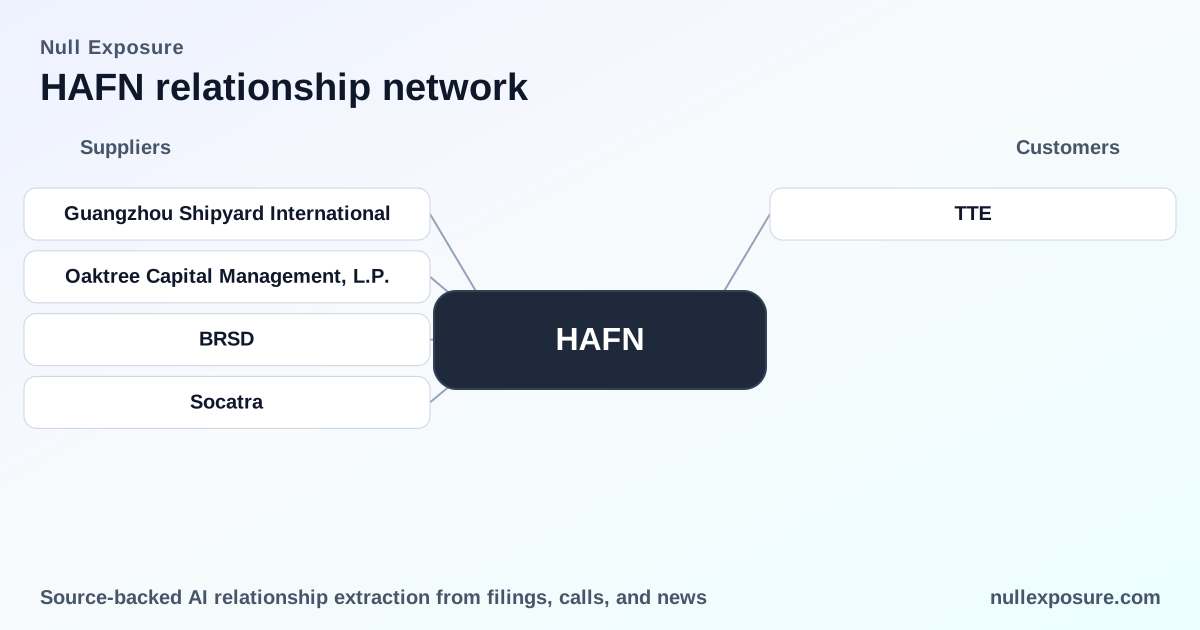
TTE (ticker TTE) — same multi-year time-charter relationship recorded under abbreviated name
The record under the abbreviated counterparty name TTE documents the identical set of multi‑year time charters of the ECOMAR vessels to TotalEnergies. Marinelink’s March 10, 2026 report captures this contractual posture and the continuation of the partnership.
What these relationships imply about risk and runway
The captured records show direct, term-based exposure to an energy major through time‑charter contracts. That contractual form produces a few concrete investment implications:
- Revenue stability: Multi‑year time charters replace spot volatility with contractual day‑rates for the chartered vessels. For the days tied to TotalEnergies, Hafnia converts vessel capacity into predictable cash flow that underpins coverage of capex, interest, and dividends.
- Counterparty concentration: The dataset captures a single major counterparty across both entries. This limited sample is a signal of concentrated commercial linkage in the visible record; investors should treat TotalEnergies as a commercially important counterparty until broader disclosure shows a more diversified roster of long-term charters.
- Cargo and operational criticality: The ECOMAR vessels are dedicated to methanol carriage. Transporting an energy feedstock under multi‑year contract to an integrated energy firm is operationally critical work that elevates the strategic value of the employed vessels during the charter period.
- Contract maturity: The presence of multi‑year term charters indicates contractual maturity and predictable earnings duration for those assets, insulating a portion of Hafnia’s cash flow from short‑term market swings.
Company-level constraints and signals
The provided constraints array contains no explicit contractual restrictions or special conditions captured in this sample. Treat this absence as a company-level signal: no additional constraint metadata was supplied, so structural risk assessment must rely on disclosed contracts, fleet employment patterns, and standard industry practice rather than flagged covenant or dependency disclosures in this dataset.
From a governance and capital-structure angle, Hafnia’s metrics give context to its customer posture: market capitalization of $4.50 billion, dividend per share of $0.546 with an ex-dividend date of 2026-03-06, and a forward P/E of 6.29, all consistent with a cash-returning shipping company that supports yield-seeking investors while retaining leverage to freight cycles.
Investor takeaways — what matters now
- Stable cash anchors: The time‑charter relationship with an investment‑grade energy counterparty like TotalEnergies provides defined revenue for the chartered vessel days and reduces short‑term revenue variance from spot rates.
- Concentration watch: Publicly captured customer exposure is narrow in the supplied results; investors should underwrite Hafnia’s revenue profile with a sensitivity to counterparty concentration until management provides a fuller charterbook disclosure.
- Earnings leverage: Hafnia’s operating profile and current multiples (EV/EBITDA ~9.13) show that the market prices a balance of steady asset income and exposure to cyclical freight markets; multi‑year charters compress downside but leave upside to spot exposure on non‑contracted days.
- Actionable data point: For analysts building counterparty risk matrices or modeling cash‑flow duration by vessel, the TotalEnergies ECOMAR time‑charters are a concrete, dated contractual input to lock into near‑term revenue schedules (Marinelink, March 10, 2026).
For a deeper mapping of Hafnia’s counterparty network and to track new contract disclosures as they surface, visit NullExposure’s research hub: https://nullexposure.com/.
Final assessment
Hafnia’s visible customer relationship set in the provided record is defined by multi‑year time‑charters to a major energy client, which strengthens near-term revenue visibility and supports dividends. The single counterparty captured drives a pragmatic risk checklist for investors: quantify the portion of vessel days under term charter versus spot exposure, monitor contract expiries, and watch for incremental charter announcements that diversify counterparties and cargo types. The combination of contracted cash flow, asset backing, and yield orientation frames Hafnia as a shipping equity with both defensive and cyclical characteristics — a profile that requires continuous monitoring of charterbook composition for accurate valuation and risk management.