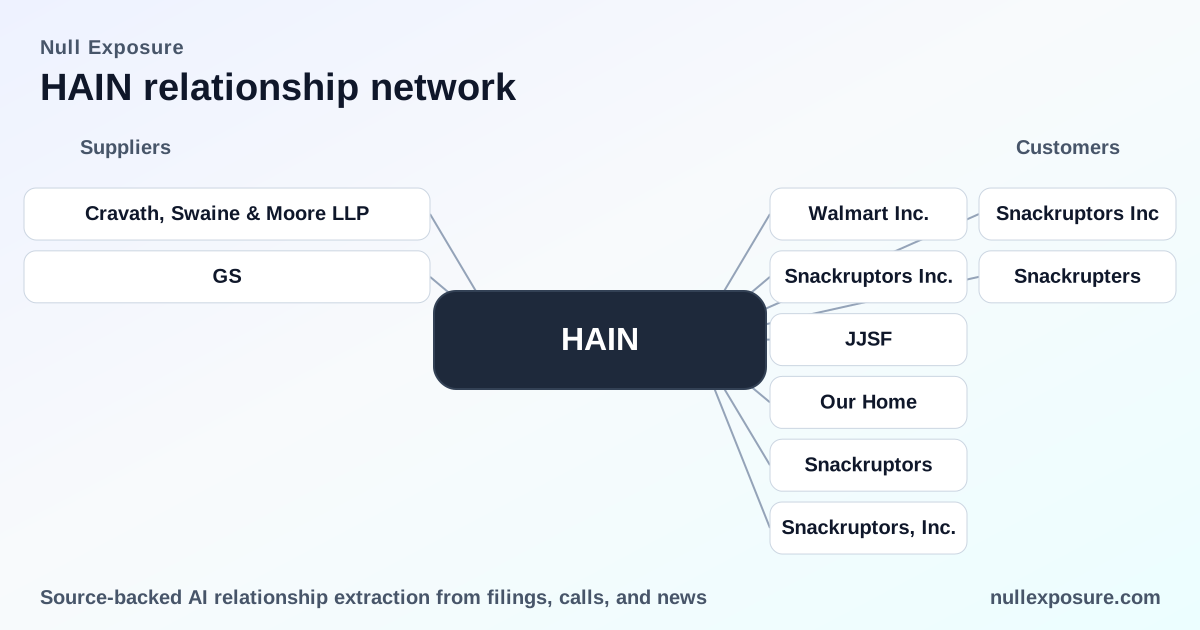
HAIN’s customer map: concentration, divestitures and what they mean for margins and risk
Hain Celestial is a branded consumer packaged goods company that monetizes by selling “better‑for‑you” food and beverage products through a mix of retailers, distributors and e‑commerce channels, while periodically monetizing non‑core assets via divestitures. Revenue depends on trade promotions and retailer relationships, with payment and promotional terms typically negotiated on short timeframes; the company has recently reshaped its North American footprint through several asset sales to sharpen margins and reduce complexity. For a focused view of Hain’s customer relationships and how they drive cash flow and risk, see Null Exposure for primary‑source parsing and trend signals: https://nullexposure.com/
Executive snapshot: why customers matter now
Hain’s commercial model is retailer‑ and distributor‑centric, with a concentrated customer base and a large global footprint. One major customer accounts for mid‑teens to high‑teens percentage of sales, and Hain has actively sold non‑core snack and personal care assets to reduce working capital and refocus on higher‑growth, higher‑margin categories. These dynamics make customer contract terms, promotional expense control and distributor stability the primary levers for near‑term earnings recovery.
Who Hain sells to — line‑by‑line relationship review
Walmart Inc.
Hain reports that sales to Walmart Inc. and its affiliates represented approximately 18% of sales in FY2025 (18% in FY2024 and 16% in FY2023), underscoring Walmart’s role as a major wholesale/retail customer for Hain’s North American business. According to Hain’s FY2025 10‑K filing (year ended June 30, 2025), Walmart is a material buyer and a source of concentrated revenue for the company.
Snackruptors Inc. (and related Snackruptors entities)
Hain agreed to and completed the sale of its North American Snacks business — including Garden Veggie Snacks, Terra and Garden of Eatin’ — to Snackruptors Inc. for $115 million in cash, a transaction announced in February 2026 and reported complete in March 2026. Industry and company press releases and trade coverage (GlobeNewswire, DairyFoods and multiple trade outlets, Feb–Mar 2026) document the definitive agreement and closing, reflecting Hain’s strategic disposition of ~38% of North American snacks revenue cited in company communications.
Our Home
Hain sold its ParmCrisps brand to Our Home, an owner of Pop Secret, as part of prior portfolio pruning (transaction reported as completed in September 2024). Trade coverage in FoodDive and regional business press (FoodDive, March–May 2026 coverage summarizing the divestiture) records the ParmCrisps transfer as part of Hain’s effort to streamline its North American snack footprint.
J&J Snack Foods Corp. (JJSF)
Hain divested the Thinsters cookie business to J&J Snack Foods Corp., a transaction announced and reported in company filings and trade press in 2024–2025; regional business coverage (NJBIZ and Snack & Bakery, Mar 2026 summaries) confirms the sale as one of several carve‑outs used to reduce lower‑performing SKUs and generate cash.
What the constraints say about Hain’s operating model and risk profile
The company disclosures and the relationship evidence produce a consistent set of operating signals investors should use to model Hain’s revenue durability and cash generation.
-
Contracting posture — predominantly short term. Hain states that most promotion and incentive arrangements do not exceed one year and that it applies the ASC 606 practical expedient for contracts shorter than a year; this indicates revenue is driven by annual promotional cycles and frequent renegotiation, increasing near‑term volatility in margins and working capital.
-
Concentration and criticality. Hain discloses that a single large customer represented roughly 16–18% of sales in recent years, and management acknowledges greater bargaining power at consolidated retailers; this creates a material customer concentration risk to revenue and pricing.
-
Relationship maturity and amortization signal longer legacy ties. The company amortizes customer relationships and trademarks over multi‑year spans (7–25 years) and reports a weighted average remaining amortization around eight years, indicating legacy contractual and brand value even where commercial terms are renewed often.
-
Geographic footprint is global but North America is the primary battleground. About 50% of net sales in FY2025 came from outside the U.S., but North America remains the largest single region and the locus of recent impairments and divestitures; investors should model differentiated growth and risk by region (North America vs. International/EMEA).
-
Role mix — from seller to distributor to reseller. Hain sells direct to retailers and through independent distributors and resellers; disclosures emphasize reliance on independent distributors for a substantial portion of sales, which creates execution risk in inventory management and distribution continuity.
-
Materiality tiers. Company language classifies customer concentration and brand reputation as potentially material or critical — reputational issues or large customer losses can have a material adverse effect on results.
-
Lifecycle signals. Several business lines and asset groups are explicit sold, held for sale, or impaired, indicating a portfolio in active rationalization rather than broad expansion; relationship stages range from active to winding‑down across specific product groups.
Strategic and risk implications for investors
-
Customer concentration is an earnings lever. With a buyer such as Walmart representing ~18% of sales, contract negotiations and placement decisions materially affect revenue and trade spend. Model inputs should stress test promotional expense elasticity and slotting fee dynamics.
-
Divestitures reduce near‑term revenue but improve focus. The $115 million sale to Snackruptors and prior disposals of ParmCrisps and Thinsters extract cash and simplify the supply chain; expect improved margin profiles if management redeploys proceeds into core, higher‑margin categories and reduces low‑return working capital.
-
Short contract durations amplify quarter‑to‑quarter variance. Given the predominance of one‑year or shorter promotional agreements and 30–91 day credit terms, inventory and trade accrual timing will drive short‑term cash volatility.
-
Regulatory and reputational risk remains a discount factor. Ongoing consumer litigation and regulatory inquiries (noted in company filings) keep brand equity and purchase behavior under pressure, particularly in sensitive categories like baby & kids.
For deeper primary‑document customer intelligence and to track subsequent buyer/retailer activity, visit Null Exposure: https://nullexposure.com/
Actionable watcher list
- Monitor reported trade promotion accruals and promotional intensity in FY2026 results.
- Track shelf placement and distribution re‑entries post‑divestiture, especially with major retailers.
- Watch cash deployment of divestiture proceeds and any announced share repurchase, deleveraging, or capex shifts.
- Reassess goodwill and intangible impairment risk in North America if organic recovery stalls.
Hain has pivoted from scale‑through‑breadth to a sharper, brand‑focused portfolio. Investors who model customer concentration, short contract cycles, and disciplined redeployment of divestiture proceeds will best capture the company’s path to margin stabilization and value realization.