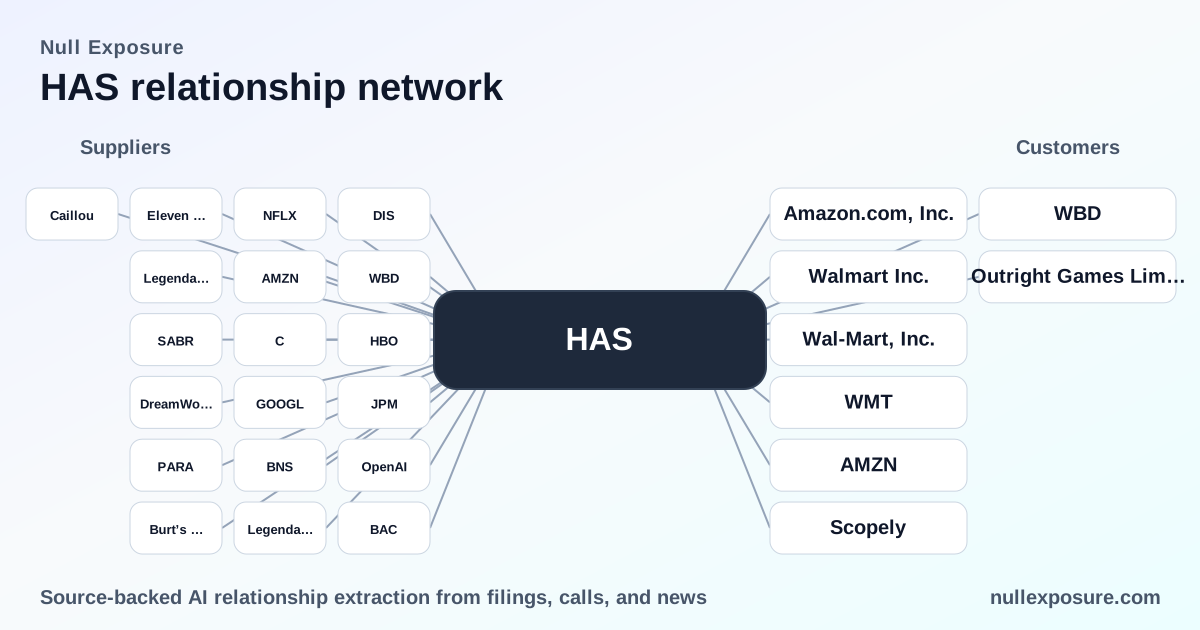
Hasbro (HAS) — Customer relationships that shape revenue and risk
Hasbro monetizes a hybrid consumer-entertainment model: the company sells finished toys and games through large retailers while extracting recurring and variable revenue from licensing, digital subscriptions, and in‑game purchases. Retail wholesale sales drive the majority of near‑term cash flow, while licensing and digital gaming provide higher-margin, usage‑linked upside. For a quick platform view of Hasbro’s customer signals, visit https://nullexposure.com/.
How Hasbro actually makes money — a compact thesis for investors
Hasbro operates three revenue engines: (1) consumer product sales sold primarily through large retail partners and distributors, (2) licensing and royalties where partners pay fixed fees or sales/usage‑based royalties to use Hasbro IP, and (3) digital & subscription revenue from Wizards of the Coast and other digital gaming initiatives (including subscriptions, in‑app purchases, and licensed digital titles). The company's model mixes short‑term, purchase‑order retail contracts with longer‑running license economics — creating a cash foundation plus scalable, variable‑margin intellectual property revenue.
Quick read: what matters to operators and investors
- Customer concentration is material. Hasbro reported its top five customers accounted for ~36% of consolidated net revenues in FY2024, with Wal‑Mart and Amazon together representing 23% (12% and 11% respectively). This is a structural risk if major retail ordering patterns shift (Hasbro 10‑K FY2024).
- Licensing is structurally usage‑linked. Hasbro records sales‑based or usage‑based royalties for IP licenses and sometimes receives minimum guarantees or advance royalties; royalty accounting was identified as a critical audit matter (Hasbro 10‑K FY2024).
- Contracts tilt short‑term. Retail buyers place purchase orders and do not make long‑term binding volume commitments, which leaves Hasbro exposed to annual retail cadence and holiday season concentration (Hasbro 10‑K FY2024).
- Digital is a growth vector and margin diversifier. Subscriptions (D&D Beyond), in‑app purchases, and licensed digital games create recurring and usage-based streams alongside physical product sales (Hasbro 10‑K, FY2024).
For a deeper signal map and customer-level intelligence see https://nullexposure.com/ (company homepage).
Customer roster — what each relationship in the record tells investors
Amazon.com, Inc. (10‑K, FY2024)
Hasbro reported Amazon as one of its largest customers, accounting for approximately 11% of consolidated net revenues in 2024, underscoring Amazon’s role as a core e‑retail channel for Hasbro products. According to Hasbro’s FY2024 Form 10‑K (filed 2024‑12‑29), Amazon represented ~11% of consolidated net revenues.
Walmart Inc. (10‑K, FY2024)
Wal‑Mart accounted for approximately 12% of consolidated net revenues in 2024, making the retailer Hasbro’s single largest customer by that metric and a central demand anchor for physical product sales. This figure is disclosed in Hasbro’s FY2024 Form 10‑K (filed 2024‑12‑29).
Wal‑Mart, Inc. (10‑K duplicate entry, FY2024)
The 10‑K reiterates Wal‑Mart’s outsized share of FY2024 revenue (12%), which reinforces the concentration signal and the operational importance of aligning production and promotional calendars to Wal‑Mart’s buying patterns (Hasbro FY2024 10‑K).
Wal‑Mart (TradingView write‑up, FY2026)
A March 2026 TradingView summary flagged Hasbro’s reliance on a small customer base including Wal‑Mart, warning that changes in retailer purchasing patterns could be a risk to revenue stability. TradingView reported this observation in a commentary on Hasbro’s 10‑K (Mar 2026).
Amazon (TradingView write‑up, FY2026)
The same TradingView piece called out Amazon alongside Wal‑Mart as a concentrated customer exposure for Hasbro, emphasizing that shifts in e‑commerce ordering behavior pose top‑line risk (TradingView, Mar 2026).
AMZN (TradingView duplicate, FY2026)
TradingView’s coverage also surfaced under the AMZN ticker label, repeating the concentration risk tied to Amazon as a customer channel (TradingView, Mar 2026).
Warner Bros. Discovery (LA Business Journal, FY2026)
LaBusinessJournal reported that Warner Bros. Discovery signed a deal with Hasbro to roll out merchandise for a show, illustrating Hasbro’s licensor/partner role in entertainment IP commercialization and third‑party content merchandising (LA Business Journal, 2026).
Walmart (BleedingCool, FY2026)
BleedingCool covered a Walmart‑exclusive Hasbro collectible release (Transformers Star Eagle), demonstrating retailer exclusives as a tactical distribution and marketing lever that can concentrate promotional volume and demand at a single partner (BleedingCool, Mar 2026).
WMT (BleedingCool duplicate, FY2026)
BleedingCool’s coverage also indexed Walmart under the WMT ticker, reiterating the same exclusive distribution example (BleedingCool, Mar 2026).
WBD (LA Business Journal duplicate, FY2026)
The LA Business Journal item appears in the feed again under the WBD ticker, confirming Warner Bros. Discovery’s merchandising tie‑up with Hasbro for a 2026 entertainment rollout (LA Business Journal, 2026).
Scopely (InsiderMonkey, FY2026)
Hasbro characterized Scopely as a fantastic partner on digital gaming initiatives, highlighting Scopely’s role as a strategic third‑party developer/publisher for Hasbro‑branded digital titles (InsiderMonkey transcript of Hasbro Q4 2025 earnings call, 2026).
Outright Games Limited (outrightgames.com, FY2026)
Outright Games lists Hasbro trademarks on a My Little Pony game release, which demonstrates licensing relationships where Hasbro grants IP rights to third‑party game publishers for console/PC products (Outright Games publisher page, 2026).
Amazon (FinancialContent press release, FY2026)
A February 2026 Hasbro press release carried by FinancialContent noted product availability through Amazon — for example, the first toy featuring a character with a hearing aid available on Amazon — underscoring Amazon’s role as a prioritized e‑retail distribution point (BizWire/FinancialContent, Feb 2026).
AMZN (FinancialContent duplicate, FY2026)
The same FinancialContent item is also indexed under the AMZN label, reiterating the Amazon channel reference for product launches (BizWire/FinancialContent, Feb 2026).
Operating constraints and what they signal to investors
Hasbro’s public disclosures and audit notes lay out constraints that frame commercial performance:
- Contracting posture: short‑term retail ordering plus usage‑based licensing. Retail buyers place purchase orders without long‑term volume commitments, while licensing is often sales‑based or usage‑based royalties, sometimes with minimum guarantees (Hasbro 10‑K FY2024). That mix produces predictable cash during holiday cycles but exposes Hasbro to promotional volatility and royalty auditing complexity.
- Concentration and criticality. Top five customers = ~36% of revenue; Wal‑Mart and Amazon alone = 23% — a material concentration that makes large retail partners operationally critical and places strategic emphasis on trade terms and supply‑chain alignment (Hasbro 10‑K FY2024).
- Revenue maturity and diversification. Physical product sales remain the cash engine (79% of revenues from finished product sales in recent years), while licensing, digital gaming subscriptions, and in‑app purchases provide higher‑margin, scalable revenue. The licensing line is mature but increasingly tied to digital and entertainment partnerships.
- Geography is global but North America‑heavy. Hasbro reports North America as the largest region by revenue; the company operates globally and is exposed to currency and regulatory differences across NA, EMEA, APAC, and LATAM (Hasbro 10‑K FY2024).
Investment implications: tight retail relationships drive short‑term cash and inventory risk; licensing and digital products are the levers for margin expansion. Active monitoring of retailer order patterns, royalty trends, and digital engagement metrics is essential.
Bottom line
Hasbro’s customer profile is a two‑speed story: large retailers provide the cash baseline and also concentration risk, while licensing and digital partnerships create variable, higher‑margin upside tied to usage and subscriptions. For investors, monitor the cadence of retailer orders, product exclusives, and royalty receipts — these are the primary drivers of short‑term volatility and medium‑term margin recovery. For continuous customer‑level signal tracking and alerts, see https://nullexposure.com/.
Bold takeaways: retailer concentration is material; licensing is usage‑linked and audited; digital subscriptions are growth and margin levers.