Hannon Armstrong (HASI) — who its customers are and why investors should care
Hannon Armstrong is a specialized capital manager that originates, acquires and services long-lived sustainable infrastructure assets—principally solar, wind, energy efficiency and behind‑the‑meter solutions—and captures returns through net interest income, gains on securitizations and recurring asset‑management and servicing fees. Its business model monetizes long‑term contracted cash flows, large structured equity commitments, and repeat servicing relationships, while using securitization and syndication to recycle capital and extract fees. Read the full company relationship profile at https://nullexposure.com/.
What the recent coverage and filings demonstrate about HASI’s customer footprint
Recent press and HASI filings emphasize two investment patterns: significant structured equity and JV commitments into residential distributed energy, and continued large-scale project investments upstream in utility and merchant renewables. The public signals show HASI acting as both a capital buyer and an ongoing service provider/servicer, with customers ranging from residential‑focused platforms to large project developers and utilities.
- Core monetization drivers: interest income from long‑term receivables, gains on sale via securitizations, and recurring servicing/asset‑management fees.
- Commercial posture: contracts are predominantly long‑dated and cash‑flow backed; HASI operates as a hands‑on manager and typical servicer for securitizations.
- Concentration & geography: revenues are concentrated in the United States and exposed to state/federal policy and utility frameworks.
- Scale: HASI routinely underwrites deals in the tens to hundreds of millions and retains servicing positions on securitizations.
Explore more on platform coverage and relationship details at https://nullexposure.com/.
Complete relationship list (each result in the dataset)
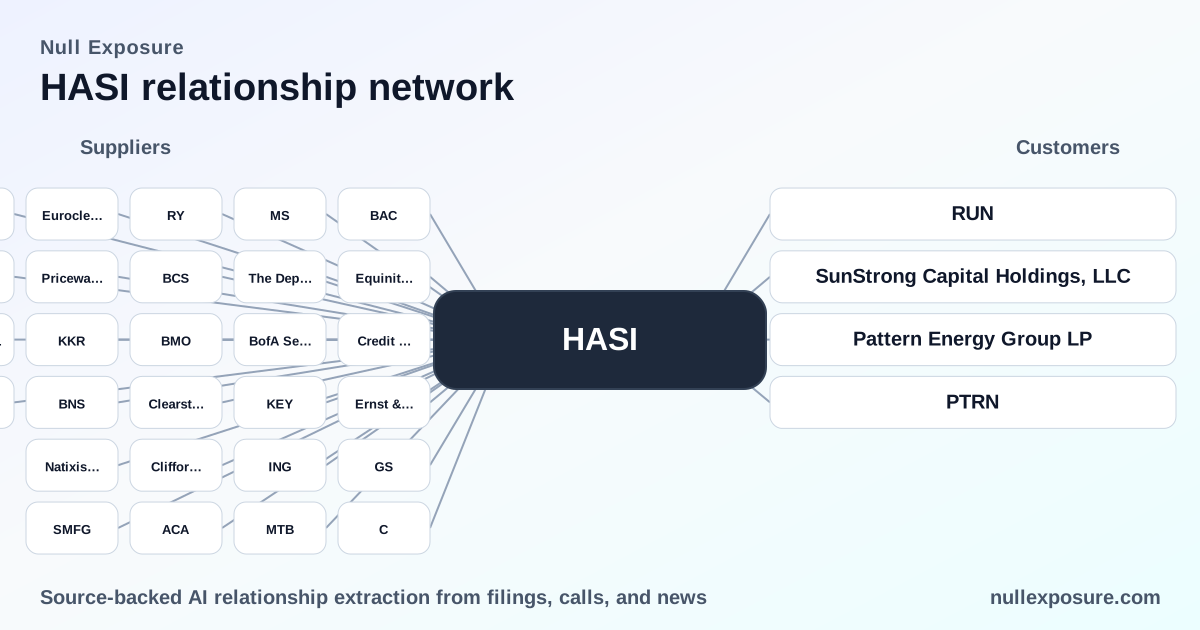
SunStrong Capital Holdings, LLC
HASI served as a co‑lead on a large ABS that securitized residential solar assets, backing a roughly $900 million transaction that positions HASI as a primary capital provider to residential solar originations. The deal was reported by Sahm Capital in October 2025. (Source: Sahm Capital news, Oct 2025 — https://www.sahmcapital.com/news/content/largest-ever-residential-solar-securitization-might-change-the-case-for-investing-in-hasi-2025-10-05)
Sunrun (RUN) — joint venture and structured equity
HASI completed an innovative joint venture with Sunrun, committing up to $500 million over 18 months to finance residential solar and battery systems and monetize long‑term cash flows from Sunrun’s residential energy assets; management underscored the JV on HASI’s Q4 earnings call and in SEC disclosures. (Sources: InsiderMonkey earnings coverage and company earnings call, Q4 2025; SEC filing December 2025 — https://www.insidermonkey.com/blog/...; SEC Form 424B5 filing, Dec 2025 — https://www.sec.gov/Archives/edgar/data/1561894/000119312526064066/d104827d424b5.htm)
Sunrun (RUN) — broader media confirmations
Multiple sell‑side and market news outlets reiterated the Sunrun JV as a strategic financing collaborative that supports hundreds of megawatts and tens of thousands of home installations, reinforcing HASI’s pivot into distributed energy finance at scale. (Sources: InsiderMonkey analyst note FY2026 and Morgan Stanley coverage cited by InsiderMonkey; Investing.com recap May 2026 — https://www.insidermonkey.com/blog/...; https://www.investing.com/news/company-news/hannon-armstrong-stock-hits-52week-high-at-3471-usd-93CH-4460784)
Sunrun Inc. (SEC disclosure)
HASI’s SEC disclosure confirmed formation of the December 2025 joint venture with Sunrun and the explicit up to $500 million commitment to finance distributed assets, documenting the capital and contractual structure for investors. (Source: HASI SEC filing, Dec 2025 — https://www.sec.gov/Archives/edgar/data/1561894/000119312526064066/d104827d424b5.htm)
Pattern Energy Group LP / Pattern (PTRN)
HASI referenced its $1.2 billion investment in the SunZia joint venture with Pattern Energy, an upstream utility‑scale transaction that is expected to underwrite multi‑GW capacity and material annual generation, highlighted on HASI’s earnings call and filings. This is an example of HASI’s large project commitments at the grid scale. (Sources: HASI Q4 2025 earnings call; SEC filing excerpts referencing SunZia with Pattern — hasi‑2025q4‑earnings‑call and SEC filing Dec 2025)
How HASI’s operating model shows up in the constraints and what that means for investors
HASI’s public disclosures produce strong company‑level signals about contract profiles, counterparty mix and economics:
- Long‑term contracting posture: HASI’s portfolio is overwhelmingly underwritten around long‑dated receivables, PPAs and triple‑net real‑estate leases with maturities stretching decades; the firm intentionally holds assets for investment horizon returns rather than short flips. This structure drives interest‑income predictability and securitization optionality, but ties earnings to long‑term rate and counterparty credit dynamics.
- Selective short‑term and spot exposure: The company also retains a minority of shorter‑term contracts and merchant sales, which introduce earnings volatility and require active hedging and asset management.
- Counterparty profile is broad but U.S.‑centric: A material share of receivables are government or investment‑grade utility off‑takers and large enterprise clients, while residential obligors exist through SPEs; overall revenue and policy exposure are concentrated in the United States.
- Dual commercial role — buyer and service provider: HASI acts both as capital buyer (investor/structured equity provider) and ongoing servicer/asset manager on many securitizations, earning recurring fees and retaining residual economics while also transferring risk when it executes sales.
- Scale and materiality: The firm handles large transactions regularly (portfolio receivables and securitization cost bases in the billions), with some individual deals in the $100M+ and $500M+ spend bands—this underlines the systemic importance of a few large JVs and securitizations to near‑term growth.
Investment implications and risk checklist
- Positive: HASI’s model captures recurring interest and fee streams, with securitization gains that accelerate capital rotation; long‑dated contracts provide portfolio cash‑flow visibility that is attractive to yield‑seeking investors.
- Watchlist risks: U.S. policy shifts, wholesale power price declines, credit stress among residential originators, and re‑contracting risk at contract end dates represent the main vectors of downside. Climate‑related operational risks can also affect generation and counterparty performance, which translates directly into credit and valuation risk.
- Governance & execution: HASI’s repeated servicer role and track record of large JV commitments (Sunrun, Pattern/SunZia, SunStrong) show an operational preference for long relationships and structured, repeatable securitization workflows—this supports fee capture but concentrates execution risk.
Bottom line
Hannon Armstrong’s customer relationships paint a clear institutional picture: it underwrites and retains long‑dated, cash‑flow backed climate assets while also monetizing via securitizations and servicing fees, and has pivoted aggressively into distributed residential energy through large JV commitments such as Sunrun. For investors, the thesis is centered on durable yield generation offset by policy and counterparty credit exposures that require active monitoring.
If you want a consolidated view of HASI’s counterparties and capital flows, visit https://nullexposure.com/ for the full relationship dataset and ongoing tracking.