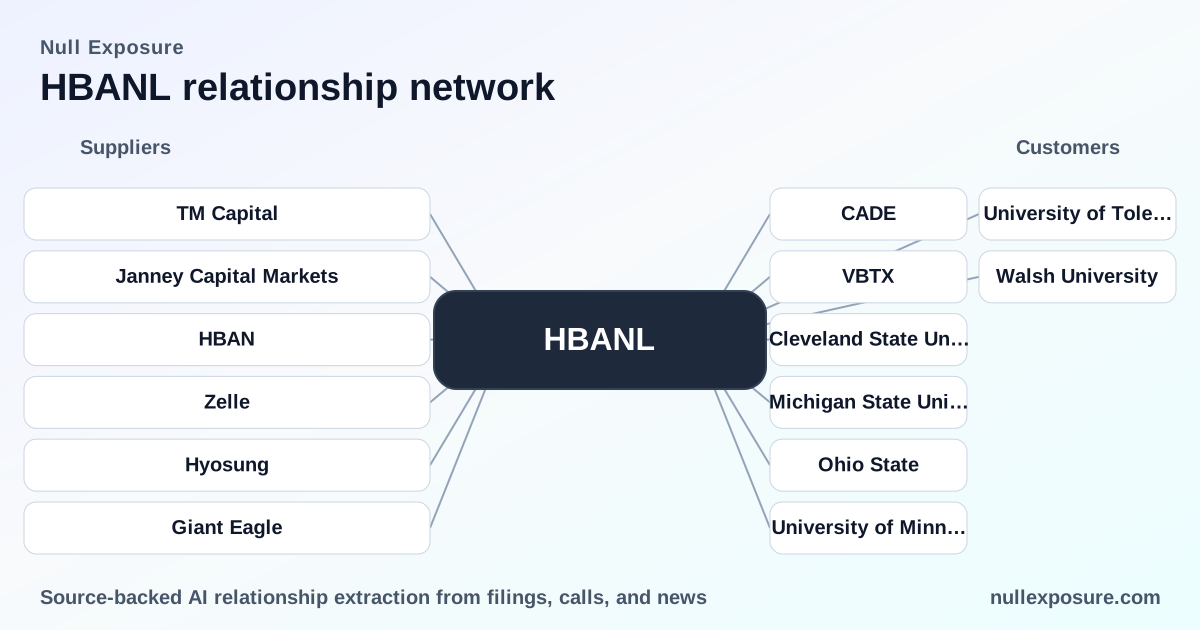
Huntington Bancshares (HBANL) — customer relationships that underpin a regional bank franchise
Huntington Bancshares operates as the bank holding company for The Huntington National Bank, monetizing through net interest income on a large loan book funded primarily by customer deposits, plus diversified noninterest revenue from payments, wealth management, mortgage banking, and capital markets services. The company’s business model combines high deposit funding stability with fee-based products (card interchange, payments, trust and advisory) and active mortgage and indirect auto finance programs that convert origination flow into saleable assets and servicing income.
For a concise dataset of Huntington’s customer relationships and how they translate into deposit and fee economics, visit https://nullexposure.com/.
What the relationship signals say about Huntington’s operating model
Huntington runs a classic diversified regional bank model with four operating characteristics that investors and operators should track:
- Contracting posture is mixed but dominated by short-term, variable-rate arrangements (e.g., many deposit products, letters-of-credit, and credit commitments are cancelable or short-dated), while core lending includes long-term mortgage and term-loan exposures that anchor interest-earning assets. This mix preserves repricing flexibility while locking in longer-duration yields on a portion of assets.
- Counterparty base is broad and layered: individual retail customers and small businesses form the volume foundation, while mid-market and large enterprise clients and government/non-profit verticals provide scale in commercial and capital-markets revenue streams.
- Customer relationships are operationally critical and material: deposits fund roughly three quarters of consolidated assets, and net interest income is Huntington’s primary revenue driver; therefore customer balance stability and credit quality directly affect liquidity and capital outcomes.
- Relationship roles are multi-dimensional: Huntington acts both as a seller (originator and seller of loans, mortgage sales) and as a service provider (payments, treasury, mortgage servicing), and it also acquires services and capabilities as a buyer—this creates multiple monetization vectors and multiple vendor/regulatory dependencies.
These company-level signals—short-term contract flexibility, deposit concentration as a funding source, broad counterparty mix, and dual seller/service-provider roles—define Huntington’s operating leverage, rate-sensitivity and regulatory footprint.
Detailed relationship-by-relationship review
Below is a plain-English summary for every relationship instance captured in public disclosures and press coverage.
Cadence (earnings call reference)
Huntington discussed applying a partnership approach to Cadence in its 2025 Q4 earnings call, indicating operational integration efforts and relationship alignment following acquisition activity. According to Huntington’s 2025 Q4 earnings call transcript (March 8, 2026), management updated investors on the Cadence integration strategy.
VBTX (earnings call reference)
Veritex (ticker VBTX) was cited in the same earnings-call slide as an example of partnership application, signaling Huntington’s recent experience assimilating regional bank partnerships. This was stated on Huntington’s 2025 Q4 earnings call (March 8, 2026).
Veritex (earnings call reference)
Management explicitly referenced Veritex when describing partnership playbooks and integration lessons on the Q4 2025 call, underscoring Huntington’s approach to scaling retail and commercial footprints. Source: Huntington 2025 Q4 earnings call (Mar 8, 2026).
CADE (CityBiz news report)
CityBiz reported Huntington completed its merger with Cadence Bank and quoted CEO Steve Steinour welcoming Cadence colleagues and customers, confirming transaction close and immediate customer migration into Huntington’s franchise. Source: CityBiz news article on the Cadence merger (March 10, 2026).
Cadence Bank (CityBiz news report)
CityBiz coverage repeats that Huntington completed the Cadence Bank acquisition and is integrating customers and staff into Huntington’s deposit, lending and product platforms. Source: CityBiz (March 10, 2026).
Cleveland State University (consumer partnership reference)
Huntington maintains campus partnerships that make its checking and debit products relevant to students at institutions such as Cleveland State University, a channel for low-cost customer acquisition and branded debit-card distribution. Source: The Penny Hoarder bank-review (2021).
Michigan State University (consumer partnership reference)
Huntington’s campus tie-ins extend to Michigan State University, where customized debit cards and localized product offers position Huntington to capture long-term retail customers. Source: The Penny Hoarder bank-review (2021).
Ohio State (consumer partnership reference)
Huntington’s partnerships with large state universities like Ohio State provide branded distribution and student-deposit flows that support retail deposit growth inside its primary footprint. Source: The Penny Hoarder bank-review (2021).
University of Minnesota (consumer partnership reference)
University-of-Minnesota affiliation is cited as part of Huntington’s campus partnership strategy, enabling targeted checking and card campaigns that seed future primary-bank relationships. Source: The Penny Hoarder bank-review (2021).
University of Toledo (consumer partnership reference)
Huntington’s relationship with University of Toledo is representative of its localized campus strategy across Ohio and neighboring states to build deposit and transaction volume from younger cohorts. Source: The Penny Hoarder bank-review (2021).
Walsh University (consumer partnership reference)
Walsh University appears on Huntington’s list of partner campuses where customized debit-card options and student services help drive customer acquisition and brand presence in local markets. Source: The Penny Hoarder bank-review (2021).
Key implications for investors and operators
- Balance-sheet sensitivity and funding model: Huntington funds ~76% of assets with customer deposits, making deposit acquisition and retention core strategic priorities; the Cadence merger expands low-cost deposit scale but also requires disciplined integration to preserve core deposit economics.
- Revenue mix and fee engines: net interest income is the primary revenue engine, supplemented by payments and wealth fees; usage-based revenue (card interchange) is recognized at transaction time and provides resilient noninterest income.
- Contracting and credit posture: the company’s agreements are largely short-term and variable-rate for funding and many commercial commitments, but remain exposed to long-term credit risks in residential mortgages and term loans that drive lifetime credit-loss provisioning.
- Diversification reduces single-counterparty concentration: the customer base spans individuals, small businesses, mid-market and government accounts, which reduces single-bet exposure but raises operational complexity across product lines and regions (primarily North America).
- Operational dependency and criticality: Huntington’s role as both seller and service provider (loan originations, servicing retained, payments and treasury) increases recurring revenue opportunities but also creates service-level and regulatory dependencies (AML, consumer protection, data privacy).
Tactical takeaway
- Watch deposit stability and integration KPIs post-Cadence close as primary signals for funding cost trajectory and net interest margin. For deeper visibility into how customer relationships and commitments translate to revenue and risk, review Huntington’s customer and contract disclosures at the company level and at https://nullexposure.com/.
For operational teams and investors evaluating counterparty exposures, the combined signals—short-term contract flexibility, material deposit funding, multi-role customer relationships, and campus-level acquisition channels—define Huntington’s opportunity set and principal risks.