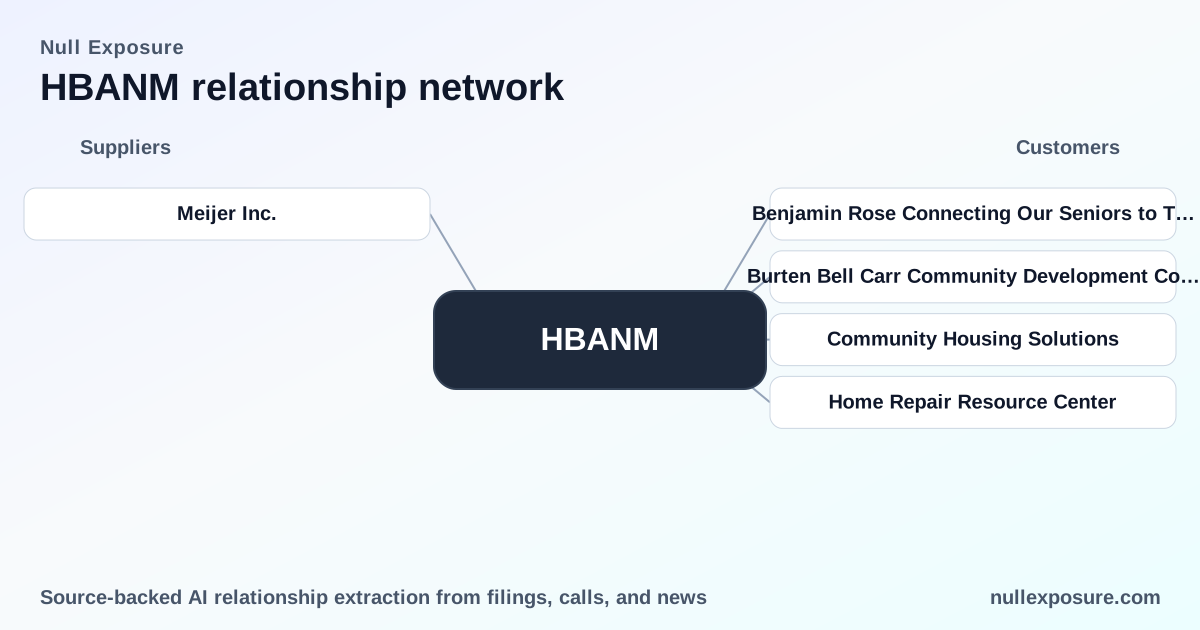
Huntington Bancshares (HBANM) — Customer Relationship Intelligence and Investment Implications
Huntington Bancshares is a multi-state regional bank that monetizes primarily through net interest income from loans and leases, supported by fee-based businesses such as payments & cash management, wealth and asset management, mortgage banking, and capital markets advisory. Its business model blends high-volume consumer deposit funding with targeted commercial lending and specialized services (mortgage servicing, dealer finance, equipment leases), producing a predictable core margin while exposing the institution to credit-cycle and deposit-concentration dynamics.
If you need a concise market view and relationship-level evidence to support underwriting or counterparty diligence, view our platform at NullExposure for the full feed and source links.
Key investor takeaways up front
- Core funding is deposit-driven: customer deposits funded 76% of total assets at December 31, 2024, making customer relationships central to liquidity and interest-margin dynamics.
- Revenue mix is interest-first, fee-second: net interest income dominates, with noninterest income (payments, wealth, capital markets) growing as strategic diversification.
- Customer relationships are heterogeneous: large numbers of individual retail relationships sit alongside mid-market and large-enterprise commercial customers, with material exposure across consumer and commercial loan portfolios.
- Community and integration activity is visible in press: local branch actions and charitable commitments show emphasis on footprint integration and reputation management after acquisitions.
How Huntington operates and what that means for counterparties
Huntington runs a hybrid contracting posture: a mix of short-term and transactional contracts (deposit accounts, card interchange, cash management) and long-term instruments (mortgages, term loans, direct financing leases). The firm recognizes subscription-style revenue for ongoing cash-management services and spot revenue for transaction fees such as wire transfers and interchange. Master netting and other framework agreements exist but collateral exchange with customer counterparties is limited.
From a counterparty profile perspective:
- High concentration of individuals and small businesses supports stable deposit funding but increases operational scale risk and regulatory oversight (consumer protection, AML, data privacy).
- Commercial counterparties range from small businesses and mid-market clients to large enterprises and government entities, supporting diversified loan origination but requiring an active credit monitoring and specialty vertical approach.
- Geographic footprint is North America–centric (Midwest and selected national products) with global policy coverage for cyber and privacy controls.
- Materiality signal: customer relationships are critical and material to funding, credit and liquidity — deposits are the largest consolidated liquidity source, and both consumer and commercial loans aggregate into sizable loan books.
These characteristics inform counterparty diligence: emphasize deposit composition, loan vintage quality, geographic concentrations in core MSAs, and operational controls around payments and servicing.
Customer interactions and media-documented relationships
The following section covers every customer-facing relationship mentioned in the available results, with a concise, sourced description for each.
TCF National Bank — post-merger customer integration
Huntington communicated directly to TCF National Bank customers after the TCF-Huntington integration, signaling active migration and customer outreach following the merger. This interaction reflects integration of acquired retail relationships into Huntington’s branch and deposit network. (OurMidland report on the TCF-Huntington merger, fiscal period FY2021 — https://www.ourmidland.com/news/article/TCF-Bank-officially-merges-with-Huntington-Bank-16285351.php)
Benjamin Rose — senior digital literacy grant tied to branch reopening
Huntington contributed funding to the Benjamin Rose “Connecting Our Seniors to Technology” program, providing $30,000 to support digital literacy for seniors in connection with actions around a reopened branch office. This is presented as part of local community remediation and customer-access measures. (Cleveland.com report, Aug 2024 — https://www.cleveland.com/business/2024/08/huntington-agrees-to-reopen-buckeye-branch-after-it-closed-the-office-over-safety-concerns.html)
Burten Bell Carr Community Development Corp. — small business safety grants
Huntington provided $25,000 to Burten Bell Carr CDC for safety improvement grants to small businesses near a reopened branch, demonstrating localized community investment intended to stabilize small-business customer relationships and branch viability. (Cleveland.com report, Aug 2024 — https://www.cleveland.com/business/2024/08/huntington-agrees-to-reopen-buckeye-branch-after-it-closed-the-office-over-safety-concerns.html)
Community Housing Solutions — housing repair funding
Huntington committed $100,000 to Community Housing Solutions to support home repairs, reflecting the bank’s broader affordable housing commitments and CRA-oriented community lending objectives. This supports both community outcomes and mortgage/retail relationship quality in targeted neighborhoods. (Cleveland.com report, Aug 2024 — https://www.cleveland.com/business/2024/08/huntington-agrees-to-reopen-buckeye-branch-after-it-closed-the-office-over-safety-concerns.html)
Home Repair Resource Center — matching community housing support
Huntington also provided $100,000 to the Home Repair Resource Center for home repairs, reinforcing community rehabilitation efforts that underpin residential lending and retail deposit franchise strength in affected neighborhoods. (Cleveland.com report, Aug 2024 — https://www.cleveland.com/business/2024/08/huntington-agrees-to-reopen-buckeye-branch-after-it-closed-the-office-over-safety-concerns.html)
What constraints and disclosures reveal about business-model risk
The company-level constraints extracted from filings present actionable signals for investors and operators:
-
Contracting posture: Huntington operates with a blend of short-term, cancellable customer contracts (most deposit and many fee relationships) and long-term lending contracts (mortgages, term loans, direct financing leases). This structure supports liquidity flexibility but requires active deposit beta management and provision timing discipline. Evidence: contractual maturity tables and statements on deposit maturities and loan terms.
-
Revenue recognition and product types: The firm generates subscription-like cash management revenue over time, spot transaction fees (wire, interchange) on transaction execution, and usage-based interchange revenue — a diversified noninterest-income base that reduces sole reliance on margin compression.
-
Counterparty mix and concentration: The customer base is heavily individual- and small-business-centric, supplemented by mid-market and larger corporate relationships and government banking. This mix delivers deposit stability but requires layered credit governance and vertical expertise for C&I growth.
-
Materiality and criticality: Customer relationships are material and critical to liquidity and earnings. Deposits are the primary funding source and any deterioration in customer deposit behavior or credit quality across lending portfolios can materially affect net income and capital.
-
Operational maturity and roles: Huntington acts as both seller (originator and lender) and service provider (mortgage servicing, payments, cash management). Mortgage servicing rights and third-party servicing positions create fee streams but introduce interest-rate and prepayment sensitivity to MSR valuations.
-
Geographic footprint: Activities are concentrated in North America (Midwestern footprint and selective nationwide products), with corporate policies acknowledging global transactional currency exposure; operational risk and regulation are therefore domestically heavy.
-
Spending scale: Public commitments and loan/investment programs indicate multi-hundred-million to multi-billion dollar programmatic allocations, reinforcing the bank’s capacity for large-scale community and portfolio commitments.
Bottom line: where this matters for investors and operators
- For investors: prioritize monitoring deposit stability metrics, loan vintage performance, ACL trajectory, and noninterest income growth in payments and wealth channels — these drive near-term earnings resilience and capital adequacy.
- For operators and counterparties: evaluate Huntington’s contract mix (short-term deposits vs. long-term loans), regulatory posture, and service-provider exposures (MSRs, payments) when structuring integrations or pricing risk.
For a deeper, relationship-by-relationship feed and the original source links used in this analysis, visit NullExposure.